Search


引用和文献 (9)
Invitrogen™
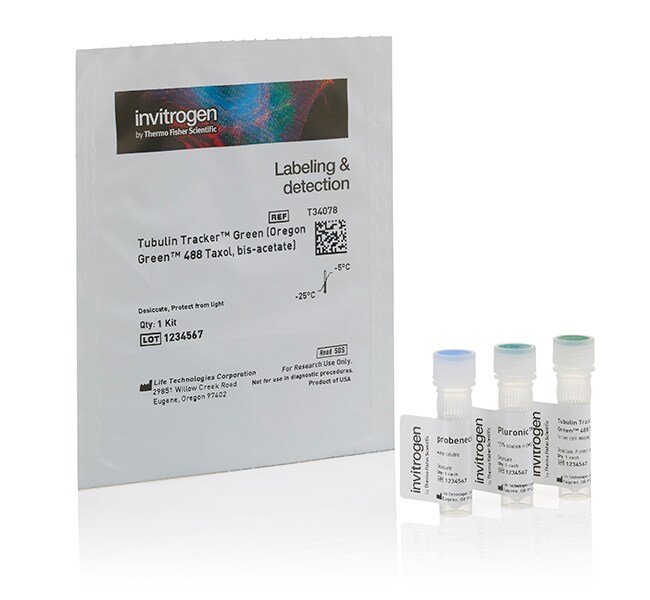
Tubulin Tracker™ Green(Oregon Green™ 488 Taxol,双乙酸酯)
Tubulin Tracker Green(Oregon Green 488 Taxol,双乙酸酯)可对活细胞中聚合的微管蛋白进行绿色荧光染色。Tubulin Tracker了解更多信息
| 货号 | 数量 |
|---|---|
| T34078 | 60张载玻片 |
货号 T34078
价格(CNY)
1,364.00
飞享价
Ends: 31-Dec-2026
1,894.00共减 530.00 (28%)
60 slides
数量:
60张载玻片
价格(CNY)
1,364.00
飞享价
Ends: 31-Dec-2026
1,894.00共减 530.00 (28%)
60 slides
Tubulin Tracker Green(Oregon Green 488 Taxol,双乙酸酯)可对活细胞中聚合的微管蛋白进行绿色荧光染色。Tubulin Tracker Green 是一种不带电荷的非荧光化合物,可轻松穿过活细胞质膜。染料进入细胞后,非特异性酯酶会将亲脂性封闭基团剪切,形成带电荷的绿色荧光产物,防止其逃离活细胞。Tubulin Tracker Green 试剂采用 Oregon Green 488 染料,其最佳吸收和发射波长为 494 nm 和 522 nm,而荧光可使用几乎所有的荧光成像仪器,通过标准的 GFP/FITC 滤光片设置可以显示荧光。可与蓝色、橙色、红色、深红色和近红外荧光基团联用。
仅供科研使用。不可用于诊断程序。
规格
染料类型Oregon Green™ 488
激发波长范围494/522
产品线TubulinTracker
数量60张载玻片
运输条件经批准可置于湿冰或干冰上运输
标签类型紫外-可见标记
产品类型Tubulin Tracker
亚细胞定位微管蛋白Tubulin
Unit Size60 slides
内容与储存
含有的材料足够用于至少60张玻片,用量 1 mL/玻片,1倍工作浓度。
1 x 20 μg Tubulin Tracker Green(Oregon Green 488 Taxol,双乙酸酯)
1 x 1 mL Pluronic F-127,20% DMSO 溶液
1 x 20 μg Tubulin Tracker Green(Oregon Green 488 Taxol,双乙酸酯)
1 x 1 mL Pluronic F-127,20% DMSO 溶液
常见问题解答 (FAQ)
What is the difference between Tubulin Tracker Green (Cat No. T34078) and Tubulin Tracker Green, for live cell imaging (Cat. No. T34075)?
With Tubulin Tracker Deep Red and Tubulin Tracker Green, can I fix samples after labeling?
How is Docetaxel in Tubulin Tracker Deep Red different from Taxol in Tubulin Tracker Green? Are there any differences in the binding or cytotoxicity between the two reagents?
引用和文献 (9)
引用和文献
Abstract
Involvement of 14-3-3 in tubulin instability and impaired axon development is mediated by Tau.
Journal:
PubMed ID:26103986
'14-3-3 proteins act as adapters that exert their function by interacting with their various protein partners. 14-3-3 proteins have been implicated in a variety of human diseases including neurodegenerative diseases. 14-3-3 proteins have recently been reported to be abundant in the neurofibrillary tangles (NFTs) observed inside the neurons of brains
Impact of C24:0 on actin-microtubule interaction in human neuronal SK-N-BE cells: evaluation by FRET confocal spectral imaging microscopy after dual staining with rhodamine-phalloidin and tubulin tracker green.
Journal:
PubMed ID:26214025
'Disorganization of the cytoskeleton of neurons has major consequences on the transport of neurotransmitters via the microtubule network. The interaction of cytoskeleton proteins (actin and tubulin) was studied in neuronal SK-N-BE cells treated with tetracosanoic acid (C24:0), which is cytotoxic and increased in Alzheimer''s disease patients. When SK-N-BE cells were
The Ovary of Tubifex tubifex (Clitellata, Naididae, Tubificinae) Is Composed of One, Huge Germ-Line Cyst that Is Enriched with Cytoskeletal Components.
Journal:
PubMed ID:26001069
Recent studies on the ovary organization and oogenesis in Tubificinae have revealed that their ovaries are small polarized structures that are composed of germ cells in subsequent stages of oogenesis that are associated with somatic cells. In syncytial cysts, as a rule, each germ cell is connected to the central
Multimodal two-photon imaging using a second harmonic generation-specific dye.
Journal:Nat Commun
PubMed ID:27156702
'Second harmonic generation (SHG) imaging can be used to visualize unique biological phenomena, but currently available dyes limit its application owing to the strong fluorescent signals that they generate together with SHG. Here we report the first non-fluorescent and membrane potential-sensitive SHG-active organic dye Ap3. Ap3 is photostable and generates
Tubulin is a molecular target of the Wnt-activating chemical probe.
Journal:BMC Biochem
PubMed ID:27207629
In drug discovery research, cell-based phenotypic screening is an essential method for obtaining potential drug candidates. Revealing the mechanism of action is a key step on the path to drug discovery. However, elucidating the target molecules of hit compounds from phenotypic screening campaigns remains a difficult and troublesome process. Simple