Is Raman spectroscopy destructive to pharmaceutical materials?
Although Raman spectroscopy is typically considered a non-destructive technique, conditions such as exposure time, laser power, and the nature of the sample may lead to sample degradation. The energy transmitted by the laser depends on the duration of exposure and the wavelength. It may change the physical state and may destroy the sample.
Is it safe to use the TruScan RM Handheld Raman Analyzer?
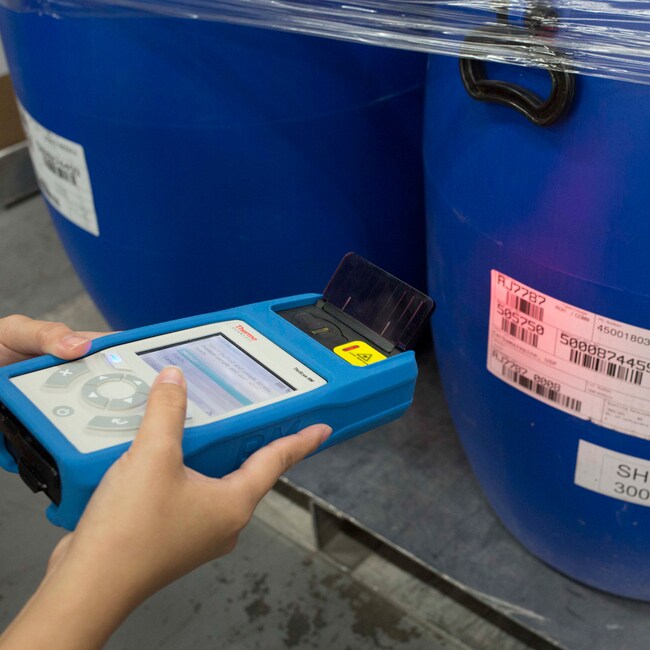
The TruScan RM Handheld Raman Analyzer uses Raman spectroscopy where an unknown sample of material is illuminated with monochromatic (single wavelength or single frequency) laser light. The danger of using high-powered lasers must be recognized, especially when their wavelengths are in the Near Infrared area of the spectrum and, therefore, not visible to the eye. Fiber optic probes should be used with caution and with reference to appropriate government regulations regarding lasers and laser classes.
The laser used in the TruScan RM Handheld Raman Analyzer is class IIIb under the FDA CDRH classification system. Never point the instrument at yourself or others. Never start the instrument unless there is a sample fully covering the laser aperture. Always terminate a measurement prior to removing the sample from the laser aperture. Country-specific regulations with which the analyzer's laser complies is available in the user manual.
The TruScan RM Handheld Raman Analyzer is compliant with EP Chapter <2.2.48> and USP Chapter <1120>. To learn more, read the following documents:
Thermo Scientific TruScan RM United States Pharmacopeia (USP) Chapter <1120> - Raman Spectroscopy Statement of Compliance (https://assets.thermofisher.com/TFS-Assets/CAD/Product-Bulletins/TSRM-USP-Compliance-Oct-2016-FINAL.pdf)
Thermo Scientific TruScan RM European Pharmacopeia (EP) Chapter <2.2.48> - Raman Spectroscopy Statement of Compliance (https://assets.thermofisher.com/TFS-Assets/CAD/Product-Bulletins/TSRM-EP-Compliance-Oct-2016-FINAL.pdf)
Can Raman spectroscopy verify stearates and other drug capsule lubricants?
Magnesium stearate is a white powder that becomes solid at room temperature. In the pharmaceutical manufacturing process, magnesium stearate is the most commonly used lubricant for capsules and tablets, and is used to help prevent pharmaceutical ingredients from adhering to manufacturing equipment. Calcium stearate, and to a lesser extent, zinc stearate, are also used as pharmaceutical excipients in manufacturing, primarily for tablet and capsule lubrication.
Magnesium stearate, calcium stearate, and zinc stearate share a similar chemical compound structure and are more challenging to verify during the incoming raw material inspection process. While some pharmaceutical handheld Raman analyzers have built-in multivariate residual analysis decision engines to identify most materials, more complex materials analysis requires users to build custom, advanced methods. Those Raman analyzers that utilize embedded chemometrics such as the TruScan RM Handheld Raman Analyzer can enable users to create customized predictive applications including classification using semi-quantitative and quantitative methods, which allows developing models that can be deployed on the analyzer. Read more in the technical note: Stearates verification using a handheld Raman analyzer (https://assets.thermofisher.com/TFS-Assets/CAD/Technical-Notes/stearates-verification-handheld-raman.pdf).
Can Raman spectroscopy analyze tablet film coatings?
Pharmaceutical companies that manufacture tablets, capsules and other solid dosage forms use a film coating on their products to differentiate visual appearance, to improve the ability to swallow and to mask objectionable tastes or odors. Film coatings also reduce tablet breakage and chipping as well as provide protection from light, moisture, and environmental gases. While the latest handheld Raman analyzers have a built-in multivariate residual analysis decision engine to identify most materials, more complex materials analysis requires users to build custom, advanced methods. Some handheld analyzers such as the TruScan RM Handheld Raman Analyzer utilize embedded chemometrics to enable users to create customized predictive applications including classification using semi-quantitative and quantitative methods, that result in Pass/Fail criteria to identify highly similar compounds such as tablet coatings. Read more in the technical note: Opadry verification using a handheld Raman analyzer (https://assets.thermofisher.com/TFS-Assets/CAD/Technical-Notes/opadry-verification-handheld-raman.pdf).
Do I need to be a scientist or expert to use Raman technology in pharmaceutical and drug manufacturing?
Some pharmaceutical handheld Raman analyzers are expressly designed for setup and use by non-experts. For example, the TruScan RM Handheld Raman Analyzer not only acquires the Raman spectrum of the material of interest but also, in real-time, determines the uncertainty of that measurement, given factors such as the sample characteristics, instrument telemetry, environment and testing environment. End users of field-material identification systems are not usually spectroscopy experts and, therefore, can rely on the instrument's built-in algorithm to convert instrument data to a qualitative result.