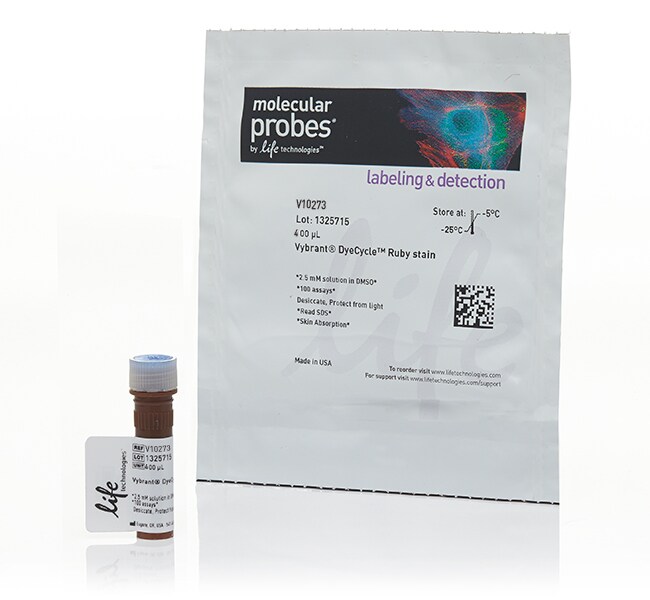
Vybrant™ DyeCycle™ Ruby 染色剂,400 次反应
Invitrogen™

Vybrant™ DyeCycle™ Ruby 染色剂,400 次反应

Vybrant® DyeCycle™ Ruby Stain is a cell permeable DNA dye that can be used for cell cycle analysis on a了解更多信息
Have Questions?
货号数量
V10273400 assays
货号 V10273
价格(CNY)
6,390.00
飞享价
Ends: 31-Dec-2025
8,490.00
共减 2,100.00 (25%)
400 assays
添加至购物车
数量:
400 assays
价格(CNY)
6,390.00
飞享价
Ends: 31-Dec-2025
8,490.00
共减 2,100.00 (25%)
400 assays
添加至购物车
Vybrant® DyeCycle™ Ruby Stain is a cell permeable DNA dye that can be used for cell cycle analysis on a 488 nm or 635 nm red diode laser.

• Precise—accurate cell cycle analysis in living cells

• Safe—low cytotoxicity for cell sorting and additional live cell experiments

• Minimal compensation—easier multiplexing

• Simple, robust staining protocol

View a selection guide for all products related to cell cycle analysis of fixed and live cells in flow cytometry.

Precise

Successful cell cycle analysis requires a dye that is DNA selective and can stain cells in a homogeneous pattern minimizing fluorescence variability. The Vybrant® DyeCycle™ Ruby Stain is an ideal tool for DNA content analysis in living cells since the stain is cell permeable and, after binding double-stranded DNA, emits a fluorescent signal that is proportional to the DNA mass (see figure).

Low Cytotoxicity

Unlike stains that require high concentrations or have chemical structures that are toxic to cells, Vybrant® DyeCycle™ Ruby Stain exhibits relatively low cytotoxicity, allowing the possibility of sorting based on the phase of the cell cycle.

Minimal Compensation

Well-suited for the popular red 633 nm laser line, the Vybrant® DyeCycle™ Ruby Stain/DNA complex has fluorescence excitation and emission maxima of 638/686 nm, respectively (see figure). The spectral characteristics allow use of the red laser for cell cycle analysis and frees up other channels for additional parameters.

The red excitation and narrow emission of Vybrant® DyeCycle™ Ruby Stain make it ideal for multiplexing due to the limited spectral overlap with other common dyes (Alexa Fluor® 488, FITC, and RPE) and fluorescent proteins (Green Fluorescent Protein (GFP)).

Simple, Robust Staining Protocol

For cell analysis, simply prepare flow cytometry tubes containing 0.5 mL of cells suspended in complete media at a concentration of 5 × 10⁵ cells/mL. To each tube, add 1 μL of Vybrant® DyeCycle™ Ruby Stain and mix well. Final stain concentration is 5 μM. Incubate at 37°C for 15–30 minutes, protected from light. Analyze without washing cells on a flow cytometer using 488 nm or 633/5 nm excitation and >670 nm emission.
仅供科研使用。不可用于诊断程序。
规格
检测方法荧光
染料类型Vybrant™ DyeCycle™ Ruby
形式溶液
产品规格
数量400 assays
运输条件室温
溶解度DMSO(二甲亚砜)
子细胞定位核酸
发射近红外
适用于(设备)流式细胞仪
产品线DyeCycle™、Molecular Probes™
产品类型染料
Unit Size400 assays
内容与储存
含 1 瓶 Vybrant™ DyeCycle™ Ruby 染色剂(2.5 mM,溶于 DMSO)。在 ≤-20°C 下干燥、避光储存。

常见问题解答 (FAQ)

我的细胞周期数据显示单一峰而非正确的细胞周期曲线,该如何解决这个问题?

许多因素影响着细胞周期曲线的质量。细胞数、染料浓度、孵育温度、孵育时间、流速(在利用流体动力学聚焦的传统流式细胞仪上处理时)、获得细胞的总数、死细胞排除以及从数据分析中除去聚集体等,都需要在分析细胞周期时考虑到。

流式细胞术可以进行哪些类型的细胞健康和活力检测?

可以通过流式细胞仪完成以下细胞健康和活力检测:

细胞凋亡检测:

细胞膜不对称性:膜联蛋白V是结构相关蛋白家族一员,其可以在Ca2+存在的情况下结合磷脂。膜联蛋白V可结合多种磷脂,但是对磷脂酰丝氨酸表现出高度的亲和性。磷脂酰丝氨酸主要存在于细胞膜的内部小叶上;然而,在细胞凋亡早期,观测到磷脂酰丝氨酸转移到外部小叶。这个转移使得在含有Ca2+孵育缓冲液存在的情况下,磷脂酰丝氨酸可与膜联蛋白V结合。凋亡中的细胞可以用膜联蛋白V染色,而正常细胞不会被染色。多种偶联不同荧光基团的膜联蛋白V可供选择。

线粒体健康:细胞凋亡早期的典型特征是线粒体紊乱,同时伴随膜和氧化还原电位改变。我们独家提供了大量可通过流式细胞术分析活细胞内的线粒体活性,同时可最大限度避免细胞功能损伤的荧光探针。

线粒体染色的MitoProbe系列染料(MitoProbe DiOC2(3) 检测试剂盒,货号 M34150;MitoProbe JC-1检测试剂盒,货号M34152;MitoProbe DiIC1(5) 检测试剂盒,货号M34151)为检测细胞凋亡过程出现的线粒体膜电位损失提供了快速、简单和可靠的流式细胞术检测手段。

半胱天冬酶活性: CellEvent Caspase-3/7 Green 流式细胞检测试剂盒(货号C10427)支持对凋亡细胞中活化的caspase-3和 caspase-7进行流式细胞术检测。该试剂盒包含新型荧光底物CellEvent Caspase-3/7 Green检测试剂和SYTOX AADvanced死细胞染色剂,可靶向识别活化的caspase-3和caspase-7的序列。

DNA片段化:细胞凋亡后期的特征是核形态改变,包括DNA片段化、染色质凝缩、核膜降解,核起泡以及DNA链断裂。凋亡过程中DNA片段出现DNA链断裂,可以通过TUNEL(末端脱氧核苷酸转移酶dUTP缺口末端标记)检测进行分析。APO-BrdU TUNEL检测(货号A23210)是一种双色检测方法,可通过成像或流式细胞术标记DNA断裂和细胞总DNA,检测细胞凋亡情况。

核染色质凝缩:细胞凋亡后期的特征是核形态改变,包括DNA片段化,染色质凝缩,核膜降解,核起泡以及DNA链断裂。凋亡的细胞表现出核染色质凝结增加。由于核染色质凝结,细胞透过性核酸染色剂发出较高的荧光,从而能够结合传统死细胞染色剂来区分凋亡细胞。

Vybrant细胞凋亡检测试剂盒#5,Hoechst 33342/Propidium Iodide(货号V13244)基于凋亡细胞染色质的压缩状态的荧光检测,为凋亡提供了一个快速和方便的检测手段。染色质凝结&膜渗透死细胞凋亡试剂盒包含Hoechst 33342、YO-PRO-1以及PI染料, 用于流式细胞仪(货号V23201)检测凋亡细胞中核染色质凝结和质膜通透性的变化。

细胞周期分析:

活细胞检测: Vybrant DyeCycle系列染料为活细胞周期分析提供了稳定的低毒性荧光染料,提供405 nm(货号V35003)、488 nm (货号V35004)、532 nm(货号V35005)或 633 nm(货号V10309和V10273)三种激发峰选择。染料毒性低,染色的细胞可储存和培养,或进行功能分析。

固定细胞检测:用FxCycle Violet染色剂(货号F10347)、SYTOX AADvanced 死细胞染色试剂盒(货号S10349)或FxCycle Far Red染色剂(货号F10348)分析细胞周期,为简单固定的细胞周期分析提供了多色选择。

细胞增殖:

染料稀释检测细胞增殖:染料稀释检测细胞增殖依赖细胞膜透过性荧光分子。染料进入到细胞后,共价结合蛋白质的氨基基团,导致染料长期保留在细胞中。通过随后的细胞分裂,每个子代细胞大约会分到亲代一半的荧光。采用流式细胞仪对细胞群的荧光强度进行分析,可以某个细胞或细胞群自标记之后的增殖情况,判定其传代次数。CellTrace荧光染色剂可在不影响细胞形态和生理功能的条件下,在体内或体外追踪传代情况。目前尚未发现该染色剂对细胞增殖活性或细胞生物学功能有影响。染色后,染料可在细胞内稳定保留若干天。可用于流式细胞仪的试剂盒包括CellTrace CFSE细胞增殖试剂盒(货号No. C34554)CellTrace Violet细胞增殖试剂盒(货号 C34557)和CellTrace Far Red细胞增殖试剂盒(货号 C34564)。

DNA合成检测:测定新合成的DNA是准确分析某个细胞或细胞群细胞增殖情况的方法。基于DNA合成的细胞增殖检测可根据掺入的修饰核苷,测定DNA合成速率。Click-iT Plus EdU细胞增殖检测利用了click化学试剂和修饰的核苷EdU,为BrdU染色提供了出色的替代方法,可用于检测和定量新合成的DNA数量。Pacific Blue(货号C10636)、Alexa Fluor 488(货号C10632和C10633)和Alexa Fluor 647(货号C10634和C10635)可用于Click-iT Plus EdU细胞增殖检测。

活力检测:

死细胞很容易与很多试剂非特异性结合,从而给出假阳性结果。因此,从流式细胞仪数据中排除死细胞,是有助于确保结果和分析准确性的关键步骤。

不能固定膜通透染色剂:SYTOX死细胞染色剂(货号S34857、S34860、S34861、S34859和S34862)不能穿过完整的细胞膜,与dsDNA结合后发出更强的荧光,从而成为我们最明亮的几种死细胞染色剂之一。非细胞通透性的经典DNA结合染料包括碘化丙啶(货号P21493)和7-AAD(货号A1310)。这两种染料已经被广泛用于流式细胞仪活性分析。CellTrace钙黄绿素AM染料可被动运输进入到贴壁和非贴壁细胞。这些细胞通透性酯酶底物可作为测定酶活性(激发荧光的必要条件)和细胞膜完整性的(在胞内保留荧光产物的必要条件)的活力探针。目前供应的蓝色(货号 C34853)、紫色(货号C34858)和绿色(货号C34852)荧光染料是活细胞短时染色的理想染料,且可用于多重流式细胞术试验。

可固定细胞活性染色剂:LIVE/DEAD可固定死细胞染色剂是可固定的细胞活性染料,有助于准确评估固定和/或通透后样品中细胞活性。LIVE/DEAD固定死细胞染色试剂盒基于荧光活性染料与细胞蛋白(胺基)的反应。这些染料不能透过活细胞膜,因此仅仅细胞表面蛋白可和染料反应,导致染色暗淡。活性染料可以透过死细胞损毁的细胞膜,将内部和外部的胺基染色,导致更加强烈的染色效果。LIVE/DEAD固定死细胞染色试剂盒可提供八单通道颜色,适用于三种包装规格的UV、405、488、532、561或633 nm激光,可满足您的试验需要。

My cell cycle data show a single peak, not a proper cell cycle profile. How can I fix this?

There are several factors that contribute to the quality of the cell cycle profile. Cell number, dye concentration, incubation temperature, incubation time, flow rate (on a traditional flow cytometer utilizing hydrodynamic focusing), total number of cells acquired, elimination of dead cells, and removal of aggregates from data analysis should all be considered when analyzing the cell cycle.

Find additional tips, troubleshooting help, and resources within our Cell Analysis Support Center.

What kinds of cell health and viability assays can be performed by flow cytometry?

The following cell health and viability assays can be performed by flow cytometry :

-Apoptosis Assays:
Membrane Asymmetry: Annexin V is a member of a family of structurally related proteins that bind phospholipids in the presence of Ca2+. Annexin V binds several phospholipids, but shows highest affinity for phosphatidylserine.
Phosphatidylserine is normally found in the inner leaflet of the cell membrane; however, in the early stages of apoptosis, phosphatidylserine is observed to translocate to the outer leaflet. This translocation makes phosphatidylserine available for annexin V binding in the presence of Ca2+ containing incubation buffer. Cells undergoing apoptosis will stain with annexin V, while normal cells will not. annexin V is available conjugated with a wide range of fluorophores.

Mitochondrial Health: A distinctive feature of the early stages of apoptosis is the disruption of the mitochondria, including changes in membrane and redox potential. We exclusively offer a number of fluorescent probes for analyzing mitochondrial activity in live cells by flow cytometry, with minimal disruption of cellular function.

The MitoProbe family of mitochondrial stains (MitoProbe DiOC2(3) Assay Kit, Cat. No. M34150, MitoProbe JC-1 Assay Kit, Cat. No. M34152, and MitoProbe DiIC1(5) Assay Kit, Cat. No. M34151) provides quick, easy, and reliable flow cytometric detection of the loss of mitochondrial membrane potential that occurs during apoptosis.

Caspase Activity: The CellEvent Caspase-3/7 Green Flow Cytometry Assay Kit (Cat. No. C10427) enables flow cytometric detection of activated caspase-3 and caspase-7 in apoptotic cells. The kit includes the novel fluorogenic substrate CellEvent Caspase-3/7 Green Detection Reagent which targets the recognition sequence for activated caspase-3 and caspase-7, as well as SYTOX AADvanced Dead Cell Stain.

DNA Fragmentation: The later stages of apoptosis are characterized by changes in nuclear morphology, including DNA fragmentation, chromatin condensation, degradation of nuclear envelope, nuclear blebbing, and DNA strand breaks. DNA fragmentation that occurs during apoptosis produces DNA strand breaks, and can be analyzed using TUNEL (terminal deoxynucleotidyl transferase dUTP nick end labeling) assays. The APO-BrdU TUNEL assay (Cat. No. A23210) is a two-color assay for labeling DNA breaks and total cellular DNA to detect apoptotic cells by imaging or flow cytometry.

Nuclear Chromatin Condensation: The later stages of apoptosis are characterized by changes in nuclear morphology, including DNA fragmentation, chromatin condensation, degradation of nuclear envelope, nuclear blebbing, and DNA strand breaks. Cells undergoing apoptosis display an increase in nuclear chromatin condensation. As the chromatin condenses, cell-permeable nucleic acid stains becomes hyperfluorescent, thus enabling the identification of apoptotic cells when combined with a traditional dead-cell stain. The Vybrant Apoptosis Assay Kit #5, Hoechst 33342/Propidium Iodide (Cat. No. V13244) provides a rapid and convenient assay for apoptosis based on fluorescence detection of the compacted state of the chromatin in apoptotic cells. The Chromatin Condensation & Membrane Permeability Dead Cell Apoptosis Kit with Hoechst 33342, YO-PRO-1, and PI dyes, for flow cytometry (Cat. No. V23201) detects apoptotic cells with changes in nuclear chromatin condensation and plasma membrane permeability.

-Cell Cycle Analysis:
Live cell assays: The Vybrant DyeCycle family of dyes offers robust fluorescent dyes for live-cell cycle analysis with limited cytotoxicity using 405 nm (Cat. No. V35003), 488 nm (Cat. No. V35004), 532 nm (Cat. No. V35005), or 633 nm (Cat. Nos. V10309 and V10273) excitation. The dyes have low cytotoxicity, allowing stained cells to be sorted and otherwise cultured or assessed with functional assays after staining.

Fixed cell assays: Analyzing cell cycle using FxCycle Violet Stain (Cat. No. F10347), SYTOX AADvanced Dead Cell Stain Kit (Cat. No. S10349) or FxCycle Far Red Stain (Cat. No. F10348) allows for multiple color options for simplified fixed cell cycle analysis.

-Cell Proliferation:
Dye dilution assays for cell proliferation: Dye dilution assays for cell proliferation rely on cell membrane–permeant fluorescent molecules. Upon entry into the cell, the dye will covalently bind to amine groups on proteins, resulting in long-term dye retention within the cell. Through subsequent cell divisions, each daughter cell receives approximately half the fluorescence of the parent. Analysis of the fluorescence intensities of cell populations by flow cytometry enables determination of the number of generations through which a cell or population has progressed since the label was applied. CellTrace fluorescent stains can be used without affecting morphology or physiology to trace generations in vivo or in vitro. There is no known effect on proliferative ability or biology of cells and they are well retained in cells for several days post-stain. Available kits for flow cytometry include CellTrace CFSE Cell Proliferation Kit (Cat. No. C34554), CellTrace Violet Cell Proliferation Kit (Cat. No. C34557), and CellTrace Far Red Cell Proliferation Kit (Cat. No. C34564).

DNA Synthesis Assays: Measuring the synthesis of new DNA is a precise way to assay cell proliferation in individual cells or in cell populations. DNA synthesis–based cell proliferation assays measure the rate of new DNA synthesis based on incorporation of modified nucleosides. The Click-iT Plus EdU cell proliferation assay utilizes the power of click chemistry and the modified nucleoside EdU to provide a superior alternative to BrdU staining for detecting and quantitating newly synthesized DNA. The Click-iT Plus EdU cell proliferation assay is available with Pacific Blue (Cat. No. C10636), Alexa Fluor 488 (Cat. Nos. C10632 and C10633), and Alexa Fluor 647 (Cat. Nos. C10634 and C10635).

-Viability Assays:
Dead cells often give false positive results, as they tend to bind non-specifically to many reagents. Therefore, removing dead cells from your flow cytometry data is a critical step to help ensure accurate results and analysis.

Non-fixable Membrane Permeability Stains: SYTOX Dead Cell Stains (Cat. Nos. S34857, S34860, S34861, S34859, and S34862) do not cross intact cell membranes, and they exhibit increased fluorescence upon dsDNA binding, making them some of our most brilliant dead cell stains. Cell-impermeant classic DNA-binding dyes include propidium iodide (Cat. No. P21493) and 7-AAD (Cat. No. A1310). Both of these dyes have been used extensively for viability assays in flow cytometry. CellTrace Calcein AM dyes can be passively loaded into adherent and nonadherent cells. These cell-permeant esterase substrates serve as viability probes that measure both enzymatic activity, which is required to activate their fluorescence, and cell membrane integrity, which is required for intracellular retention of their fluorescent products. Available with blue (Cat. No. C34853), violet (Cat. No. C34858), and green (Cat. No. C34852) fluorescence, these dyes are ideal for short-term staining of live cells and can be used in multiplexed flow cytometry experiments.

Fixable Viability Stains: The LIVE/DEAD Fixable Dead Cell Stains are fixable viability dyes that help to ensure accurate assessment of cell viability in samples after fixation and/or permeabilization. LIVE/DEAD Fixable Dead Cell Stain Kits are based on the reaction of a fluorescent reactive dye with cellular proteins (amines). These dyes cannot penetrate live-cell membranes, so only cell-surface proteins are available to react with the dye, resulting in dim staining. The reactive dye can permeate the damaged membranes of dead cells and stain both the interior and exterior amines, resulting in more intense staining. LIVE/DEAD Fixable Dead Cell Stain Kits are available in eight single-channel colors available for UV, 405, 488, 532, 561, or 633 nm lasers in three packaging sizes to match your experiment.


Find additional tips, troubleshooting help, and resources within our Cell Analysis Support Center.