Search


引用和文献 (22)
Invitrogen™
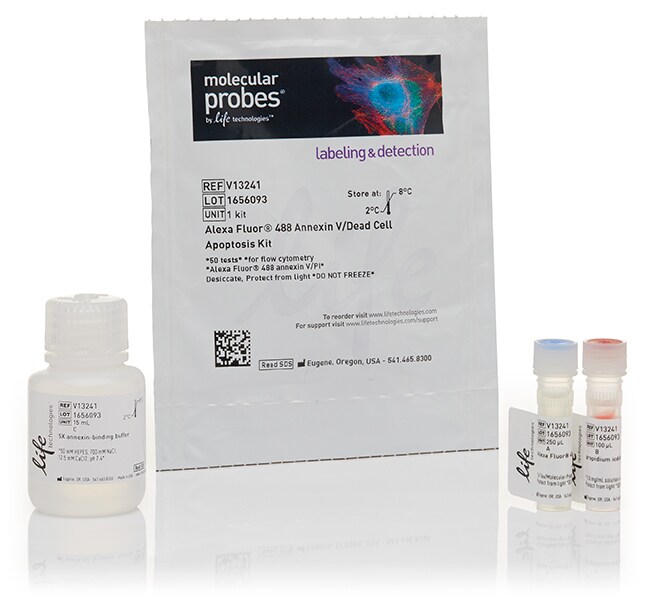
用于进行流式细胞分析的含 Annexin V 的死细胞凋亡试剂盒
使用含 Annexin V 和偶联荧光染料(如 Alexa Fluor 488、FITC、PI、PE、APC 和 SYTOX Green)的死细胞凋亡试剂盒评估细胞活力。
Have Questions?
更改视图

| 货号 | 数量 | 标签或染料 |
|---|---|---|
| V13241 | 50 Assays | Alexa Fluor 488, Propidium Iodide |
| V13242 | 1 Kit | FITC, Propidium Iodide |
| V35112 | 1 Kit | SYTOX Green, R-PE |
| V35113 | 1 Kit | SYTOX Green, APC |
| V13245 | 250 Assays | Alexa Fluor 488, Propidium Iodide |
货号 V13241
价格(CNY)
1,775.00
飞享价
Ends: 31-Dec-2026
2,358.00共减 583.00 (25%)
50 assays
数量:
50 Assays
标签或染料:
Alexa Fluor 488, Propidium Iodide
价格(CNY)
1,775.00
飞享价
Ends: 31-Dec-2026
2,358.00共减 583.00 (25%)
50 assays
在流式细胞分析期间,使用含 Annexin V 偶联物(包括 Alexa Fluor 488、FITC、碘化丙啶、PE、APC 和 SYTOX Green)的死细胞凋亡试剂盒可轻松区分活细胞、死细胞和凋亡细胞。这些偶联物通过不同的染料区分活细胞、死细胞或凋亡细胞,这对于使用多参数研究确认细胞活力和细胞凋亡非常重要。
使用用于进行流式细胞分析的含 Annexin V 的死细胞凋亡试剂盒测定细胞活力时有以下几个优势:
优异的亮度
与蛋白浓度或纯化水平较低的其他 Annexin V 试剂盒不同,Annexin V Alexa Fluor 488 偶联物针对流式细胞分析进行了优化,以使凋亡细胞与活细胞之间显示极大的差异。Alexa Fluor 488 染料是一种优异的绿色荧光染料,光谱与荧光素 (FITC) 相似。
高结合效率
Annexin V 偶联物由高纯度 cys-膜联蛋白制成,这使得结合效率更高,使得细胞凋亡过程的表征准确度极高。
多参数
许多出版物至少需要两种不同的方法来识别凋亡细胞。该多参数试剂盒可检测细胞膜细胞质表面磷脂酰丝氨酸 (PS),同时使用碘化丙啶确定膜完整性。
含有 Annexin V Alexa Fluor 488 和 PI 的死细胞凋亡试剂盒
含有 Annexin V Alexa Fluor 488 和碘化丙啶 (PI) 的死细胞凋亡试剂盒 (V13241, V13245) 用于进行流式细胞分析,通过检测磷脂酰丝氨酸 (PS) 表达和膜通透性来测量早期细胞凋亡。当细胞用 Annexin V 和碘化丙啶染色时,表达 PS 的凋亡细胞显示绿色荧光,可在 FITC 通道中检测到,并显示低红色荧光。死亡或坏死细胞显示明亮的红色荧光,无绿色荧光,而活细胞显示无绿色或红色荧光。
含有 Annexin V PE 和 SYTOX Green 的死细胞凋亡试剂盒
含有 Annexin V PE 和 SYTOX Green 的死细胞凋亡试剂盒可在流式细胞分析期间使用偶联橙色荧光藻胆蛋白 R-PE 的重组膜联蛋白 V 检测凋亡细胞的 PS 外化,死细胞则用 SYTOX Green 核酸染色剂进行检测。经过两种探针处理后,凋亡细胞显示橙色荧光,死细胞显示绿色荧光,活细胞几乎不显示荧光。在使用 488 nm 激光流式细胞仪的 530/30 nm 和 585/42 nm 带通滤光片中可轻松区分这些细胞群。
含有 Annexin V APC 和 SYTOX Green 的死细胞凋亡试剂盒
含有 Annexin V APC 和 SYTOX Green 的死细胞凋亡试剂盒可在流式细胞分析期间使用偶联红色激光激发别藻蓝蛋白的重组膜联蛋白 V 检测凋亡细胞的 PS 外化,死细胞则用 SYTOX Green 核酸染色剂进行检测。通过与外化 PS 结合的膜联蛋白 V 检测凋亡细胞。活细胞几乎不显示荧光,凋亡细胞显示红色荧光和极少的绿色荧光,晚期凋亡细胞显示较高水平的红色和橙色荧光。这些细胞群可以很容易地通过含有 488 nm 和 633 nm 激发源(氩离子激光器和 HeNe 激光器)的流式细胞仪加以区分。
含 Annexin V FITC 和 PI 的死细胞凋亡试剂盒
含 Annexin V FITC 和 PI 的死细胞凋亡试剂盒可使用偶联绿色荧光 FITC 染料的重组膜联蛋白 V 检测凋亡细胞的 PS 外化,死细胞则用 PI 进行检测。经 PI 染色的坏死细胞显示红色荧光。两种探针处理后,凋亡细胞显示绿色荧光,死细胞显示红色和绿色荧光,活细胞显示少量或无荧光。
优异的亮度
与蛋白浓度或纯化水平较低的其他 Annexin V 试剂盒不同,Annexin V Alexa Fluor 488 偶联物针对流式细胞分析进行了优化,以使凋亡细胞与活细胞之间显示极大的差异。Alexa Fluor 488 染料是一种优异的绿色荧光染料,光谱与荧光素 (FITC) 相似。
高结合效率
Annexin V 偶联物由高纯度 cys-膜联蛋白制成,这使得结合效率更高,使得细胞凋亡过程的表征准确度极高。
多参数
许多出版物至少需要两种不同的方法来识别凋亡细胞。该多参数试剂盒可检测细胞膜细胞质表面磷脂酰丝氨酸 (PS),同时使用碘化丙啶确定膜完整性。
含有 Annexin V Alexa Fluor 488 和 PI 的死细胞凋亡试剂盒
含有 Annexin V Alexa Fluor 488 和碘化丙啶 (PI) 的死细胞凋亡试剂盒 (V13241, V13245) 用于进行流式细胞分析,通过检测磷脂酰丝氨酸 (PS) 表达和膜通透性来测量早期细胞凋亡。当细胞用 Annexin V 和碘化丙啶染色时,表达 PS 的凋亡细胞显示绿色荧光,可在 FITC 通道中检测到,并显示低红色荧光。死亡或坏死细胞显示明亮的红色荧光,无绿色荧光,而活细胞显示无绿色或红色荧光。
含有 Annexin V PE 和 SYTOX Green 的死细胞凋亡试剂盒
含有 Annexin V PE 和 SYTOX Green 的死细胞凋亡试剂盒可在流式细胞分析期间使用偶联橙色荧光藻胆蛋白 R-PE 的重组膜联蛋白 V 检测凋亡细胞的 PS 外化,死细胞则用 SYTOX Green 核酸染色剂进行检测。经过两种探针处理后,凋亡细胞显示橙色荧光,死细胞显示绿色荧光,活细胞几乎不显示荧光。在使用 488 nm 激光流式细胞仪的 530/30 nm 和 585/42 nm 带通滤光片中可轻松区分这些细胞群。
含有 Annexin V APC 和 SYTOX Green 的死细胞凋亡试剂盒
含有 Annexin V APC 和 SYTOX Green 的死细胞凋亡试剂盒可在流式细胞分析期间使用偶联红色激光激发别藻蓝蛋白的重组膜联蛋白 V 检测凋亡细胞的 PS 外化,死细胞则用 SYTOX Green 核酸染色剂进行检测。通过与外化 PS 结合的膜联蛋白 V 检测凋亡细胞。活细胞几乎不显示荧光,凋亡细胞显示红色荧光和极少的绿色荧光,晚期凋亡细胞显示较高水平的红色和橙色荧光。这些细胞群可以很容易地通过含有 488 nm 和 633 nm 激发源(氩离子激光器和 HeNe 激光器)的流式细胞仪加以区分。
含 Annexin V FITC 和 PI 的死细胞凋亡试剂盒
含 Annexin V FITC 和 PI 的死细胞凋亡试剂盒可使用偶联绿色荧光 FITC 染料的重组膜联蛋白 V 检测凋亡细胞的 PS 外化,死细胞则用 PI 进行检测。经 PI 染色的坏死细胞显示红色荧光。两种探针处理后,凋亡细胞显示绿色荧光,死细胞显示红色和绿色荧光,活细胞显示少量或无荧光。
仅供科研使用。不可用于诊断程序。
规格
描述带膜联蛋白 V Alexa Fluor 488 & 碘化丙啶 (PI) 的死细胞凋亡试剂盒
激发/发射499、535/521、617
流式细胞仪激光线路488
适用于(设备)荧光显微镜、流式细胞仪
标签或染料Alexa Fluor 488, Propidium Iodide
产品类型细胞凋亡检测试剂盒
数量50 Assays
运输条件湿冰
Unit Size50 assays
内容与储存
含 1 小瓶 Annexin V Alexa Fluor 488 偶联物 (250 µL)、1 小瓶碘化丙啶 (PI, 100 µL) 和 1 瓶膜联蛋白结合缓冲液(5X 溶液,15 mL)。在冰箱(2°C 至 8°C)中避光储存。
常见问题解答 (FAQ)
我用胰蛋白酶消化贴壁细胞并用膜联蛋白V标记,现在甚至在对照的未处理细胞中,流式数据结果都显示出高比例的细胞凋亡,这是什么原因所致?
我能在成像实验中检测膜联蛋白V染色么?
流式细胞仪分析时,我应该在什么时候用膜联蛋白V染色粘连细胞?在胰蛋白酶消化前或后?
我能固定膜联蛋白V标记的细胞么?
When using Dead Cell Apoptosis Kits with Annexin V for Flow Cytometry, what does a PI+ only population (hence Annexin V negative) correspond to?
引用和文献 (22)
引用和文献
Abstract
H2AX phosphorylation within the G1 phase after UV irradiation depends on nucleotide excision repair and not DNA double-strand breaks.
Journal:Proc Natl Acad Sci U S A
PubMed ID:16788066
'The variant histone H2AX is phosphorylated in response to UV irradiation of primary human fibroblasts in a complex fashion that is radically different from that commonly reported after DNA double-strand breaks. H2AX phosphorylation after exposure to ionizing radiation produces foci, which are detectable by immunofluorescence microscopy and have been adopted
Aberrant T cell differentiation in the absence of Dicer.
Journal:J Exp Med
PubMed ID:16009718
'Dicer is an RNaseIII-like enzyme that is required for generating short interfering RNAs and microRNAs. The latter have been implicated in regulating cell fate determination in invertebrates and vertebrates. To test the requirement for Dicer in cell-lineage decisions in a mammalian organism, we have generated a conditional allele of dicer-1
Nuclear relocation of the nephrin and CD2AP-binding protein dendrin promotes apoptosis of podocytes.
Journal:Proc Natl Acad Sci U S A
PubMed ID:17537921
'Kidney podocytes and their slit diaphragms (SDs) form the final barrier to urinary protein loss. There is mounting evidence that SD proteins also participate in intracellular signaling pathways. The SD protein nephrin serves as a component of a signaling complex that directly links podocyte junctional integrity to actin cytoskeletal dynamics.
An anti-transferrin receptor-avidin fusion protein exhibits both strong proapoptotic activity and the ability to deliver various molecules into cancer cells.
Journal:Proc Natl Acad Sci U S A
PubMed ID:12149472
'We have developed an antibody fusion protein (anti-rat TfR IgG3-Av) with the ability to deliver different molecules into cancer cells. It consists of avidin genetically fused to the C(H)3 region of a human IgG3 specific for the rat transferrin receptor. It forms strong, noncovalent interactions with biotinylated molecules such as
Protein kinase Cepsilon activates protein kinase B/Akt via DNA-PK to protect against tumor necrosis factor-alpha-induced cell death.
Journal:J Biol Chem
PubMed ID:16785234
'We have previously shown that protein kinase Cepsilon (PKCepsilon) protects breast cancer cells from tumor necrosis factor-alpha (TNF)-induced cell death. In the present study, we have investigated if the antiapoptotic function of PKCepsilon is mediated via Akt and the mechanism by which PKCepsilon regulates Akt activity. TNF caused a transient