Search


引用和文献 (8)
Invitrogen™
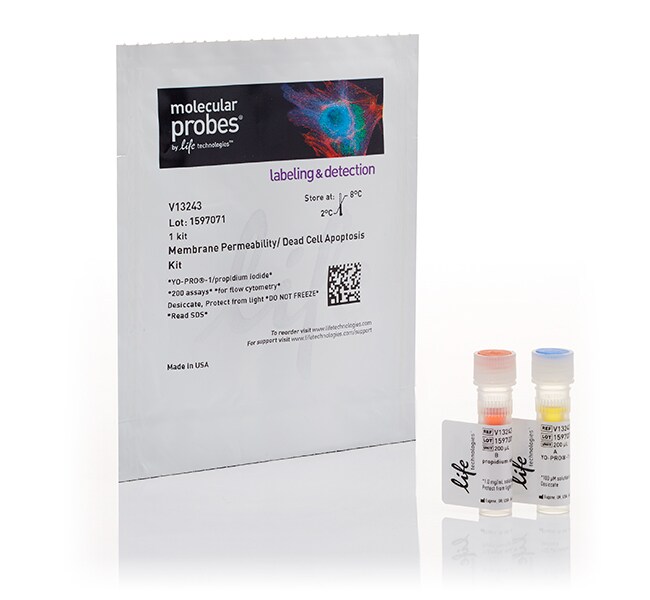
用于对凋亡和坏死细胞染色的 Vybrant™ 细胞凋亡检测试剂盒
使用用于对凋亡和坏死细胞染色的 Vybrant 细胞凋亡检测试剂盒(提供包括 YO-PRO-1 和 Hoechst 33342 在内的染料)易于区分出现凋亡细胞的细胞。
Have Questions?
更改视图

| 货号 | 标签或染料 | 描述 |
|---|---|---|
| V13243 | YO-PRO-1、碘化丙啶 | Vybrant 细胞凋亡检测试剂盒 #4 |
| V13244 | Hoechst 33342、碘化丙啶 | Vybrant 细胞凋亡检测试剂盒 #5 |
| V23200 | Alexa Fluor™ 350 链霉素亲和素、碘化丙啶、生物素-X 膜联蛋白 V | Vybrant 细胞凋亡检测试剂盒 #6 |
货号 V13243
价格(CNY)
3,845.00
飞享价
Ends: 31-Dec-2026
5,108.00共减 1,263.00 (25%)
200 assays
标签或染料:
YO-PRO-1、碘化丙啶
描述:
Vybrant 细胞凋亡检测试剂盒 #4
价格(CNY)
3,845.00
飞享价
Ends: 31-Dec-2026
5,108.00共减 1,263.00 (25%)
200 assays
凋亡细胞经过多种生理过程,包括细胞膜可透过性和染色质凝集的变化,可使用凋亡和坏死细胞染色方案中的不同染料进行区分。Vybrant 细胞凋亡检测试剂盒提供了链霉素亲和素生物素-膜联蛋白 V、碘化丙啶 (PI)、YO-PRO-1 和 Hoechst 33342 染料,以区分活细胞与凋亡或坏死细胞,然后可通过流式细胞分析显示结果。
Vybrant 细胞凋亡检测试剂盒提供了快速且便利的基于细胞染色染料的方法,用于区分凋亡和坏死细胞与健康细胞,然后可通过流式细胞分析显示结果。
Vybrant 细胞凋亡检测试剂盒 #4 通过细胞膜可透过性变化检测细胞凋亡情况。该试剂盒含有即用型 YO-PRO-1 和碘化丙啶 (PI) 核酸染色剂溶液。YO-PRO-1 染色剂选择性穿过凋亡细胞的质膜并标记这些细胞,使其发出中等强度的绿色荧光。坏死细胞可被 PI 染上红色荧光。
Vybrant 细胞凋亡检测试剂盒#5 或用于进行流式细胞分析的含 Hoechst 33342 和 PI 的染色质凝集/死细胞凋亡检测试剂盒为研究凋亡细胞内的染色质收缩提供了一种快速且便利的荧光检测方法。本试剂盒含有即用型蓝色荧光 Hoechst 33342 染料溶液(经过染色,凋亡细胞凝集染色质的亮度高于非凋亡细胞染色质的亮度)和红色荧光 PI 染料溶液(对死细胞染色)。
Vybrant 细胞凋亡检测试剂盒 #6 提供了一种快速且便利的细胞凋亡检测方法,使用亮蓝荧光 Alexa Fluor 350 链霉素亲和素偶联物结合生物素-X 膜联蛋白 V,通过流式细胞分析或成像检测凋亡细胞群。此外,该试剂盒包括即用型荧光红色 PI 核酸结合染料溶液。PI 不可透过活细胞和凋亡细胞,但是可以与其核酸紧密结合而将坏死细胞染上红色荧光。该试剂盒所含各试剂的含量足以进行约 50 次流式细胞分析。
Vybrant 细胞凋亡检测试剂盒 #4 通过细胞膜可透过性变化检测细胞凋亡情况。该试剂盒含有即用型 YO-PRO-1 和碘化丙啶 (PI) 核酸染色剂溶液。YO-PRO-1 染色剂选择性穿过凋亡细胞的质膜并标记这些细胞,使其发出中等强度的绿色荧光。坏死细胞可被 PI 染上红色荧光。
Vybrant 细胞凋亡检测试剂盒#5 或用于进行流式细胞分析的含 Hoechst 33342 和 PI 的染色质凝集/死细胞凋亡检测试剂盒为研究凋亡细胞内的染色质收缩提供了一种快速且便利的荧光检测方法。本试剂盒含有即用型蓝色荧光 Hoechst 33342 染料溶液(经过染色,凋亡细胞凝集染色质的亮度高于非凋亡细胞染色质的亮度)和红色荧光 PI 染料溶液(对死细胞染色)。
Vybrant 细胞凋亡检测试剂盒 #6 提供了一种快速且便利的细胞凋亡检测方法,使用亮蓝荧光 Alexa Fluor 350 链霉素亲和素偶联物结合生物素-X 膜联蛋白 V,通过流式细胞分析或成像检测凋亡细胞群。此外,该试剂盒包括即用型荧光红色 PI 核酸结合染料溶液。PI 不可透过活细胞和凋亡细胞,但是可以与其核酸紧密结合而将坏死细胞染上红色荧光。该试剂盒所含各试剂的含量足以进行约 50 次流式细胞分析。
仅供科研使用。不可用于诊断程序。
规格
颜色绿色、红色
描述Vybrant 细胞凋亡检测试剂盒 #4
激发/发射YO-PRO-1:491/509 碘化丙啶:535/617
流式细胞仪激光线路488
适用于(设备)流式细胞仪
标签类型其他标记或染料
标签或染料YO-PRO-1、碘化丙啶
产品线Vybrant
产品类型细胞凋亡测定试剂盒
数量200 assays
运输条件室温
检测方法荧光
产品规格管装
Unit Size200 assays
内容与储存
含 1 小瓶 YO-PRO-1 和 1 瓶碘化丙啶。 避光储存在冷藏冰箱 (2–8°C) 中。
常见问题解答 (FAQ)
什么是细胞连续凋亡的相对期间时限,我该用什么样的产品去检测不同的凋亡事件?
What are the fluorescence excitation/emission maxima for the dyes in the Membrane Permeability/Dead Cell Apoptosis Kit with YO-PRO-1 and PI for Flow Cytometry aka Vybrant Apoptosis Assay Kit #4, YO-PRO-1/Propidium Iodide)?
What is the relative time-frame of apoptosis progression, and what products can I use to detect the different apoptotic events?
引用和文献 (8)
引用和文献
Abstract
Contribution of membrane localization to the apoptotic activity of PUMA.
Journal:Apoptosis
PubMed ID:17968660
'The BH3-only protein PUMA plays an important role in the activation of apoptosis in response to p53. In different studies, PUMA has been described to function by either directly activating the pro-apoptotic proteins Bax and Bak, or by neutralizing anti-apoptotic members of the Bcl2 family. We have examined the contribution
Release of hypoacetylated and trimethylated histone H4 is an epigenetic marker of early apoptosis.
Journal:J Biol Chem
PubMed ID:16531610
'Nuclear events such as chromatin condensation, DNA cleavage at internucleosomal sites, and histone release from chromatin are recognized as hallmarks of apoptosis. However, there is no complete understanding of the molecular events underlying these changes. It is likely that epigenetic changes such as DNA methylation and histone modifications that are
Chlorophenols and chlorocatechols induce apoptosis in human lymphocytes (in vitro).
Journal:Toxicol Lett
PubMed ID:19766705
In this work the effect of 2,4,5-trichlorophenol (2,4,5-TCP), pentachlorophenol (PCP), 4,6-dichloroguaiacol (4,6-DCG), tetrachloroguaiacol (TeCG), 4,5-dichlorocatechol (4,5-DCC) and tetrachlorocatechol (TeCC) on the induction of apoptosis in human peripheral blood lymphocytes was examined. The analysis of the changes in mitochondrial transmembrane potential (DeltaPsi(m)) was performed using JC-9 fluorescent probe. It was noted
Comparison of apoptosis and mortality measurements in peripheral blood mononuclear cells (PBMCs) using multiple methods.
Journal:Cell Prolif
PubMed ID:16202038
Death through apoptosis is the main process by which aged cells that have lost their function are eliminated. Apoptotic cells are usually detected microscopically by changes in their morphology. However, determination of early apoptotic events is important for in vitro (and ex vivo) studies. The main objective of the present
Relocalization of STIM1 for activation of store-operated Ca(2+) entry is determined by the depletion of subplasma membrane endoplasmic reticulum Ca(2+) store.
Journal:J Biol Chem
PubMed ID:17298947
STIM1 (stromal interacting molecule 1), an endoplasmic reticulum (ER) protein that controls store-operated Ca(2+) entry (SOCE), redistributes into punctae at the cell periphery after store depletion. This redistribution is suggested to have a causal role in activation of SOCE. However, whether peripheral STIM1 punctae that are involved in regulation of