Search


引用和文献 (6)
Invitrogen™
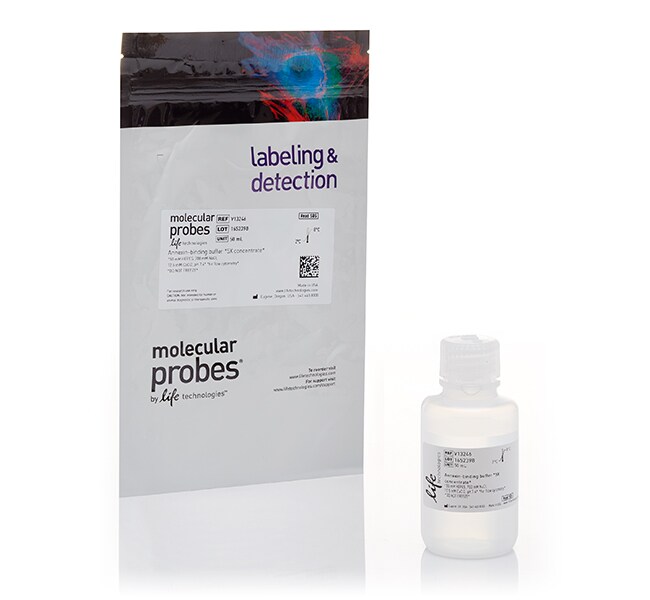
Annexin 结合缓冲液 (5X)(用于流式细胞术)
Annexin 结合缓冲液 (5X)(用于流式细胞术)
| 货号 | 数量 |
|---|---|
| V13246 | 50 mL |
货号 V13246
价格(CNY)
806.00
飞享价
Ends: 31-Dec-2026
1,070.00共减 264.00 (25%)
50 mL
数量:
50 mL
价格(CNY)
806.00
飞享价
Ends: 31-Dec-2026
1,070.00共减 264.00 (25%)
50 mL
该产品设计用于促进 Annexin V 与磷脂酰丝氨酸结合,以检测细胞凋亡。
仅供科研使用。不可用于诊断程序。
规格
适用于(应用)流式细胞分析
形式浓缩型
配方50 mM HEPES,700 mM NaCl,12.5 mM CaCl2,pH 7.4
产品类型膜联蛋白结合缓冲液
数量50 mL
运输条件湿冰
pH7.4
Unit Size50 mL
内容与储存
含有1瓶膜联蛋白结合缓冲液(5x 溶液,50 mL)。
储存在 2–8°C 下。
储存在 2–8°C 下。
常见问题解答 (FAQ)
我用胰蛋白酶消化贴壁细胞并用膜联蛋白V标记,现在甚至在对照的未处理细胞中,流式数据结果都显示出高比例的细胞凋亡,这是什么原因所致?
我能在成像实验中检测膜联蛋白V染色么?
流式细胞仪分析时,我应该在什么时候用膜联蛋白V染色粘连细胞?在胰蛋白酶消化前或后?
我能固定膜联蛋白V标记的细胞么?
I trypsinized my adherent cells and labeled with annexin V, and now my flow data is showing a high percentage of apoptotic cells even for control, untreated cells. What is the problem?
引用和文献 (6)
引用和文献
Abstract
Surface functionalization of doxorubicin-loaded liposomes with octa-arginine for enhanced anticancer activity.
Journal:Eur J Pharm Biopharm
PubMed ID:23333899
Doxorubicin-loaded PEGylated liposomes (commercially available as DOXIL or Lipodox) were surface functionalized with a cell-penetrating peptide, octa-arginine (R8). For this purpose, R8-peptide was conjugated to the polyethylene glycol-dioleoyl phosphatidylethanolamine (PEG-DOPE) amphiphilic co-polymer. The resultant R8-PEG-PE conjugate was introduced into the lipid bilayer of liposomes at 2 mol% of total lipid
Bruton's tyrosine kinase is at the crossroads of metabolic adaptation in primary malignant human lymphocytes.
Journal:Sci Rep
PubMed ID:31363127
'In this work we explored metabolic aspects of human primary leukemic lymphocytes that hold a potential impact on the treatment of Bruton tyrosine kinase (BTK)-driven diseases. Our results suggest that there is crosstalk between Bruton tyrosine kinase (BTK) signaling and bioenergetic stress responses. In primary chronic lymphocytic leukemia (CLL) lymphocytes,
Ibrutinib Resistance Is Reduced by an Inhibitor of Fatty Acid Oxidation in Primary CLL Lymphocytes.
Journal:Front Oncol
PubMed ID:30319974
Chronic Lymphocytic Leukemia (CLL) is an incurable disease, characterized by the accumulation of malignant B-lymphocytes in the blood stream (quiescent state) and homing tissues (where they can proliferate). In CLL, the targeting of B-cell receptor signaling through a Burton's tyrosine kinase inhibitor (ibrutinib) has rendered outstanding clinical results. However, complete
A tyrosine kinase-activating variant Asn666Ser in PDGFRB causes a progeria-like condition in the severe end of Penttinen syndrome.
Journal:Eur J Hum Genet
PubMed ID:30573803
Missense variants located to the "molecular brake" in the tyrosine kinase hinge region of platelet-derived growth factor receptor-ß, encoded by PFGFRB, can cause Penttinen-type (Val665Ala) and Penttinen-like (Asn666His) premature ageing syndromes, as well as infantile myofibromatosis (Asn666Lys and Pro660Thr). We have found the same de novo PDGFRB c.1997A>G p.(Asn666Ser) variants
Functional Autophagic Flux Regulates AgNP Uptake And The Internalized Nanoparticles Determine Tumor Cell Fate By Temporally Regulating Flux.
Journal:Int J Nanomedicine
PubMed ID:31819419
Silver nanoparticles (AgNPs) are known to induce the conserved, cellular, homeostatic process- autophagy in tumor cells. Previous studies primarily focus on the pro-survival role of autophagy post AgNP exposure in tumor cells, but seldom on its role in AgNP uptake, or on the functional significance of autophagy temporal dynamics. Our