Search


引用和文献 (5)
Invitrogen™
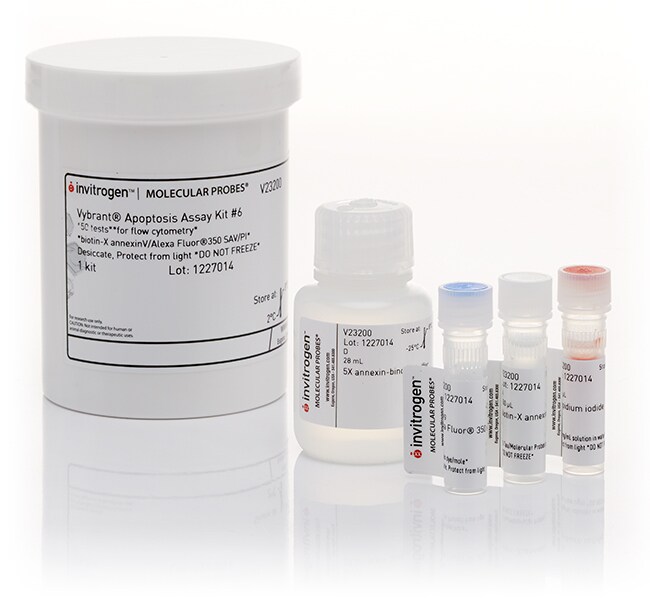
用于对凋亡和坏死细胞染色的 Vybrant™ 细胞凋亡检测试剂盒
使用用于对凋亡和坏死细胞染色的 Vybrant 细胞凋亡检测试剂盒(提供包括 YO-PRO-1 和 Hoechst 33342 在内的染料)易于区分出现凋亡细胞的细胞。
Have Questions?
更改视图

| 货号 | 标签或染料 | 描述 |
|---|---|---|
| V23200 | Alexa Fluor™ 350 链霉素亲和素、碘化丙啶、生物素-X 膜联蛋白 V | Vybrant 细胞凋亡检测试剂盒 #6 |
| V13243 | YO-PRO-1、碘化丙啶 | Vybrant 细胞凋亡检测试剂盒 #4 |
| V13244 | Hoechst 33342、碘化丙啶 | Vybrant 细胞凋亡检测试剂盒 #5 |
货号 V23200
价格(CNY)
4,825.00
飞享价
Ends: 31-Dec-2026
6,410.00共减 1,585.00 (25%)
50 assays
标签或染料:
Alexa Fluor™ 350 链霉素亲和素、碘化丙啶、生物素-X 膜联蛋白 V
描述:
Vybrant 细胞凋亡检测试剂盒 #6
价格(CNY)
4,825.00
飞享价
Ends: 31-Dec-2026
6,410.00共减 1,585.00 (25%)
50 assays
凋亡细胞经过多种生理过程,包括细胞膜可透过性和染色质凝集的变化,可使用凋亡和坏死细胞染色方案中的不同染料进行区分。Vybrant 细胞凋亡检测试剂盒提供了链霉素亲和素生物素-膜联蛋白 V、碘化丙啶 (PI)、YO-PRO-1 和 Hoechst 33342 染料,以区分活细胞与凋亡或坏死细胞,然后可通过流式细胞分析显示结果。
Vybrant 细胞凋亡检测试剂盒提供了快速且便利的基于细胞染色染料的方法,用于区分凋亡和坏死细胞与健康细胞,然后可通过流式细胞分析显示结果。
Vybrant 细胞凋亡检测试剂盒 #4 通过细胞膜可透过性变化检测细胞凋亡情况。该试剂盒含有即用型 YO-PRO-1 和碘化丙啶 (PI) 核酸染色剂溶液。YO-PRO-1 染色剂选择性穿过凋亡细胞的质膜并标记这些细胞,使其发出中等强度的绿色荧光。坏死细胞可被 PI 染上红色荧光。
Vybrant 细胞凋亡检测试剂盒#5 或用于进行流式细胞分析的含 Hoechst 33342 和 PI 的染色质凝集/死细胞凋亡检测试剂盒为研究凋亡细胞内的染色质收缩提供了一种快速且便利的荧光检测方法。本试剂盒含有即用型蓝色荧光 Hoechst 33342 染料溶液(经过染色,凋亡细胞凝集染色质的亮度高于非凋亡细胞染色质的亮度)和红色荧光 PI 染料溶液(对死细胞染色)。
Vybrant 细胞凋亡检测试剂盒 #6 提供了一种快速且便利的细胞凋亡检测方法,使用亮蓝荧光 Alexa Fluor 350 链霉素亲和素偶联物结合生物素-X 膜联蛋白 V,通过流式细胞分析或成像检测凋亡细胞群。此外,该试剂盒包括即用型荧光红色 PI 核酸结合染料溶液。PI 不可透过活细胞和凋亡细胞,但是可以与其核酸紧密结合而将坏死细胞染上红色荧光。该试剂盒所含各试剂的含量足以进行约 50 次流式细胞分析。
Vybrant 细胞凋亡检测试剂盒 #4 通过细胞膜可透过性变化检测细胞凋亡情况。该试剂盒含有即用型 YO-PRO-1 和碘化丙啶 (PI) 核酸染色剂溶液。YO-PRO-1 染色剂选择性穿过凋亡细胞的质膜并标记这些细胞,使其发出中等强度的绿色荧光。坏死细胞可被 PI 染上红色荧光。
Vybrant 细胞凋亡检测试剂盒#5 或用于进行流式细胞分析的含 Hoechst 33342 和 PI 的染色质凝集/死细胞凋亡检测试剂盒为研究凋亡细胞内的染色质收缩提供了一种快速且便利的荧光检测方法。本试剂盒含有即用型蓝色荧光 Hoechst 33342 染料溶液(经过染色,凋亡细胞凝集染色质的亮度高于非凋亡细胞染色质的亮度)和红色荧光 PI 染料溶液(对死细胞染色)。
Vybrant 细胞凋亡检测试剂盒 #6 提供了一种快速且便利的细胞凋亡检测方法,使用亮蓝荧光 Alexa Fluor 350 链霉素亲和素偶联物结合生物素-X 膜联蛋白 V,通过流式细胞分析或成像检测凋亡细胞群。此外,该试剂盒包括即用型荧光红色 PI 核酸结合染料溶液。PI 不可透过活细胞和凋亡细胞,但是可以与其核酸紧密结合而将坏死细胞染上红色荧光。该试剂盒所含各试剂的含量足以进行约 50 次流式细胞分析。
仅供科研使用。不可用于诊断程序。
规格
颜色蓝色、红色
描述Vybrant 细胞凋亡检测试剂盒 #6
激发/发射Alexa Fluor™ 346/442:346 PI:535/617
流式细胞仪激光线路UV,488
适用于(设备)流式细胞仪
标签类型Alexa Fluor™ 染色剂、生物素 & 其他半抗原、其他标记或染色剂
标签或染料Alexa Fluor™ 350 链霉素亲和素、碘化丙啶、生物素-X 膜联蛋白 V
产品线Alexa Fluor
产品类型细胞凋亡试剂盒
数量50 assays
运输条件湿冰
检测方法荧光
产品规格管装
Unit Size50 assays
内容与储存
1 小瓶生物素-x 膜联蛋白 V、1 小瓶 Alexa Fluor™ 350 链霉素亲和素、1 小瓶碘化丙啶产品、1 瓶 5x 膜联蛋白结合缓冲液 避光储存在冷藏冰箱 (2–8°C) 中。
引用和文献 (5)
引用和文献
Abstract
mTOR-dependent proliferation defect in human ES-derived neural stem cells affected by myotonic dystrophy type 1.
Journal:J Cell Sci
PubMed ID:23444380
'Patients with myotonic dystrophy type 1 exhibit a diversity of symptoms that affect many different organs. Among these are cognitive dysfunctions, the origin of which has remained elusive, partly because of the difficulty in accessing neural cells. Here, we have taken advantage of pluripotent stem cell lines derived from embryos
Glucagon-like peptide 1 stimulates post-translational activation of glucokinase in pancreatic beta cells.
Journal:J Biol Chem
PubMed ID:21454584
Glucagon-like peptide 1 (GLP-1) potentiates glucose-stimulated insulin secretion from pancreatic ß cells, yet does not directly stimulate secretion. The mechanisms underlying this phenomenon are incompletely understood. Here, we report that GLP-1 augments glucose-dependent rises in NAD(P)H autofluorescence in both ßTC3 insulinoma cells and islets in a manner consistent with post-translational
Nuclear expression of E2F4 induces cell death via multiple pathways in normal human intestinal epithelial crypt cells but not in colon cancer cells.
Journal:Am J Physiol Gastrointest Liver Physiol
PubMed ID:17656449
E2F transcription factors control cell cycle progression. The localization of E2F4 in intestinal epithelial cells is cell cycle dependent, being cytoplasmic in quiescent differentiated cells but nuclear in proliferative cells. However, whether nuclear translocation of E2F4 alone is sufficient to trigger intestinal epithelial cell proliferation remains to be established. Adenoviruses
G protein-coupled receptor-promoted trafficking of Gbeta1gamma2 leads to AKT activation at endosomes via a mechanism mediated by Gbeta1gamma2-Rab11a interaction.
Journal:Mol Biol Cell
PubMed ID:18701709
G-protein coupled receptors activate heterotrimeric G proteins at the plasma membrane in which most of their effectors are intrinsically located or transiently associated as the external signal is being transduced. This paradigm has been extended to the intracellular compartments by studies in yeast showing that trafficking of Galpha activates phosphatidylinositol
Tetramethylpyrazine regulates breast cancer cell viability, migration, invasion and apoptosis by affecting the activity of Akt and caspase-3.
Journal:Oncol Lett
PubMed ID:29541225
Tetramethylpyrazine (TMP), an effective component of the traditional Chinese medicine Chuanxiong Hort, has been proven to exhibit a beneficial effect in a number of types of malignant epithelial cancer. However, the mode of action of TMP on breast cancer cells remains unknown. The aim of the present study was to