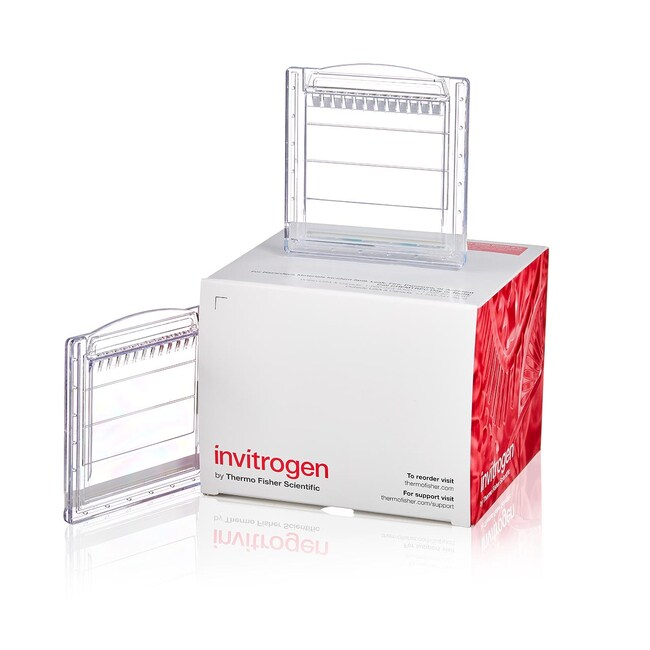
Novex™ WedgeWell™ 4% 至 12%,Tris-甘氨酸,1.0 mm,微型蛋白凝胶,12 孔
Run Invitrogen Mini Protein Gels in Bio-Rad's Mini-PROTEAN® Tetra Cell. Click here for more information.
Save now and restock on reagents and precast protein gels! Click here for more information.
Novex™ WedgeWell™ 4% 至 12%,Tris-甘氨酸,1.0 mm,微型蛋白凝胶,12 孔
Invitrogen™

Novex™ WedgeWell™ 4% 至 12%,Tris-甘氨酸,1.0 mm,微型蛋白凝胶,12 孔

Invitrogen Novex Tris-甘氨酸微型胶(WedgeWell 规格)是聚丙烯酰胺凝胶,能够将宽范围分子量蛋白可重现地分离为可清晰分辨的条带,且样品加载容量高出两倍。
Have Questions?
更改视图buttonViewtableView
货号数量
XP04122BOX12孔10 块凝胶/盒
XP04120PK210孔2 块凝胶/盒
XP04120BOX10孔10 块凝胶/盒
XP04125BOX15孔10 块凝胶/盒
货号 XP04122BOX
价格(CNY)
1,325.00
10 gels (1 box)
添加至购物车
孔:
12孔
数量:
10 块凝胶/盒
价格(CNY)
1,325.00
10 gels (1 box)
添加至购物车
Invitrogen Novex Tris-甘氨酸微型胶(WedgeWell 规格)是聚丙烯酰胺凝胶,能够将宽范围分子量蛋白可重现地分离为可清晰分辨的条带,且样品加载容量高出两倍。Novex Tris-甘氨酸小型凝胶基于传统 Laemmli 蛋白电泳系统,可与 Laemmli 样品和电泳缓冲液搭配使用。

Novex Tris-甘氨酸凝胶(WedgeWell 规格)的特点包括:
延长有效期—凝胶可在 4°C 下储存长达 12 个月
多样性—用于天然和变性蛋白检测
楔形孔—可轻松加载达两倍样品体积
快速运行条件—使用恒定电压在不到 60 分钟内快速分离蛋白

为您的实验选择合适的凝胶规格
Novex Tris-甘氨酸凝胶 WedgeWell 规格具有从 6% 到 18% 的多种固定浓度,以及范围为 4–12%、4–20%、8–16% 和 10–20% 的梯度。有多种孔规格(包括 10 孔、12 孔和 15 孔)和不同包装规格可供选择。

可用于天然或变性的蛋白分离
Novex Tris-甘氨酸凝胶(WedgeWell 规格)不含 SDS,可用于天然或变性的蛋白分离。对于变性蛋白,我们推荐使用 Novex Tris-甘氨酸 SDS 上样缓冲液 (LC2676) 以及 Novex Tris-甘氨酸 SDS 电泳缓冲液 (LC26755)。对于非变性蛋白,我们推荐使用 Novex Tris-甘氨酸非变性上样缓冲液 (LC2673) 以及 Novex Tris-甘氨酸非变性电泳缓冲液 (LC2672)。

便于使用
Novex Tris-甘氨酸凝胶(WedgeWell 规格)具有创新的楔形孔,与其他 1.0 mm 厚的凝胶相比,样品上样量高出两倍。楔形孔的开口也更大,使上样更容易。

若要将蛋白转印到膜上,我们推荐使用 Novex Tris-甘氨酸转印缓冲液 (LC367),以使用 Invitrogen 小型印迹模块 (B1000) 进行传统湿式转印。转印时还可使用 Invitrogen Power Blotter 进行快速半干转印,或使用 iBlot 2 凝胶转印仪 (IB21001) 进行快速干式转印。

For Research Use Only. Not for use in diagnostic procedures.
规格
凝胶厚度1.0 mm
长度(公制)8 cm
分离模式分子量
产品线Novex™,WedgeWell™
数量10 块凝胶/盒
推荐应用变性,天然
上样容量最多 45 µL
有效期12个月
运输条件湿冰
储存要求存储在 2°C 到 8°C。切勿冷冻。
宽度(公制)8 cm
适用于(设备)Mini Gel Tank 小型垂直电泳槽, XCell SureLock Mini-Cell 电泳槽操作指南
凝胶百分比4 至 12%
凝胶尺寸小型
凝胶类型Tris-甘氨酸 Plus
分离范围30 至 250 kDa
分离类型变性,天然
12孔
Unit Size10 gels (1 box)
内容与储存
一盒包含 10 块凝胶。在冷藏冰箱 (2–8°C) 中储存。有效期可长达 12 个月,具体取决于凝胶类型。

常见问题解答 (FAQ)

我正在以恒定电压进行Tris-甘氨酸凝胶转印,但电流读数高于预期起始电流。可能因为什么?

电流异常升高的最常见原因是转膜缓冲液。如果转膜缓冲液浓度太高,会导致电导率增加和电流升高。如果不小心用Tris-HCl代替了转膜缓冲液所需的Tris base,也会导致高电流。Tris-HCl可使缓冲液pH降低,引起电导率和电流升高,从而导致过热。我们建议检查转膜缓冲液及其试剂成分,然后重新稀释或重新配制缓冲液。

Is it okay to use protein gels past their expiration date?

We do not recommend using gels past their expiration date because over time, the polyacrylamide hydrolyzes to acrylic acid and ammonia and this will affect the resolution of the proteins. Breakdown of polyacrylamide matrix is identified by:
- Ghost bands and doublets, seen first in the high molecular weight proteins
- Smiling of dye front across the gel, with bands in outer lanes becoming very slanted - proteins run slower there due to change in pH and pore size over time.


Find additional tips, troubleshooting help, and resources within our Protein Electrophoresis and Western Blotting Support Center.

Can I run your protein gels overnight?

This is not really recommended, but it is always possible to increase run time by lowering the voltage of the run. In general, the relationships are linear - i.e., decreasing voltage by half will double the run time.

Find additional tips, troubleshooting help, and resources within our Protein Electrophoresis and Western Blotting Support Center.

Do I need to increase the voltage when I run a 1.5 mm protein gel versus a 1.0 mm gel?

If you are running the gel at constant voltage, you do not need to increase the voltage regardless of the thickness of the gel.

Find additional tips, troubleshooting help, and resources within our Protein Electrophoresis and Western Blotting Support Center.

Why do you recommend running your protein gels at constant voltage?

Using constant voltage allows the current and power to decrease during the run, providing a safety margin in case of a break in the system. Having lower power is a safety benefit and will also decrease the chances of experiencing an overheating of the gel. Further, the constant voltage setting does not need adjustment to account for differences in number or thickness of gels being run.

Find additional tips, troubleshooting help, and resources within ourProtein Gel 1D Electrophoresis Support Center.