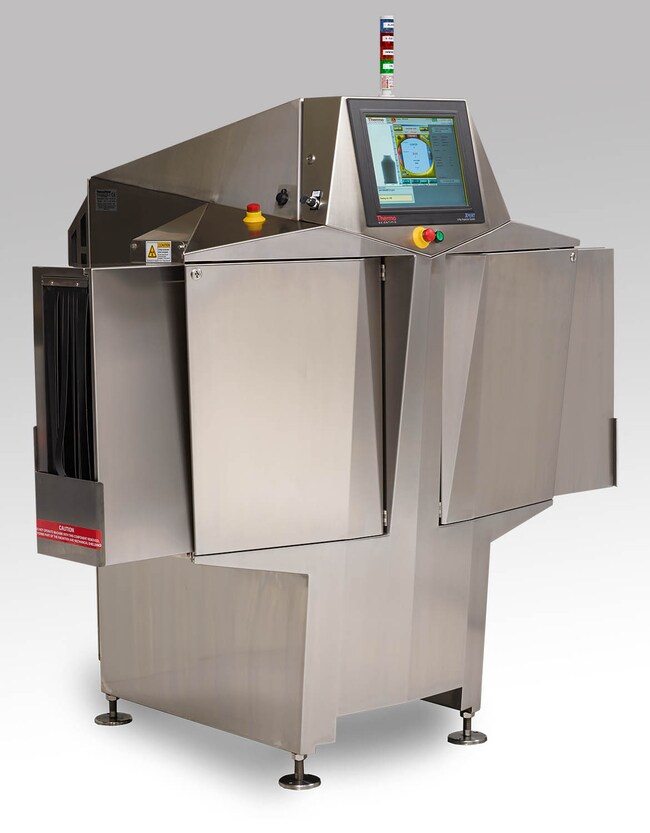

Xpert™ 侧射型 X 射线检查系统
Xpert™ 侧射型 X 射线检查系统
Xpert™ 侧射型 X 射线检查系统
Xpert™ 侧射型 X 射线检查系统
Xpert™ 侧射型 X 射线检查系统
Thermo Scientific™

Xpert™ 侧射型 X 射线检查系统

对高大的直立式包装进行高速单光束 X 射线检查,以避免尴尬、成本高昂的产品召回,并在消费者发现之前避免问题。
Have Questions?
货号产品类型
XPERTS400Xpert Sideshoot X-Ray Inspection System
货号 XPERTS400
价格(CNY)
-
申请报价
产品类型:
Xpert Sideshoot X-Ray Inspection System
借助 Thermo Scientific™ Xpert™ 侧射型 X 射线检查系统,轻松检测存在于瓶瓶罐罐中的任何地方的异物。这种高速、高性能的水平X-射线束(从后到前)系统为高大的直立式包装提供单光束X-射线检测,并包括专门用于检测听装罐和瓶子所有区域内物体的软件。该系统的设计目的在于,使用现有的传送机来降低成本和减少占地面积。该系统符合 HACCP 要求,并且可以升级至符合 IP69K 直冲式规格。

Xpert 侧射型 X 射线检查系统 

  • 设计用于高型包装检查,例如金属罐、塑料瓶 X 射线、纸箱和站立袋。
  • 扫描垂直方向的容器时,大的水平光束可提供更高的灵敏度和更准确的结果。
  • 为高型包装开发的特定软件算法可查找问题区域(如包装边线、底部中心和顶部)中的污染物。 
  • 执行产品验证检查以估计填充水平,或确定包装是否已凹陷或是否有封口未闭合。 
  • 专为高速的罐、瓶、纸箱和袋生产线而设计,这些生产线每分钟可处理多达 500 个包装。 
  • 易于安装和使用 — 紧凑的长度适合狭窄的生产空间,高度可根据现有的传送机轻松做出调整。 
  • 可提供直型或无帘的弯型线路配置。
  • 适用于整体配置的可选传送机。

规格
传送带速度5m/min 至 80m/min(16ft/min 至 263ft/min),内置可选 VFD 以控制传送机速度
压缩空气80 psi 至 100 psi(5.5 巴至 6.9 巴)
传送机可达高度900 mm +/- 100 mm (35.4 in. +/- 3.9 in.),由客户提供或 Thermo Fisher 提供(可选)
检测区域底部、侧面、主体和顶部
检测器分辨率0.8 mm(标配),0.4 mm(可选)
数字输入提供 6 种(两种为光电眼预留,一种为编码器预留)
数字输出提供 4 种(一种为剔除设备预留)
电气要求190 至 240 VAC,50/60 Hz,20A 工作电流
出口/安全符合性北美地区的 CE、UL508A 标准
人机界面15 英寸对角线触摸屏,带保护罩
可用检查算法总填充不足、常规盖/弯曲罐检测,以及其他自定义检查
界面语言英语、西班牙语、意大利语、法语、德语、中文;其他语言可应要求提供
入侵防护等级IP65,可以选择升级至 IP69K
机器冷却内置 3750 BTU (1100W) 柜式空调
最小产品差异X 射线采集和准确剔除需要 10 mm (0.4 in)
网络端口以太网
工作温度5°C 至 38°C(41°F 至 100°F)
产品类型Xpert Sideshoot X-Ray Inspection System
辐射安全符合性FDA CFR 21 第 1020.40 部分、UK IRR 1999、RED 法案(联系工厂以了解其他地区认证)
相对湿度20% - 90%,非冷凝
安全特性X 射线电源键、紧急制动装置、辐射防护帘、LED X 射线即将发射/正在辐照指示灯、所有门都配有磁性联锁
系统/传送机可达长度带帘的 1.8 m (5.9 ft) 直型配置,无帘的 3.1 m (10.2 ft) 弯型配置(不包括可选传送机)。
USB 端口2.0 防水端口,位于机器外侧
X 射线防护帘弯型配置无要求
X 射线防护帘材料专有的无铅材料
X 射线电源80 kV,6 mA (480 W)
可用检测算法二进制阈值(多种类型)和 1D/2D 对比度
检测器扫描率每秒高达 2800 行
IP 防护等级IP65
Unit SizeEach

常见问题解答 (FAQ)

Is X-ray inspection of pet foods safe?

X-ray inspection of packaged and bulk food products is proven to be extremely safe. There is no documented evidence of adverse health effects of X-rays on equipment operators, the food products that travel through the equipment, and ultimately, the pet consuming those products.

What is the best inspection technology for wet pet food?

Since wet or moist pet foods have a high product effect, X-ray inspection is the best technology to detect contaminants such as metal, glass, stone, and other dense foreign objects.

What is the best inspection technology for dry/kibble pet food?

Metal detection works very well with dry/kibble pet food and treats that do not have a product effect that wet or moist pet foods do. Metal detection equipment provides reliable, cost-effective protection from even the smallest metal contaminants found in pet food production anywhere in a process. If the packaging material contains metal, X-ray inspection would be the right choice. In addition, if there are other contaminant concerns such as stone, high density plastic or glass, X-ray inspection systems will detect these contaminants as well.

Where are the best places on the pet food production line to utilize inspection equipment?

There are several points in the pet food production process that benefit from food safety inspection (metal detectors, X-ray inspection) and checkweighing technology. Here are some examples:

- Incoming ingredients. Large pet food producers may require that their vendors meet specific HACCP objectives and provide proof of inspection. Even with those methodologies in place, some will also inspect incoming ingredients. Typical incoming inspection consists of drop through and bulk flow metal detectors.

- After mixing/rendering. Processing equipment such as an industrial blender or mixer will age over time and potentially introduce small particles or shavings of metal into the product being processed. It is important to position inspection equipment after this process equipment to catch any contaminants as early in production as possible, so it doesn't affect final product quality as well as damage equipment further downstream. The inspection equipment type will depend on the product type and whether its formulation creates a “product effect”. Wet or moist pet food products are more suited toward X-ray equipment, while metal detectors perform well with dry or kibble type pet food products.

- After filling/packing. The recommended inspection equipment type is dependent on the packaging material or combination of materials that have been selected for this product. Metal components such as aluminum foil trays, metal cans, aluminum foil bags or metalized firm structures are much more suited to X-ray inspection. Flexible materials without a metal component, paperboard folding cartons, bags or pouches work very well with either metal detectors or X-ray inspection systems. At this stage, checkweighers are frequently used in combination with a metal detector or X-ray inspection system to ensure product weight matches information printed on the product label.

- After case packing. After case packing is another good inspection point as this is the last stop before the finished products leave the facility. The recommended inspection equipment type is dependent on the packaging material of the individual product. This is typically done via X-ray inspection. In addition to contaminant detection, the X-ray system's ability to detect missing pieces will help ensure that the specified count has been loaded into the case. In certain situations, especially when X-ray inspection is not included at the end of the line, checkweighers are placed here to ensure that the proper number of packages are contained inside the case.

What is "product effect" in pet food manufacturing?

“Product effect” occurs when a product has a conductive property which affects the magnetic field generated by the food metal detector. This is typically found in high salt, high moisture product environments. For example, wet cat food will show significantly more product effect due to its high moisture and salt content. This negatively impacts the metal detector's ability to distinguish between actual non-ferrous metal contaminants and the false signal given by the combination of typical product attributes. In these situations, industrial X-ray inspection equipment will produce significantly better results since product effect is not a factor.