Search


引用和文献 (1)
Invitrogen™
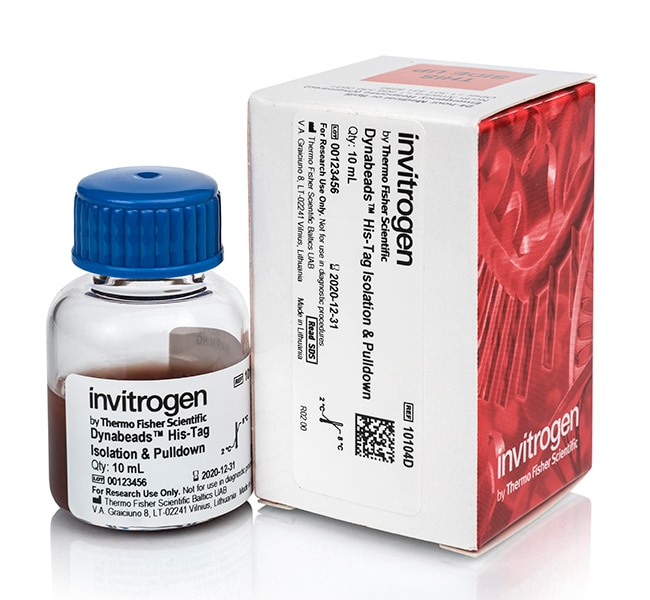
Dynabeads™ His-Tag Isolation and Pulldown
Dynabeads™ His-Tag Isolation and Pulldown beads are 1-μm monosized, monodispersed, superparamagnetic beads with an NTA-Cobalt-based ligand which has a high了解更多信息
Have Questions?
更改视图

| 货号 | 数量 |
|---|---|
| 10104D | 10 mL |
| 10103D | 2 mL |
货号 10104D
价格(CNY)
9,369.00
飞享价
Ends: 31-Dec-2026
12,492.00共减 3,123.00 (25%)
Each
数量:
10 mL
价格(CNY)
9,369.00
飞享价
Ends: 31-Dec-2026
12,492.00共减 3,123.00 (25%)
Each
Dynabeads™ His-Tag Isolation and Pulldown beads are 1-μm monosized, monodispersed, superparamagnetic beads with an NTA-Cobalt-based ligand which has a high affinity towards His-tags and similar structures on molecular targets. Their small but uniform bead size presents a high surface area per mg beads and a correspondingly high capacity for the target molecule. They enable single-step isolation of tagged molecules in manual or automated workflows that helps ensure good recovery of the target. Dynabeads His-Tag Isolation and Pulldown beads can also be a great starting point for other advanced experimental approaches where solid magnetic support is needed.
Benefits of Dynabeads His-Tag and Pulldown beads include:
• Performance—high sensitivity and reproducibility securing consistent results
• Efficiency—fast binding kinetics and high binding capacity
• Flexibility—flexible protocols with gentle and efficient liquid-phase reaction kinetics
• Automation-ready—automation protocols available with the KingFisher Purification instruments
Good signal-to-noise for numerous applications
Dynabeads His-Tag Isolation and Pulldown beads are an ideal tool for isolation of tagged recombinant proteins. They are also suited for other applications with high signal-to-noise requirements. Using the principles of immobilized metal affinity binding together with the inert surface of Dynabeads magnetic beads helps ensure a clean capture with extremely low carryover of unwanted proteins. Since the bead surface is loaded with cobalt ions, it is also possible to make a stable and lasting bond with the target molecule through oxidation if the downstream applications require it. The beads are added to the solution containing the target and mixed for 5-10 minutes. After washing, the target is eluted off and ready for downstream applications.
More than just a pulldown
In addition to being a great tool for protein pulldown and isolation, the Dynabeads His-Tag Isolation and Pulldown beads can serve as a platform for target immobilization. The bead carries cobalt Co2+ ions, so it is possible to cement the bond between the bead and the target just by using mildly oxidative conditions, such as 10 mM hydrogen peroxide for 30–60 minutes. This oxidizes cobalt to the Co3+ state, making the connection between the bead and the target permanent. It will not elute in the commonly used elution buffers for IMAC. This can later be used for applications requiring a strongly bound target, without the risk of reduced target yield.
Automation-ready for use with KingFisher purification systems
The 1-μm magnetic beads are ideal for high-throughput enrichment. This process can be automated using any of our KingFisher sample purification systems or liquid handlers.
Commercial supply
Our manufacturing sites are ISO 13485-certified. Bead characteristics and manufacturing conditions help ensure consistency and batch reproducibility making them an ideal choice for commercial supply. If you are in the process of customizing Dynabeads His-Tag Isolation and Pulldown beads in a commercial product or service or need a larger bulk volume of this product, please contact us at oemdynal@lifetech.com or see our Dynabeads OEM page.
Learn more about Dynabeads magnetic beads and KingFisher Sample Purification Systems:
• See our immunoprecipitation selection table, data, and references
• Dynabeads magnetic beads selection guide
• See magnets for Dynabeads magnetic beads separations
• KingFisher automation protocols
• Watch a video about the KingFisher Flex instrument
仅供科研使用。不可用于诊断程序。
规格
结合属性1.6 mg of a 28 kDa histidine-tagged protein/mL (40 mg) beads
认证/合规ISO9001 和 ISO13485
颜色Brown
最大浓度40 mg/mL
直径(公制)1 μm
最终产品类型His-Tagged Protein
适用于(应用)Isolation of His-tagged Recombinant Proteins
适用于(设备)KingFisher Sample Purification System, DynaMag magnets
产品规格Magnetic beads
高通量能力兼容高通量应用
配基类型Nitrilotriacetic acid (NTA)
材料磁性聚苯乙烯
数量10 mL
调控状态RUO
样品类型Cell Cultures, Tissue Digests, Intact Proteins, Cell Lysates, Cell Extracts
有效期自生产之日起 36 个月
运输条件室温
足够用于200 Tests
表面功能基团Cobalt-based immobilized metal affinity
靶标His-tagged proteins
产品线Dynabeads
类型磁珠
Unit SizeEach
内容与储存
Dynabeads His-Tag Isolation and Pulldown beads are supplied in 20% ethanol. Store at 2°C to 8°C.
常见问题解答 (FAQ)
我的Dynabeads磁珠不能很好地吸附到磁力架上,对此你们有什么建议吗?
我想要分离较长的双链DNA片段,你们有什么产品可以推荐?
我能否使用Dynabeads磁珠分离单链DNA模板?
什么是磁化率?
我如何确定Dynabeads磁珠的偶联效率?
引用和文献 (1)
引用和文献
Abstract
Resolving cadherin interactions and binding cooperativity at the single-molecule level.
Journal:Proc Natl Acad Sci U S A
PubMed ID:19114658
The cadherin family of Ca(2+)-dependent cell adhesion proteins are critical for the morphogenesis and functional organization of tissues in multicellular organisms, but the molecular interactions between cadherins that are at the core of cell-cell adhesion are a matter of considerable debate. A widely-accepted model is that cadherins adhere in 3