Search


引用和文献 (3)
Gibco™
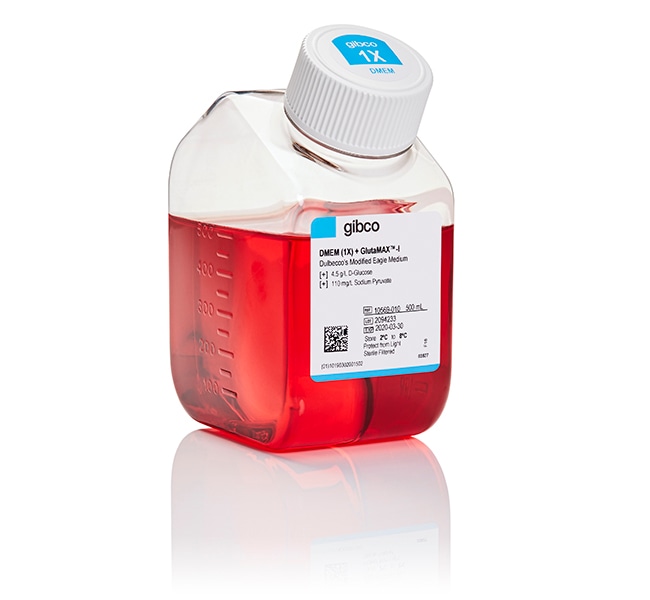
DMEM,高糖,GlutaMAX™ 添加剂,丙酮酸盐
DMEM (Dulbecco's Modified Eagle Medium)是一种广泛使用的基础培养基,可用于支持很多种类的哺乳动物细胞生长。已经在 DMEM 中成功培养出的细胞包括原代成纤维细胞、神经元、胶质细胞了解更多信息
Have Questions?
更改视图

| 货号 | 数量 |
|---|---|
| 10569010 | 500 mL |
| 10569044 | 10 x 500 mL |
| 10569069 | 5 L |
| 10569077 | 10 L |
货号 10569010
价格(CNY)
438.00
飞享价
Ends: 31-Dec-2026
548.00共减 110.00 (20%)
Each
数量:
500 mL
价格(CNY)
438.00
飞享价
Ends: 31-Dec-2026
548.00共减 110.00 (20%)
Each
DMEM (Dulbecco's Modified Eagle Medium)是一种广泛使用的基础培养基,可用于支持很多种类的哺乳动物细胞生长。已经在 DMEM 中成功培养出的细胞包括原代成纤维细胞、神经元、胶质细胞、HUVEC、平滑肌细胞,以及 HeLa、293、Cos-7 和 PC-12 等细胞系。针对广泛的细胞培养应用,提供了多种组分的 DMEM 改良培养基。使用培养基选择工具查找适合的配方。
这种 DMEM 的改良方式如下:
可提供完整配方。
使用 DMEM
DMEM 与其他培养基的不同之处在于其含有相当于初始 Eagle 最低必需培养基 4 倍浓度的氨基酸和维生素。DMEM 最初采用低浓度葡萄糖 (1 g/L) 和丙酮酸钠配制,但通常在含/不含丙酮酸钠的高糖环境下使用。含有 GlutaMAX™ 添加剂的 DMEM 培养基具有易于使用的包装形式,可显著减少有毒氨的积累,改善细胞活力和生长。DMEM 不含蛋白质、脂质或生长因子。因此,DMEM 需要补充营养成分,通常需要添加 10% 胎牛血清 (FBS)。DMEM 使用碳酸氢钠缓冲系统 (3.7 g/L),因此需要 5–10% CO2 的环境来维持生理 pH 值。
cGMP 生产和质量体系
DMEM 在位于纽约格兰德岛上符合 cGMP 要求的工厂内生产。该工厂是在FDA登记的医疗器械生产商,且通过ISO 13485标准认证。为确保供应链连续性,我们同时提供由我们的苏格兰工厂生产的等同 DMEM 产品 (31966-021)。该工厂也是在 FDA 注册的医疗器械生产商,且通过 ISO 13485 标准认证。
这种 DMEM 的改良方式如下:
| 包含 | 不含 |
| •高糖 | •HEPES: |
| •丙酮酸钠 | |
| •GlutaMAX™ | |
| • 酚红 |
可提供完整配方。
使用 DMEM
DMEM 与其他培养基的不同之处在于其含有相当于初始 Eagle 最低必需培养基 4 倍浓度的氨基酸和维生素。DMEM 最初采用低浓度葡萄糖 (1 g/L) 和丙酮酸钠配制,但通常在含/不含丙酮酸钠的高糖环境下使用。含有 GlutaMAX™ 添加剂的 DMEM 培养基具有易于使用的包装形式,可显著减少有毒氨的积累,改善细胞活力和生长。DMEM 不含蛋白质、脂质或生长因子。因此,DMEM 需要补充营养成分,通常需要添加 10% 胎牛血清 (FBS)。DMEM 使用碳酸氢钠缓冲系统 (3.7 g/L),因此需要 5–10% CO2 的环境来维持生理 pH 值。
cGMP 生产和质量体系
DMEM 在位于纽约格兰德岛上符合 cGMP 要求的工厂内生产。该工厂是在FDA登记的医疗器械生产商,且通过ISO 13485标准认证。为确保供应链连续性,我们同时提供由我们的苏格兰工厂生产的等同 DMEM 产品 (31966-021)。该工厂也是在 FDA 注册的医疗器械生产商,且通过 ISO 13485 标准认证。
仅用于研究和生产用途。不可用于临床诊断或直接用于人类或动物。
规格
细胞系HeLa、293、Cos-7 和 PC-12
细胞类型原代成纤维细胞、神经元、神经胶质细胞、HUVEC、平滑肌细胞
最大浓度1 X
培养环境CO2
适用于(应用)哺乳动物细胞培养
产品规格Bottle
生产质量cGMP-compliant under the ISO 13485 standard
产品线Gibco、GlutaMAX
产品类型DMEM(Dulbecco 改良 Eagle 培养基)
数量500 mL
有效期自生产之日起 12 个月
运输条件室温
分类非动物源性
培养类型Mammalian Cell Culture
形式液体
血清水平标准血清
无菌无菌过滤
灭菌方法无菌过滤
加有添加剂高糖, GlutaMAX, 酚红, 丙酮酸钠
不加添加剂不含 HEPES
Unit SizeEach
内容与储存
储存条件:2-8°C。避光储存
运输条件:环境
有效期:自生产之日起 12 个月
运输条件:环境
有效期:自生产之日起 12 个月
常见问题解答 (FAQ)
加入血清后的培养基可以使用多久?
我的培养基是室温条件下运送来的,但注明应保存于冷藏条件下。这会有影响么?
清除,缺少或降解谷氨酰胺或生长因子等促生长的基本成份会对培养物的生长速率造成影响么?
配方中含有Gibco GlutaMAX添加剂会改变L-谷氨酰胺的含量么?
我该如何去除细胞培养基中的支原体污染?
引用和文献 (3)
引用和文献
Abstract
Membrane topology influences N-glycosylation of the prion protein.
Journal:EMBO J
PubMed ID:11179215
'The glycosylation state of the glycosyl-phosphatidylinositol (GPI) anchored cellular prion protein (PrPC) can influence the formation of the disease form of the protein responsible for the neurodegenerative spongiform encephalopathies. We have investigated the role of membrane topology in the N-glycosylation of PrP by expressing a C-terminal transmembrane anchored form, PrP-CTM,
The protein SET binds the neuronal Cdk5 activator p35nck5a and modulates Cdk5/p35nck5a activity.
Journal:J Biol Chem
PubMed ID:11741927
'The neuronal Cdk5 kinase is composed of the catalytic subunit Cdk5 and the activator protein p35(nck5a) or its isoform, p39(nck5ai). To identify novel p35(nck5a)- and p39(nck5ai)-binding proteins, fragments of p35(nck5a) and p39(nck5ai) were utilized in affinity isolation of binding proteins from rat brain homogenates, and the isolated proteins were identified
Production of mice using iPS cells and tetraploid complementation.
Journal:Nat Protoc
PubMed ID:20431542
'Induced pluripotent stem cells (iPSCs) are considered to be an attractive alternative to embryonic stem cells (ESCs) and may provide great potential for clinical applications in regenerative medicine. Although possessing characteristics similar to ESCs, the true pluripotency of these newly studied iPSCs was not known because none of the previously