Search


引用和文献 (16)
Gibco™
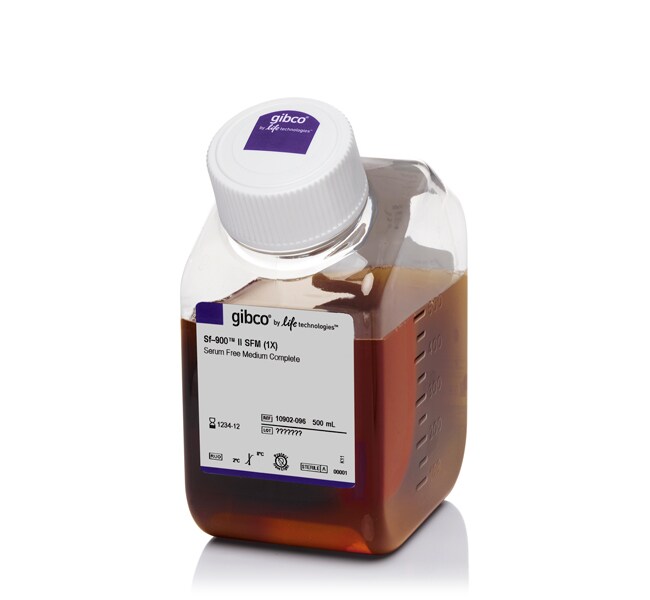
Sf-900™ II SFM
Sf-900™ II SFM 是一种无血清、无蛋白的昆虫细胞培养基,其经过优化,可用于草地贪夜蛾(Sf9 和 Sf21)细胞的生长和维持,并可利用杆状病毒表达载体系统 (BEVS)了解更多信息
Have Questions?
更改视图

| 货号 | 数量 |
|---|---|
| 10902096 | 500 mL |
| 10902088 | 1000 mL |
| 10902104 | 6 x 1 L |
货号 10902096
价格(CNY)
826.00
Each
数量:
500 mL
价格(CNY)
826.00
Each
Sf-900™ II SFM 是一种无血清、无蛋白的昆虫细胞培养基,其经过优化,可用于草地贪夜蛾(Sf9 和 Sf21)细胞的生长和维持,并可利用杆状病毒表达载体系统 (BEVS) 大规模生产重组蛋白。该培养基适用于悬浮和单层培养方法,并支持其他鳞翅目昆虫细胞系的生长。Sf-900™ II SFM 特点:
•优异的长期、高密度生长
• 经优化用于重组蛋白生产
• 无血清、无蛋白、即用型配方
• 可在生物反应器中扩展
优异的长期、高密度生长
草地贪夜蛾 (Sf9) 细胞在 Sf-900™ II SFM 中生长达到最大细胞密度 9 至 12 x 106 个细胞/mL,与竞争剂配方和 Grace 培养基(参见产品手册)相比显著改善。使用 Lymantria dispar(舞毒蛾)和 Trichoplusia ni(Tn-368;粉纹夜蛾)细胞系还观察到最大细胞密度增加 20–100%。Sf-900™ II SFM 能够支持培养物传代 >20 代。
经优化用于重组蛋白生产
传统上,使用补充有 10% FBS 的 Grace 培养基进行重组蛋白表达。Sf-900™ II SFM 是一种改善的无血清、无蛋白培养基,设计用于培养 Sf9 和其他鳞翅目昆虫细胞系以及生产昆虫病毒和 rDNA 蛋白。
无血清、无蛋白、即用型配方
Sf-900™ II SFM 是一种无血清、无蛋白培养基,可更容易地纯化您的目标蛋白。Sf-900™ II SFM 为即用型;不需要添加血清、谷氨酰胺或表面活性剂。适应其他市售无血清培养基的细胞可直接加入 Sf-900™ II SFM 传代培养,通常无需进一步适应。细胞通常需要适应一些含血清配方。
可在生物反应器中扩展
使用 5 L Celligen™ 生物反应器证明了 Sf-900™ II SFM 在大规模细胞培养系统中的实用性。成功感染 rAcNPV 产生 rβ-Gal 和 rEPO(参见产品手册)。
产品用途
在生产过程中使用 Gibco™ Sf-900 II SFM 并已向 FDA 提交申请的客户可以向我们索取授权使用书以便引用我们的 II 类 药物主文件 (DMF)。
cGMP 生产和质量体系
为确保供应链的稳定,我们在位于纽约格兰德岛和英国苏格兰的两个独立工厂内生产 Sf-900 II SFM。两家工厂均符合 cGMP 生产要求,并通过 ISO 13485 认证,是在 FDA 注册的医疗器械生产商。
•优异的长期、高密度生长
• 经优化用于重组蛋白生产
• 无血清、无蛋白、即用型配方
• 可在生物反应器中扩展
优异的长期、高密度生长
草地贪夜蛾 (Sf9) 细胞在 Sf-900™ II SFM 中生长达到最大细胞密度 9 至 12 x 106 个细胞/mL,与竞争剂配方和 Grace 培养基(参见产品手册)相比显著改善。使用 Lymantria dispar(舞毒蛾)和 Trichoplusia ni(Tn-368;粉纹夜蛾)细胞系还观察到最大细胞密度增加 20–100%。Sf-900™ II SFM 能够支持培养物传代 >20 代。
经优化用于重组蛋白生产
传统上,使用补充有 10% FBS 的 Grace 培养基进行重组蛋白表达。Sf-900™ II SFM 是一种改善的无血清、无蛋白培养基,设计用于培养 Sf9 和其他鳞翅目昆虫细胞系以及生产昆虫病毒和 rDNA 蛋白。
无血清、无蛋白、即用型配方
Sf-900™ II SFM 是一种无血清、无蛋白培养基,可更容易地纯化您的目标蛋白。Sf-900™ II SFM 为即用型;不需要添加血清、谷氨酰胺或表面活性剂。适应其他市售无血清培养基的细胞可直接加入 Sf-900™ II SFM 传代培养,通常无需进一步适应。细胞通常需要适应一些含血清配方。
可在生物反应器中扩展
使用 5 L Celligen™ 生物反应器证明了 Sf-900™ II SFM 在大规模细胞培养系统中的实用性。成功感染 rAcNPV 产生 rβ-Gal 和 rEPO(参见产品手册)。
产品用途
在生产过程中使用 Gibco™ Sf-900 II SFM 并已向 FDA 提交申请的客户可以向我们索取授权使用书以便引用我们的 II 类 药物主文件 (DMF)。
cGMP 生产和质量体系
为确保供应链的稳定,我们在位于纽约格兰德岛和英国苏格兰的两个独立工厂内生产 Sf-900 II SFM。两家工厂均符合 cGMP 生产要求,并通过 ISO 13485 认证,是在 FDA 注册的医疗器械生产商。
仅供科研使用。不可用于诊断程序。
规格
细胞系Sf21, Sf9
细胞类型昆虫细胞
产品线Gibco, Sf-900
产品类型昆虫细胞无血清培养基 (SFM)
数量500 mL
运输条件室温
种属草地贪夜蛾 (S. frugiperda, Spodoptera frugiperda)
分类无蛋白, 无血清
形式液体
血清水平无血清
加有添加剂谷氨酰胺
Unit SizeEach
内容与储存
储存条件:2°C 至 8°C。避光储存
运输条件:环境
有效期:自生产之日起 12 个月
运输条件:环境
有效期:自生产之日起 12 个月
常见问题解答 (FAQ)
昆虫细胞培养可使用哪些种类和浓度的杀菌剂?
在将血清加入我的培养基之前,是否需要对其进行热灭活操作?
你们是否提供无血清的昆虫培养基?
How do I adapt my cells to serum-free medium?
Why is it necessary to gradually adapt the cells to serum-free medium?
引用和文献 (16)
引用和文献
Abstract
Hydrolysis of biological peptides by human angiotensin-converting enzyme-related carboxypeptidase.
Journal:J Biol Chem
PubMed ID:11815627
'Human angiotensin-converting enzyme-related carboxypeptidase (ACE2) is a zinc metalloprotease whose closest homolog is angiotensin I-converting enzyme. To begin to elucidate the physiological role of ACE2, ACE2 was purified, and its catalytic activity was characterized. ACE2 proteolytic activity has a pH optimum of 6.5 and is enhanced by monovalent anions, which
hsp90 is required for heme binding and activation of apo-neuronal nitric-oxide synthase: geldanamycin-mediated oxidant generation is unrelated to any action of hsp90.
Journal:J Biol Chem
PubMed ID:11923316
'It is established that neuronal NO synthase (nNOS) is associated with the chaperone hsp90, although the functional role for this interaction has not been defined. We have discovered that inhibition of hsp90 by radicicol or geldanamycin nearly prevents the heme-mediated activation and assembly of heme-deficient apo-nNOS in insect cells. This
The major conformational IgE-binding epitopes of hevein (Hev b6.02) are identified by a novel chimera-based allergen epitope mapping strategy.
Journal:J Biol Chem
PubMed ID:11909866
'A novel approach to localize and reconstruct conformational IgE-binding epitope regions of hevein (Hev b6.02), a major natural rubber latex allergen, is described. An antimicrobial protein (AMP) from the amaranth Amaranthus caudatus was used as an immunologically non-IgE-binding adaptor molecule to which terminal or central parts of hevein were fused.
Enhancing yield of infectious Bursal disease virus structural proteins in baculovirus expression systems: focus on media, protease inhibitors, and dissolved oxygen.
Journal:Biotechnol Prog
PubMed ID:10585191
'Structural proteins of the poultry pathogen, infectious bursal disease virus (IBDV), were expressed in the baculovirus/insect cell expression system. To date, several reports have indicated that animal virus structural proteins are expressed only at low yield in this system. In this article, several factors were examined to enhance yield. These
Crystal Structure of Imaginal Disc Growth Factor-2. A MEMBER OF A NEW FAMILY OF GROWTH-PROMOTING GLYCOPROTEINS FROM DROSOPHILA MELANOGASTER.
Journal:J Biol Chem
PubMed ID:11821393
'Imaginal disc growth factor-2 (IDGF-2) is a member of a recently described family of Drosophila melanogaster-soluble polypeptide growth factors that promote cell proliferation in imaginal discs. Although their precise mode of action has not been established, IDGFs cooperate with insulin in stimulating the growth of imaginal disc cells. We report