Search


引用和文献 (6)
Gibco™
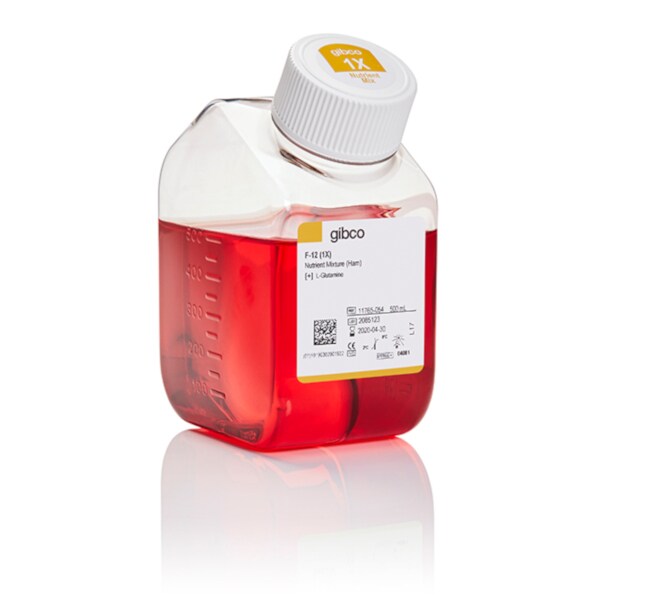
Ham's F-12 营养混合物
Ham's F-12 营养混合物 (F-12) 设计用于中国仓鼠卵巢 (CHO) 细胞的无血清单细胞铺板。自此之后,F-12 已用于 CHO了解更多信息
Have Questions?
更改视图

| 货号 | 数量 |
|---|---|
| 11765062 | 10 x 500 mL |
| 11765054 | 500 mL |
| 11765047 | 1000 mL |
| 11765070 | 6 x 1000 mL |
货号 11765062
价格(CNY)
3,735.00
Online exclusive
Ends: 31-Dec-2026
4,669.00共减 934.00 (20%)
Each
数量:
10 x 500 mL
价格(CNY)
3,735.00
Online exclusive
Ends: 31-Dec-2026
4,669.00共减 934.00 (20%)
Each
Ham's F-12 营养混合物 (F-12) 设计用于中国仓鼠卵巢 (CHO) 细胞的无血清单细胞铺板。自此之后,F-12 已用于 CHO 培养物的无血清生长以及其他哺乳动物细胞的添加血清生长,包括软骨细胞和大鼠前列腺上皮细胞。针对广泛的细胞培养应用,提供了多种 F-12 改良培养基。使用培养基选择工具查找适合的配方。
这种 Ham's F-12 的改良方式如下:
可提供完整配方。
F-12 的使用
与其他基础培养基相比,F-12 含有更广泛的成分,包括锌、腐胺、次黄嘌呤和胸苷。F-12 不含蛋白质或生长因子。因此,F-12 需要添加剂,通常采用 10%胎牛血清 (FBS)。F-12 使用碳酸氢钠缓冲系统 (1.176 g/L),因此需要 5–10% CO2 环境来维持生理 pH 值。
cGMP 生产和质量体系
为确保供应链连续性,我们在两家独立工厂生产 F-12;一家工厂位于纽约格兰德岛,另一家位于英国苏格兰。两家工厂均符合 cGMP 生产要求,并通过 ISO 13485 认证,是在 FDA 登记的医疗器械生产商。
这种 Ham's F-12 的改良方式如下:
| 包含 |
| •L-谷氨酰胺 |
| • 酚红 |
可提供完整配方。
F-12 的使用
与其他基础培养基相比,F-12 含有更广泛的成分,包括锌、腐胺、次黄嘌呤和胸苷。F-12 不含蛋白质或生长因子。因此,F-12 需要添加剂,通常采用 10%胎牛血清 (FBS)。F-12 使用碳酸氢钠缓冲系统 (1.176 g/L),因此需要 5–10% CO2 环境来维持生理 pH 值。
cGMP 生产和质量体系
为确保供应链连续性,我们在两家独立工厂生产 F-12;一家工厂位于纽约格兰德岛,另一家位于英国苏格兰。两家工厂均符合 cGMP 生产要求,并通过 ISO 13485 认证,是在 FDA 登记的医疗器械生产商。
规格
细胞系CHO、COS-7 和大鼠前列腺上皮细胞
细胞类型原代大鼠星形胶质细胞
最大浓度1 X
生产质量cGMP-compliant under the ISO 13485 standard
产品线Gibco
产品类型Ham's F-12 营养混合物
数量10 x 500 mL
有效期自生产之日起 12 个月
运输条件室温
分类非动物源性
形式液体
无菌无菌过滤
灭菌方法无菌过滤
加有添加剂谷氨酰胺, 酚红, 丙酮酸钠
不加添加剂不含 HEPES
Unit SizeEach
内容与储存
储存条件:2°C 至 8°C。避光
运输条件:环境
有效期:自生产之日起 12 个月
运输条件:环境
有效期:自生产之日起 12 个月
常见问题解答 (FAQ)
加入血清后的培养基可以使用多久?
我的培养基是室温条件下运送来的,但注明应保存于冷藏条件下。这会有影响么?
我该如何去除细胞培养基中的支原体污染?
我发现培养物的生长速率变缓。我该如何处理?
我的细胞不能贴附于培养容器。我该如何处理?
引用和文献 (6)
引用和文献
Abstract
Structural basis of G protein specificity of human endothelin receptors. A study with endothelinA/B chimeras.
Journal:J Biol Chem
PubMed ID:7730310
'The endothelin (ET) family of peptides acts via two subtypes of guanine nucleotide-binding regulatory protein (G protein)-coupled receptors termed ETA and ETB. ET-1 stimulated cAMP formation in Chinese hamster ovary (CHO) cells stably expressing human wild-type ETA (CHO/hETA cells) while it inhibited cAMP formation in CHO cells expressing human wild-type
Molecular cloning and functional analysis of the promoter of the human squalene synthase gene.
Journal:J Biol Chem
PubMed ID:7665618
'We have cloned and characterized the 5''-flanking region of the gene encoding human squalene synthase. We report here the promoter activity of successively 5''-truncated sections of a 1 kilobase of this region by fusing it to the coding region of a luciferase reporter gene. DNA segments of 200 base pairs
Isolation, characterization, and differentiation of human multipotent dermal stem cells.
Journal:Methods Mol Biol
PubMed ID:23483399
Skin, as the body's largest organ, has been extensively used to study adult stem cells. Most previous skin-related studies have focused on stem cells isolated from hair follicles and from keratinocytes. Here we present a protocol to isolate multipotent neural crest stem-like dermis-derived stem cells (termed dermal stem cells or
Functional analysis of the human D2 dopamine receptor missense variants.
Journal:J Biol Chem
PubMed ID:8824240
The human dopamine D2 receptor gene (DRD2) has three polymorphic variants that predict the amino acid substitutions Val96 --> Ala, Pro310 --> Ser, and Ser311 --> Cys in the receptor protein. We have investigated the ligand binding and signal transduction properties of these human D2 receptor variants by stably expressing
Requirement of tyrosine residues 333 and 338 of the growth hormone (GH) receptor for selected GH-stimulated function.
Journal:J Biol Chem
PubMed ID:7665593
We have examined the involvement of tyrosine residues 333 and 338 of the growth hormone (GH) receptor in the cellular response to GH. Stable Chinese hamster ovary (CHO) cell clones expressing a receptor with tyrosine residues at position 333 and 338 of the receptor substituted for phenylalanine (CHO-GHR1-638 Y333F, Y338F)