Search


引用和文献 (147)
Gibco™
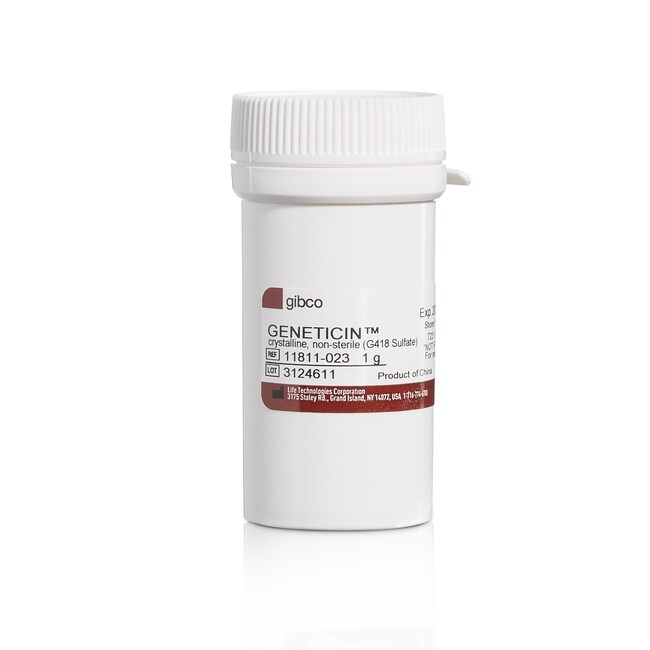
Geneticin™ 选择性抗生素(G418 硫酸盐),粉末
Geneticin™ 选择性抗生素(G418 硫酸盐)由细菌红橙小单孢菌生成,通过与原核和真核细胞中的核糖体结合,从而抑制蛋白合成。携带大肠杆菌 APH (3’) – I了解更多信息
Have Questions?
更改视图

| 货号 | 数量 |
|---|---|
| 11811023 | 1 g |
| 11811031 | 5 g |
| 11811098 | 25 g |
货号 11811023
价格(CNY)
1,077.00
Online exclusive
Ends: 31-Dec-2026
1,426.00共减 349.00 (24%)
Each
数量:
1 g
价格(CNY)
1,077.00
Online exclusive
Ends: 31-Dec-2026
1,426.00共减 349.00 (24%)
Each
Geneticin™ 选择性抗生素(G418 硫酸盐)由细菌红橙小单孢菌生成,通过与原核和真核细胞中的核糖体结合,从而抑制蛋白合成。携带大肠杆菌 APH (3’) – I 和 APH (3’) – II 抗性基因可获得 Geneticin™ 选择性抗生素(G418 硫酸盐)抗性。用于细菌时,Gibco™ Geneticin™ 选择性抗生素(G418 硫酸盐)用作选择性抗生素的浓度范围为 100 - 200 µg/mL,用于大多数哺乳动物细胞时,浓度范围为 200 – 500 µg/mL。本产品以粉末形式提供,应制成 10 – 50 mg/mL 水储备液。我们提供多种细胞培养抗生素,方便使用。
产品用途
仅供研究使用:不适用于动物或人诊断或治疗用途。
两地 cGMP 生产和质量体系
为确保供应链的稳定,同时在位于纽约格兰德岛和英国苏格兰的两家独立工厂生产 Gibco™ Geneticin™ 选择性抗生素(G418 硫酸盐)。两家工厂均符合 cGMP 生产要求,并通过 ISO 13485 认证,是在 FDA 注册的医疗器械生产商。
产品用途
仅供研究使用:不适用于动物或人诊断或治疗用途。
两地 cGMP 生产和质量体系
为确保供应链的稳定,同时在位于纽约格兰德岛和英国苏格兰的两家独立工厂生产 Gibco™ Geneticin™ 选择性抗生素(G418 硫酸盐)。两家工厂均符合 cGMP 生产要求,并通过 ISO 13485 认证,是在 FDA 注册的医疗器械生产商。
仅供科研使用。不可用于诊断程序。
规格
细胞类型真核细胞、原核细胞
最大浓度10-50 μg/mL
适用于(应用)真核细胞选择⁄稳定细胞系生成
产品线Geneticin
数量1 g
有效期24 个月
运输条件室温
形式粉末
产品类型Geneticin
无菌Non-sterile
Unit SizeEach
内容与储存
储存条件:15 至 30°C
运输条件:环境条件
有效期:自生产之日起 24 个月
运输条件:环境条件
有效期:自生产之日起 24 个月
常见问题解答 (FAQ)
哺乳动物细胞的稳转筛选过程中可一起使用哪些种类的抗生素(Geneticin,Zeocin,潮霉素B,杀稻瘟素和嘌呤霉素)?
我该如何对我的培养物去污染?
你们提供哪些抗生素来帮助用户控制或减少细胞培养中的污染情况?
Which of your antibiotics (Geneticin, Zeocin, Hygromycin B, Blasticidin, and Puromycin) can be used together for stable selection in mammalian cells?
Can Neomycin be used in mammalian selection? Can Neomycin be used instead of Kanamycin in bacterial selection?
引用和文献 (147)
引用和文献
Abstract
Cloning and functional expression of a thyrotropin receptor cDNA from rat fat cells.
Journal:J Biol Chem
PubMed ID:7738021
Thyrotropin receptor (TSH-R) has been thought to be thyroid-specific, but, by Northern blot analysis, we found that rat adipose tissue expressed TSH-R mRNAs in amounts approaching those in the thyroid. To investigate the function of TSH-R from adipose tissue, we screened a rat fat cell lambda gt11 cDNA library for
Role of tyrosine kinase Jak2 in prolactin-induced differentiation and growth of mammary epithelial cells.
Journal:J Biol Chem
PubMed ID:11821424
Genetic studies in mice have established a critical role for prolactin receptors and transcription factor Stat5 in mammary gland differentiation. However, the enzymatic coupling between prolactin receptors and Stat5 in this process has not been established. In addition to Jak2, several other tyrosine kinases reportedly also are associated with prolactin
DBC2, a candidate for a tumor suppressor gene involved in breast cancer.
Journal:Proc Natl Acad Sci U S A
PubMed ID:12370419
A previously uncharacterized gene, DBC2 (deleted in breast cancer), was cloned from a homozygously deleted region at human chromosome 8p21. DBC2 contains a highly conserved RAS domain and two putative protein interacting domains. Our analyses indicate that DBC2 is the best candidate tumor suppressor gene from this region. It lies
The connecting segment between both epidermal growth factor-like domains in blood coagulation factor IX contributes to stimulation by factor VIIIa and its isolated A2 domain.
Journal:J Biol Chem
PubMed ID:11925427
The light chain of activated factor IX comprises multiple interactions between both epidermal growth factor-like domains that contribute to enzymatic activity and binding of factor IXa to its cofactor factor VIIIa. To investigate the association between factor IXa-specific properties and surface-exposed structure elements, chimeras were constructed in which the interconnection
A functional role for the B56 alpha-subunit of protein phosphatase 2A in ceramide-mediated regulation of Bcl2 phosphorylation status and function.
Journal:J Biol Chem
PubMed ID:11929874
'Recently it has been shown that the potent apoptotic agent ceramide activates a mitochondrial protein phosphatase 2A (PP2A) and promotes dephosphorylation of the anti-apoptotic molecule Bcl2 (Ruvolo, P. P., Deng, X., Ito, T., Carr, B. K., and May, W. S. (1999) J. Biol. Chem. 274, 20296-20300). In cells expressing Bcl2,