Search


引用和文献 (5)
Gibco™
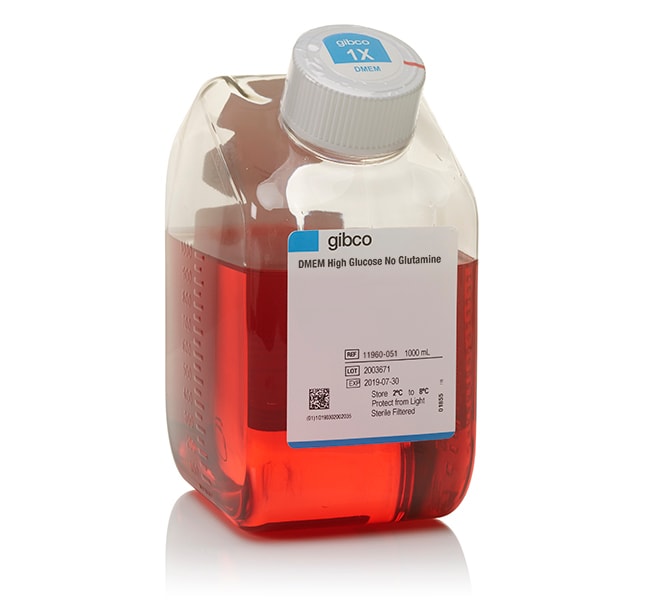
DMEM,高糖,不含谷氨酰胺
DMEM (Dulbecco's Modified Eagle Medium)是一种广泛使用的基础培养基,可用于支持很多种类的哺乳动物细胞生长。已经在 DMEM 中成功培养出的细胞包括原代成纤维细胞、神经元、胶质细胞了解更多信息
Have Questions?
更改视图

| 货号 | 数量 |
|---|---|
| 11960051 | 1000 mL |
| 11960044 | 500 mL |
| 11960069 | 10 x 500 mL |
| 11960077 | 6 x 1000 mL |
货号 11960051
价格(CNY)
654.00
Online exclusive
Ends: 31-Dec-2026
817.00共减 163.00 (20%)
Each
数量:
1000 mL
价格(CNY)
654.00
Online exclusive
Ends: 31-Dec-2026
817.00共减 163.00 (20%)
Each
DMEM (Dulbecco's Modified Eagle Medium)是一种广泛使用的基础培养基,可用于支持很多种类的哺乳动物细胞生长。已经在 DMEM 中成功培养出的细胞包括原代成纤维细胞、神经元、胶质细胞、HUVEC、平滑肌细胞,以及 HeLa、293、Cos-7 和 PC-12 等细胞系。针对广泛的细胞培养应用,提供了多种组分的 DMEM 改良培养基。使用培养基选择工具查找适合的配方。
这种 DMEM 的改良方式如下:
可提供完整配方。
使用 DMEM
DMEM 与其他培养基的不同之处在于其含有相当于初始 Eagle 最低必需培养基 4 倍浓度的氨基酸和维生素。DMEM 最初采用低浓度葡萄糖 (1 g/L) 和丙酮酸钠配制,但通常在含/不含丙酮酸钠的高糖环境下使用。DMEM 不含蛋白质、脂质或生长因子。因此,DMEM 需要补充营养成分,通常需要添加 10% 胎牛血清 (FBS)。DMEM 使用碳酸氢钠缓冲系统 (3.7 g/L),因此需要 5–10% CO2 的环境来维持生理 pH 值。
cGMP 生产和质量体系
DMEM 在位于纽约格兰德岛上符合 cGMP 要求的工厂内生产。该工厂是在FDA登记的医疗器械生产商,且通过ISO 13485标准认证。
这种 DMEM 的改良方式如下:
| 包含 | 不含 |
| •高糖 | •L-谷氨酰胺 |
| •酚红 | •丙酮酸钠 |
| • HEPES |
可提供完整配方。
使用 DMEM
DMEM 与其他培养基的不同之处在于其含有相当于初始 Eagle 最低必需培养基 4 倍浓度的氨基酸和维生素。DMEM 最初采用低浓度葡萄糖 (1 g/L) 和丙酮酸钠配制,但通常在含/不含丙酮酸钠的高糖环境下使用。DMEM 不含蛋白质、脂质或生长因子。因此,DMEM 需要补充营养成分,通常需要添加 10% 胎牛血清 (FBS)。DMEM 使用碳酸氢钠缓冲系统 (3.7 g/L),因此需要 5–10% CO2 的环境来维持生理 pH 值。
cGMP 生产和质量体系
DMEM 在位于纽约格兰德岛上符合 cGMP 要求的工厂内生产。该工厂是在FDA登记的医疗器械生产商,且通过ISO 13485标准认证。
仅用于研究和生产用途。不可用于临床诊断或直接用于人类或动物。
规格
细胞系HeLa、293、Cos-7 和 PC-12
细胞类型原代成纤维细胞、神经元、神经胶质细胞、HUVEC、平滑肌细胞
最大浓度1 X
培养环境CO2
适用于(应用)Mammalian Cell Culture
产品规格Bottle
生产质量cGMP-compliant under the ISO 13485 standard
产品线Gibco
产品类型DMEM(Dulbecco 改良 Eagle 培养基)
数量1000 mL
有效期自生产之日起 12 个月
运输条件室温
分类非动物源性
培养类型Mammalian Cell Culture
形式液体
血清水平标准血清
无菌无菌过滤
灭菌方法无菌过滤
加有添加剂高糖, 酚红
不加添加剂无谷氨酰胺, 不含 HEPES, 不含丙酮酸钠
Unit SizeEach
内容与储存
储存条件:2-8°C。避光储存
运输条件:环境
有效期:自生产之日起 12 个月
运输条件:环境
有效期:自生产之日起 12 个月
常见问题解答 (FAQ)
What is the manganese concentration in DMEM? Do you offer manganese-free DMEM?
引用和文献 (5)
引用和文献
Abstract
Fibroblast growth factor receptor-1 signaling induces osteopontin expression and vascular smooth muscle cell-dependent adventitial fibroblast migration in vitro.
Journal:Circulation
PubMed ID:12176960
'BACKGROUND: Increased expression of osteopontin (OPN), fibroblast growth factors (FGFs), and their type-1 receptor (FGFR-1) is associated with neointima formation and atherosclerosis. This study tested the hypothesis that ligand activation of FGFR-1 stimulates OPN expression in rat aortic smooth muscle cells (RASMCs), explored the signaling pathway involved, and assessed the
Interaction codes within the family of mammalian Phox and Bem1p domain-containing proteins.
Journal:J Biol Chem
PubMed ID:12813044
'The Phox and Bem1p (PB1) domain constitutes a recently recognized protein-protein interaction domain found in the atypical protein kinase C (aPKC) isoenzymes, lambda/iota- and zeta PKC; members of mitogen-activated protein kinase (MAPK) modules like MEK5, MEKK2, and MEKK3; and in several scaffold proteins involved in cellular signaling. Among the last
Ascorbic-acid transporter Slc23a1 is essential for vitamin C transport into the brain and for perinatal survival.
Journal:Nat Med
PubMed ID:11984580
The only proven requirement for ascorbic acid (vitamin C) is in preventing scurvy, presumably because it is a cofactor for hydroxylases required for post-translational modifications that stabilize collagen. We have created mice deficient in the mouse ortholog (solute carrier family 23 member 1 or Slc23a1) of a rat ascorbic-acid transporter,
Characterization of the 46-kDa intermediates of matrix metalloproteinase 3 (stromelysin 1) obtained by site-directed mutation of phenylalanine 83.
Journal:J Biol Chem
PubMed ID:8631880
The precursor of matrix metalloproteinase 3 (MMP-3/ stromelysin 1) is activated in vitro by proteinases or mercurial compounds by stepwise processes which include the initial formation of short-lived intermediates and the subsequent intermolecular cleavage of the His82-Phe83 bond to generate the fully activated mature MMP-3 (Nagase, H., Enghild, J. J.,
Statin prevents tissue factor expression in human endothelial cells: role of Rho/Rho-kinase and Akt pathways.
Journal:Circulation
PubMed ID:11956113
BACKGROUND: Tissue factor plays a pivotal role in thrombus formation in acute coronary syndromes. However, the regulatory mechanisms underlying tissue factor expression are poorly understood. Statins are effective in patients with acute coronary syndromes. Hence, the aim of this study was to clarify in human endothelial cells the signaling pathways