Search


引用和文献 (4)
Gibco™
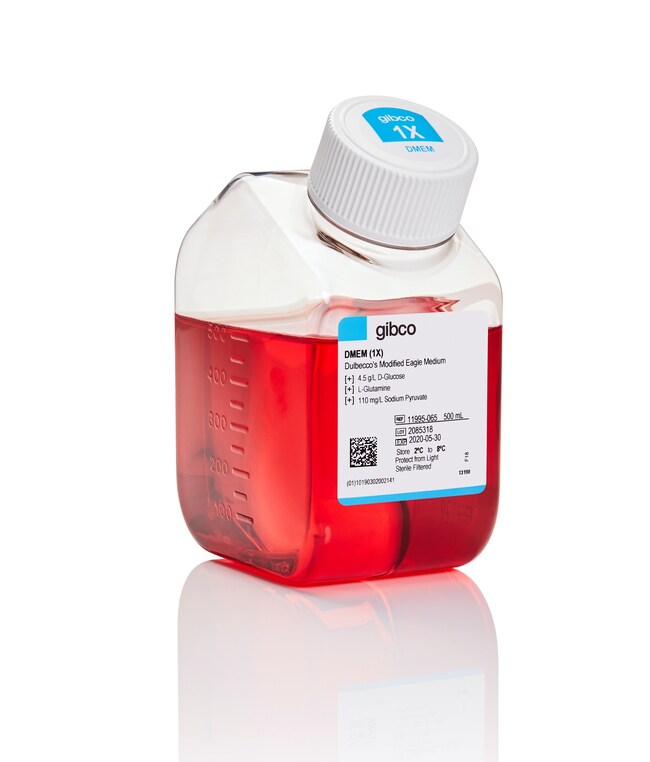
DMEM,高糖,含丙酮酸盐
DMEM (Dulbecco's Modified Eagle Medium)是一种广泛使用的基础培养基,可用于支持很多种类的哺乳动物细胞生长。已经在 DMEM 中成功培养出的细胞包括原代成纤维细胞、神经元、胶质细胞了解更多信息
Have Questions?
更改视图

| 货号 | 数量 |
|---|---|
| 11995073 | 10 x 500 mL |
| 11995065 | 500 mL |
| 11995040 | 1000 mL |
| 11995081 | 6 x 1000 mL |
| 11995115 | 5 L |
| 11995123 | 10 L |
货号 11995073
价格(CNY)
3,362.00
飞享价
Ends: 31-Dec-2026
4,202.00共减 840.00 (20%)
Each
数量:
10 x 500 mL
价格(CNY)
3,362.00
飞享价
Ends: 31-Dec-2026
4,202.00共减 840.00 (20%)
Each
DMEM (Dulbecco's Modified Eagle Medium)是一种广泛使用的基础培养基,可用于支持很多种类的哺乳动物细胞生长。已经在 DMEM 中成功培养出的细胞包括原代成纤维细胞、神经元、胶质细胞、HUVEC、平滑肌细胞,以及 HeLa、293、Cos-7 和 PC-12 等细胞系。Life Technologies 针对广泛的细胞培养应用,提供了大量的 DMEM 改良培养基。使用培养基选择工具查找适合的配方。
可提供完整配方。
使用 DMEM
DMEM 与其他培养基的不同之处在于其含有相当于初始 Eagle 最低必需培养基 4 倍浓度的氨基酸和维生素。DMEM 最初采用低浓度葡萄糖 (1 g/L) 和丙酮酸钠配制,但通常在含/不含丙酮酸钠的高糖环境下使用。DMEM 不含蛋白质、脂质或生长因子。因此,DMEM 需要补充剂,通常添加 10% 胎牛血清 (FBS)。DMEM 使用碳酸氢钠缓冲系统 (3.7 g/L),因此需要 5–10% CO2 的环境来维持生理 pH 值。
cGMP 生产和质量体系
DMEM 在位于纽约格兰德岛上符合 cGMP 要求的工厂内生产。该工厂是在FDA登记的医疗器械生产商,且通过ISO 13485标准认证。为确保供应链的稳定,Life Technologies 同时提供由我们的苏格兰工厂生产的相同 DMEM 产品 (41966-029)。后者亦是在FDA登记的医疗仪器生产商,且符合ISO 13485标准。
这种 DMEM 的改良方式如下:
| 包含 | 不含 |
| •高糖 | •HEPES: |
| •L-谷氨酰胺 | |
| •酚红 | |
| • 丙酮酸钠 |
可提供完整配方。
使用 DMEM
DMEM 与其他培养基的不同之处在于其含有相当于初始 Eagle 最低必需培养基 4 倍浓度的氨基酸和维生素。DMEM 最初采用低浓度葡萄糖 (1 g/L) 和丙酮酸钠配制,但通常在含/不含丙酮酸钠的高糖环境下使用。DMEM 不含蛋白质、脂质或生长因子。因此,DMEM 需要补充剂,通常添加 10% 胎牛血清 (FBS)。DMEM 使用碳酸氢钠缓冲系统 (3.7 g/L),因此需要 5–10% CO2 的环境来维持生理 pH 值。
cGMP 生产和质量体系
DMEM 在位于纽约格兰德岛上符合 cGMP 要求的工厂内生产。该工厂是在FDA登记的医疗器械生产商,且通过ISO 13485标准认证。为确保供应链的稳定,Life Technologies 同时提供由我们的苏格兰工厂生产的相同 DMEM 产品 (41966-029)。后者亦是在FDA登记的医疗仪器生产商,且符合ISO 13485标准。
仅用于研究和生产用途。不可用于临床诊断或直接用于人类或动物。
规格
细胞系HeLa、293、Cos-7 和 PC-12
细胞类型原代成纤维细胞、神经元、神经胶质细胞、HUVEC、平滑肌细胞
最大浓度1 X
培养环境CO2
适用于(应用)哺乳动物细胞培养
产品规格Bottles
葡萄糖浓度4500 mg/L
生产质量cGMP-compliant under the ISO 13485 standard
产品线Gibco
产品类型DMEM(Dulbecco 改良 Eagle 培养基)
数量10 x 500 mL
有效期自生产之日起 12 个月
运输条件环境
分类非动物源性
培养类型Mammalian Cell Culture
形式液体
血清水平标准血清
无菌无菌过滤
灭菌方法无菌过滤
加有添加剂高糖, 谷氨酰胺, 酚红, 丙酮酸钠
不加添加剂不含 HEPES
Unit SizeEach
内容与储存
储存条件:2°C 至 8°C(避光)
运输条件:环境
有效期:自生产之日起 12 个月
运输条件:环境
有效期:自生产之日起 12 个月
常见问题解答 (FAQ)
加入血清后的培养基可以使用多久?
我的培养基是室温条件下运送来的,但注明应保存于冷藏条件下。这会有影响么?
我该如何去除细胞培养基中的支原体污染?
我发现培养物的生长速率变缓。我该如何处理?
我的细胞不能贴附于培养容器。我该如何处理?
引用和文献 (4)
引用和文献
Abstract
Astrocytes in culture produce anandamide and other acylethanolamides.
Journal:J Biol Chem
PubMed ID:11916961
'Anandamide (arachidonylethanolamide) is an endocannabinoid that belongs to the acylethanolamide lipid family. It is produced by neurons in a calcium-dependent manner and acts through cannabinoid CB1 receptors. Other members of the acylethanolamide lipid family are also produced by neurons and act through G-protein-coupled receptors: homo-gamma-linolenylethanolamide (HEA) and docosatetraenylethanolamide (DEA) act
PRiMA: the membrane anchor of acetylcholinesterase in the brain.
Journal:Neuron
PubMed ID:11804574
'As a tetramer, acetylcholinesterase (AChE) is anchored to the basal lamina of the neuromuscular junction and to the membrane of neuronal synapses. We have previously shown that collagen Q (ColQ) anchors AChE at the neuromuscular junction. We have now cloned the gene PRiMA (proline-rich membrane anchor) encoding the AChE anchor
Isolation of muscle-derived stem/progenitor cells based on adhesion characteristics to collagen-coated surfaces.
Journal:Methods Mol Biol
PubMed ID:23400434
Our lab developed and optimized a method, known as the modified pre-plate technique, to isolate stem/progenitor cells from skeletal muscle. This method separates different populations of myogenic cells based on their propensity to adhere to a collagen I-coated surface. Based on their surface markers and stem-like properties, including self-renewal, multi-lineage
Neuromuscular electrical stimulation as a method to maximize the beneficial effects of muscle stem cells transplanted into dystrophic skeletal muscle.
Journal:PLoS One
PubMed ID:23526927
Cellular therapy is a potential approach to improve the regenerative capacity of damaged or diseased skeletal muscle. However, its clinical use has often been limited by impaired donor cell survival, proliferation and differentiation following transplantation. Additionally, functional improvements after transplantation are all-too-often negligible. Because the host microenvironment plays an important