Search


引用和文献 (26)
Gibco™
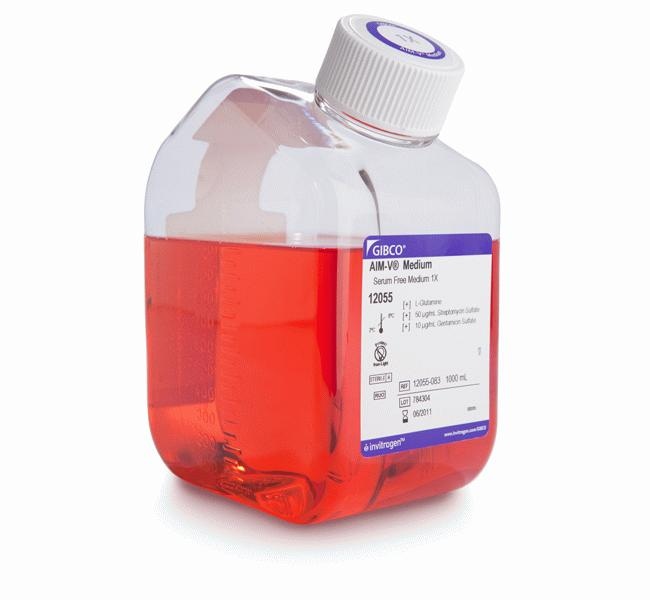
AIM V™ 培养基,液体(研究级)
含 L-谷氨酰胺、50 µg/mL 硫酸链霉素和 10 µg/mL 硫酸庆大霉素。了解更多信息
Have Questions?
更改视图

| 货号 | 数量 |
|---|---|
| 12055083 | 1000 mL |
| 12055091 | 500 mL |
货号 12055083
价格(CNY)
2,855.00
Each
数量:
1000 mL
价格(CNY)
2,855.00
Each
含 L-谷氨酰胺、50 µg/mL 硫酸链霉素和 10 µg/mL 硫酸庆大霉素。
仅供科研使用。不可用于诊断程序。
规格
细胞类型单核细胞、树突状细胞、T 细胞、杂交瘤细胞、PBMC、成纤维细胞、巨噬细胞、骨髓瘤细胞、淋巴细胞
所含抗生素硫酸链霉素、庆大霉素
产品线AIM V
产品类型无血清培养基 (SFM)
纯度或质量等级研究级
数量1000 mL
运输条件室温
培养类型哺乳动物细胞培养
形式液体
加有添加剂谷氨酰胺, 酚红, HSA
Unit SizeEach
内容与储存
避光储存在冷藏冰箱 (2-8°C) 中。
常见问题解答 (FAQ)
What is the difference between AIM V Medium (Cat. Nos. 12055083, 12055091) and CTS AIM V SFM (Cat. Nos. 0870112DK, 0870112BK)?
Which serum-free medium would you recommend for culture and expansion of mouse T cells?
引用和文献 (26)
引用和文献
Abstract
Low oxygen tension and autologous plasma enhance T-cell proliferation and CD49d expression density in serum-free media.
Journal:Cytotherapy
PubMed ID:11953028
'Background As cellular immunotherapy with ex vivo expanded cells becomes more widely used to treat a variety of illnesses, optimization of culture parameters, to maximize cell production and function, is essential for continued success. The effects of reduced oxygen tension and autologous plasma on T-cell expansion, receptor expression, apoptosis, and
Effects of interleukin 4 upon human tumoricidal cells obtained from patients bearing solid tumors.
Journal:J Leukoc Biol
PubMed ID:1991997
'The use of human interleukin 4 (IL4) in the generation of tumoricidal effector cells derived from cancer patients undergoing either interleukin 2/lymphokine activated killer cells (IL2/LAK) therapy or tumor derived activated cell (TDAC) therapy was examined in the present study. Human IL4 alone did not generate LAK cells from patients
T(84) epithelial cells respond to 5-hydroxytryptamine when grown in serum-free media.
Journal:Eur J Pharmacol
PubMed ID:10708712
The aim of this study was to establish the cause of insensitivity of T(84) human colonic epithelial cells to 5-hydroxytryptamine (5-HT). Monolayers of T(84) cells were placed in modified Ussing chambers for measurement of short-circuit current, an index of secretion. When grown in serum-supplemented media, T(84) cells gave secretory responses
Generation of human autologous melanoma-specific cytotoxic T cells from tumor-involved lymph nodes.
Journal:Mol Biother
PubMed ID:1910625
Cytotoxic T lymphocytes (CTL) specific for autologous human melanoma have been successfully generated in vitro from tumor bearing lymph nodes without any stimulation by the autologous tumor. Tumor-involved lymph node cells (LNC) were cultured in serum free medium (AIM-V) containing 1,000 U/ml of recombinant interleukin-2. The best expansion and specific
Extracellular mRNA induces dendritic cell activation by stimulating tumor necrosis factor-alpha secretion and signaling through a nucleotide receptor.
Journal:J Biol Chem
PubMed ID:11821398
We previously demonstrated that dendritic cell (DC) pulsing with antigen-encoded mRNA resulted in the loading of both major histocompatibility complex class I and II antigen presentation pathways and the delivery of an activation signal. Coculture of mRNA-pulsed DC with T cells led to the induction of a potent primary immune