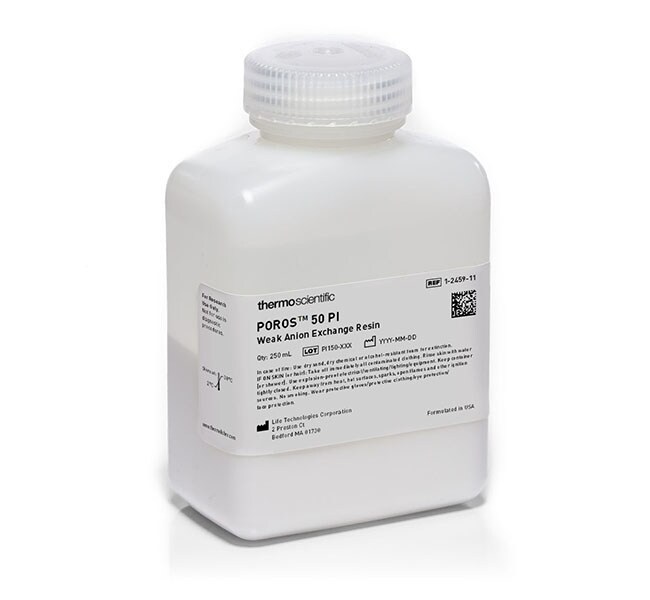
POROS™ 50 PI 弱阴离子交换树脂
Thermo Scientific™

POROS™ 50 PI 弱阴离子交换树脂

Applied Biosystems™ POROS™ 弱阴离子交换基质。POROS™ 50微米散装树脂适用于较低压力下,包括大规模下游生物工艺。POROS™ PI 基于一种聚乙烯亚胺官能团,该官能团可产生一种设计用于生物分子分离和纯化的高容量、高效色谱™了解更多信息
Have Questions?
更改视图buttonViewtableView
货号数量
1245911
又称 1-2459-11
250 mL
124590650 mL
1245907
又称 1-2459-07
1 L
1245909
又称 1-2459-09
5 L
1245908
又称 1-2459-08
10 L
货号 1245911
又称 1-2459-11
价格(CNY)
16,246.00
Each
添加至购物车
数量:
250 mL
价格(CNY)
16,246.00
Each
添加至购物车
Applied Biosystems™ POROS™ 弱阴离子交换基质。POROS™ 50微米散装树脂适用于较低压力下,包括大规模下游生物工艺。POROS™ PI 基于一种聚乙烯亚胺官能团,该官能团可产生一种设计用于生物分子分离和纯化的高容量、高效色谱™ 树脂。

POROS™ 高效色谱™ 基质和预填充色谱柱

用于分析至工艺规模分离的高效色谱树脂。
• 更高的生产率:与高效色谱™ 相关的高通量和高动态容量
• 化学稳定性:可侵入性清洗和消毒
• 增强了生物分子通路:通过大微孔(范围为 500-10000 Å)
• 聚苯乙烯二乙烯基苯粒子提供:产生稳健、易于填充的基质
• 可在较短的时间内开发出更好的分离方法:高效色谱树技术的速度可将数周实验缩短至短短几个小时的工作,因此,您有充足的时间来探索分离的所有变量

缩短样品制备时间

您可以用高速高效色谱技术替代多个样品制备步骤。比如,采用高流速处理稀释样品来替代使用大量物质的透析。在少量新缓冲液中进行洗脱可实现缓冲液交换和浓缩。

创建适用于更高效分析的新型检测方法

高效色谱技术不限于标准分离模式。酶和亲和配体都可被固定于POROS 介质上。通过将快速柱上蛋白酶切与快速柱上免疫检测和色谱分离相结合,可创建具有无限潜力的全新检测方法。

高容量、高分离度、高速
与传统色谱基质相比,POROS™ 高效色谱™ 树脂粒子设计有两类细微孔。大的“贯穿孔”允许微粒之间发生对流流动,将样品分子快速地运载至其内部小的“扩散”孔。通过减少发生扩散的距离,也减少了样品分子与内部结合位点相互作用需要的时间。扩散将不再被限制而流速会显著提高——同时不影响分辨率和容量。与传统介质的50到360 cm⁄hr的分离速度相比,其分离速度可达1,000至5000 cm⁄hr。
For Research Use Only. Not for use in diagnostic procedures.
规格
结合强度
孔径500 to 10,000 Å
数量250 mL
运输条件室温
固定相PI(聚乙烯亚胺)
形式悬浮液
产品线POROS™
类型树脂
Unit SizeEach
内容与储存
在室温下储存。

常见问题解答 (FAQ)

Are POROS analytical columns compatible with HPLC systems from Waters or Agilent?

All of the pre-packed POROS columns, regardless of column size or resin, have the same 10-32 female fittings on the column. Columns are compatible with Waters and Agilent HPLC systems. You will need 1/16 inch male fittings for the HPLC to attach the column.

Find additional tips, troubleshooting help, and resources within our Protein Purification and Isolation Support Center.

For any POROS analytical column, is the column compatible with an AKTA or Avant purification system?

All of the pre-packed columns, regardless column size or resin, have the same 10-32 female fittings on the column. They are all compatible with the AKTA instrument platform, however due to the column volume of the 2.1 mmD x 30 mmL columns (0.1 mL), these will not perform well in AKTA or Avant purification systems due to the relative size of the hold- up volume in these systems. The smallest column (PEEK or SS) that could feasibly be used in these systems is the 4.6mmD x 50mmL (0.8 mL) format.

Find additional tips, troubleshooting help, and resources within our Protein Purification and Isolation Support Center.

Are the pre-packed POROS CaptureSelect or any POROS analytical columns compatible with an UPLC or is the use of these columns limited to HPLC?

UPLC is typically described as chromatography with sub-2 µm particles, which drives higher efficiency/better separation independent of operating flow rate. As particle size decreases, backpressure increases so the UPLC systems tend to have higher pressure ratings compared to HPLC systems. The flow rates on UPLC systems would be sufficient for POROS columns. Pump capabilities are typically 0.1-1.0 mL/min, so not as fast as a HPLC, but sufficient. Hold-up volumes on UPLC systems are lower than HPLCs, so this can help with sensitivity and efficiency. So from a pressure and flow standpoint there should be no challenge to operate a POROS CaptureSelect column on a UPLC system.

That being said, care should be taken running POROS columns on UPLC systems. Higher pressure safety interlock MUST be set at the rated column pressure, typically 180 bar. HPLC column hardware is not rated to operate at the static pressures possible and typical on UPLC systems. A clog or the like on a UPLC system could generate unsafe pressures on any HPLC-rated column before the default UPLC safety pressure interlock is tripped.

Find additional tips, troubleshooting help, and resources within our Protein Purification and Isolation Support Center.

What is the physical or mechanical stability of POROS resins?

The physical stability of POROS resins is high. Customers have agitated, with overhead mixing and or bottom gassing for long periods of time (5-10 hours) and have performed hundreds of diaphragm pump passes during stall packs. Keep in mind that agitation with any device that creates grinding and sheer, such as with a magnetic stir bar, is not recommended for any type of resin.

Find additional tips, troubleshooting help, and resources within our Protein Purification and Isolation Support Center.

What should I do if a POROS column dries out or air is pumped onto the column?

POROS resins rehydrate quite well. Here is the procedure that we recommend:

1. Flow 5% ethanol over the column at ?350 cm/hour for 3 CVs, followed by water or 0.1 M sodium chloride at 300 cm/hour for 3 CVs.
2. If baseline noise is still present, flow 20% ethanol over the column at 300 cm/hour for 3 CVs, followed by water or 0.1 M sodium chloride at 300 cm/hour for 3 CVs.
3. If you have established column qualification tests and specifications, perform the tests after rewetting.

Find additional tips, troubleshooting help, and resources within our Protein Purification and Isolation Support Center.