Search


引用和文献 (10)
Gibco™
Advanced DMEM
Advanced DMEM (Dulbecco's Modified Eagle Medium) 是一种广泛使用的基础培养基,可在减少胎牛血清 (FBS) 添加量的情况下培养哺乳动物细胞。与经典了解更多信息
Have Questions?
更改视图

| 货号 | 数量 |
|---|---|
| 12491023 | 10 x 500 mL |
| 12491015 | 500 mL |
货号 12491023
价格(CNY)
5,885.00
Each
数量:
10 x 500 mL
价格(CNY)
5,885.00
Each
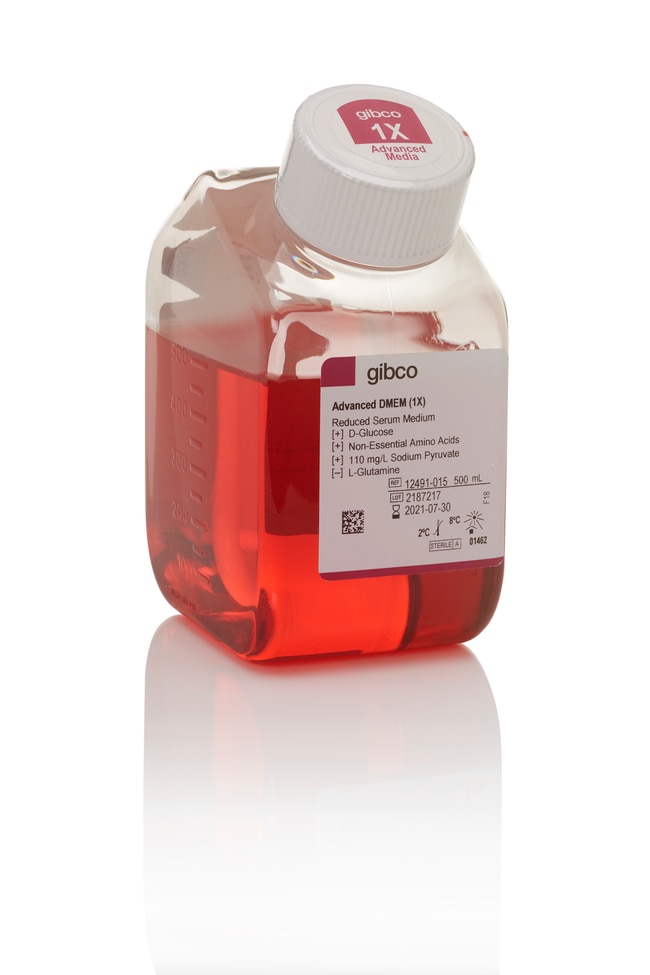
Advanced DMEM (Dulbecco's Modified Eagle Medium) 是一种广泛使用的基础培养基,可在减少胎牛血清 (FBS) 添加量的情况下培养哺乳动物细胞。与经典 DMEM 相比,血清添加量可减少 50–90%,而细胞生长速率或形态无变化。无需适应即可在 Advanced DMEM 中成功培养的细胞包括 MDBK、HepG2、COS-7、A549、MDCK、WI-38 和 Vero。
该 Advanced DMEM 的生产方式如下:
可提供完整配方。
使用 Advanced DMEM
Advanced DMEM 培养基相比其他培养基之所以具有可减少血清添加量的独特效果,是因为添加了以下成分:乙醇胺、谷胱甘肽、抗坏血酸、胰岛素、转铁蛋白、AlbuMAX™ I 富含脂质牛血清白蛋白以及多种微量元素(亚硒酸钠、偏钒酸铵、硫酸铜和氯化锰)。Advanced DMEM 需要补充 1–5% 胎牛血清和 4 mM L-谷氨酰胺或 GlutaMAX™ 补充剂。许多细胞系不需要适应即可使用这种培养基。必须针对每种细胞系优化 FBS 浓度以较大限度减少血清添加量。Advanced DMEM 使用碳酸氢钠缓冲系统 (3.7 g/L),因此需要 5–10% CO2 环境来维持生理 pH 值。
cGMP 生产和质量体系
为确保供应链的稳定,同时在位于纽约格兰德岛和英国苏格兰的两家独立工厂生产 Advanced DMEM。两家工厂均符合 cGMP 生产要求,并通过 ISO 13485 认证,是在 FDA 注册的医疗器械生产商。
该 Advanced DMEM 的生产方式如下:
| 包含 | 不含 |
| •高糖 | •L-谷氨酰胺 |
| •非必需氨基酸 | |
| •丙酮酸钠 | |
| • 酚红 |
可提供完整配方。
使用 Advanced DMEM
Advanced DMEM 培养基相比其他培养基之所以具有可减少血清添加量的独特效果,是因为添加了以下成分:乙醇胺、谷胱甘肽、抗坏血酸、胰岛素、转铁蛋白、AlbuMAX™ I 富含脂质牛血清白蛋白以及多种微量元素(亚硒酸钠、偏钒酸铵、硫酸铜和氯化锰)。Advanced DMEM 需要补充 1–5% 胎牛血清和 4 mM L-谷氨酰胺或 GlutaMAX™ 补充剂。许多细胞系不需要适应即可使用这种培养基。必须针对每种细胞系优化 FBS 浓度以较大限度减少血清添加量。Advanced DMEM 使用碳酸氢钠缓冲系统 (3.7 g/L),因此需要 5–10% CO2 环境来维持生理 pH 值。
cGMP 生产和质量体系
为确保供应链的稳定,同时在位于纽约格兰德岛和英国苏格兰的两家独立工厂生产 Advanced DMEM。两家工厂均符合 cGMP 生产要求,并通过 ISO 13485 认证,是在 FDA 注册的医疗器械生产商。
仅供科研使用。不可用于诊断程序。
规格
细胞系MDBK、HepG2、COS-7、A549、MDCK、Wi-38 和 Vero
最大浓度1 X
生产质量cGMP-compliant under the ISO 13485 standard
产品线Gibco
产品类型DMEM(Dulbecco 改良 Eagle 培养基)
数量10 x 500 mL
有效期自生产之日起 12 个月
运输条件室温
分类动物来源
形式液体
血清水平Advanced(减血清)
无菌无菌过滤
灭菌方法无菌过滤
加有添加剂高糖, 酚红, 丙酮酸钠, 非必需氨基酸
不加添加剂无谷氨酰胺, 不含 HEPES
Unit SizeEach
内容与储存
储存条件:2-8°C。避光储存
运输条件:环境
有效期:自生产之日起 12 个月
运输条件:环境
有效期:自生产之日起 12 个月
常见问题解答 (FAQ)
加入血清后的培养基可以使用多久?
我的培养基是室温条件下运送来的,但注明应保存于冷藏条件下。这会有影响么?
我该如何去除细胞培养基中的支原体污染?
我发现培养物的生长速率变缓。我该如何处理?
我的细胞不能贴附于培养容器。我该如何处理?
引用和文献 (10)
引用和文献
Abstract
Serum-free media for the growth of primary bovine myoblasts.
Journal:Cytotechnology
PubMed ID:31884572
The demand for meat is expected to exceed production capacity by livestock in the coming decennia. Therefore, cultured beef might be a viable alternative to traditional livestock-derived beef. One of the problems however is the sustainability of cultured beef through the use of fetal bovine serum. We aimed to identify
Viral complementation allows HIV-1 replication without integration.
Journal:Retrovirology
PubMed ID:18613957
BACKGROUND: The integration of HIV-1 DNA into cellular chromatin is required for high levels of viral gene expression and for the production of new virions. However, the majority of HIV-1 DNA remains unintegrated and is generally considered a replicative dead-end. A limited amount of early gene expression from unintegrated DNA
miR-452-5p suppressed the metastasis of Non-small cell lung cancer through regulating Moesin.
Journal:Journal of Cancer
PubMed ID:37497401
Background: Non-small cell lung cancer (NSCLC) is a common malignant tumor, and it is characterized by high mortality. MicroRNA-452-5p (miR-452-5p) and Moesin (MSN) have been proved to be related with regulation of tumors. If miR-452-5p could regulate NSCLC through targeting MSN remain unclear. Methods: TargetScan data and GEPIA databases were
Down-regulation of miR-424 inhibited the metastasis of endometrial carcinoma via targeting PTEN/PI3K/AKT signaling pathway.
Journal:Journal of Cancer
PubMed ID:37781075
Background: The incidence of endometrial carcinoma (EC) has been increasing annually, and treatment of advanced cases remains challenging. MicroRNA-424 (miR-424) was reported to affect several types of tumors, but its role in EC has not been studied. Methods: We generated transient knockdown models of miR-424 and PTEN in EC cells.
An in vivo model of human small intestine using pluripotent stem cells.
Journal:Nature medicine
PubMed ID:25326803
Differentiation of human pluripotent stem cells (hPSCs) into organ-specific subtypes offers an exciting avenue for the study of embryonic development and disease processes, for pharmacologic studies and as a potential resource for therapeutic transplant(1,2). To date, limited in vivo models exist for human intestine, all of which are dependent upon