Search


引用和文献 (60)
Invitrogen™
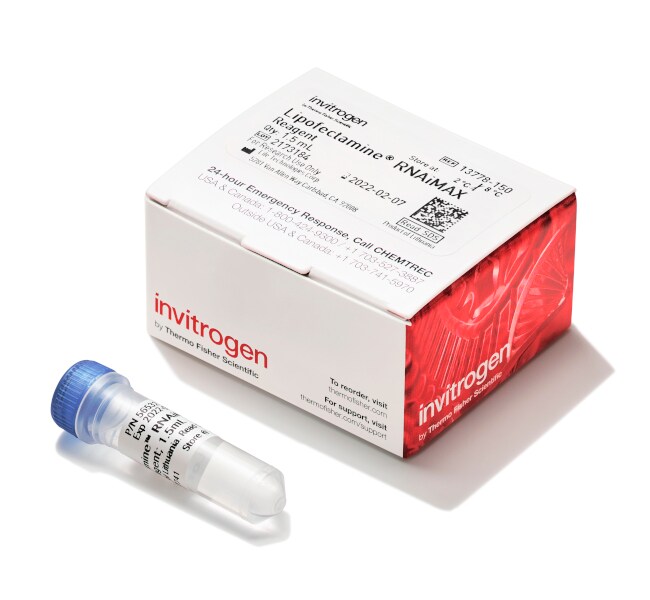
Lipofectamine™ RNAiMAX 转染试剂
Lipofectamine™ RNAiMAX 转染试剂可对多种细胞类型提供极高转染效率,以用于 siRNA 介导的基因敲低实验。Lipofectamine™ RNAiMAX 是专有的 RNAi 特异性阳离子脂肪制剂,专为将了解更多信息
Have Questions?
更改视图

| 货号 | 数量 |
|---|---|
| 13778150 | 1.5 mL |
| 13778075 | 0.75 mL |
| 13778100 | 0.1 mL |
| 13778030 | 0.3 mL |
| 13778500 | 15 mL |
货号 13778150
价格(CNY)
6,999.00
飞享价
Ends: 31-Dec-2026
11,367.00共减 4,368.00 (38%)
Each
数量:
1.5 mL
价格(CNY)
6,999.00
飞享价
Ends: 31-Dec-2026
11,367.00共减 4,368.00 (38%)
Each
Lipofectamine™ RNAiMAX 转染试剂可对多种细胞类型提供极高转染效率,以用于 siRNA 介导的基因敲低实验。Lipofectamine™ RNAiMAX 是专有的 RNAi 特异性阳离子脂肪制剂,专为将 siRNA 和 miRNA 递送至所有细胞类型而设计。
使用 Lipofectamine™ RNAiMAX 转染试剂,您将获得:
• 出色的转染效率,且所需 RNAi 浓度更低,从而实现更有效的基因敲低,且非特异性效应极低
• 由于在转染试剂的 10 倍浓度范围内细胞毒性极轻微,从而轻松优化
• 对 miRNA 拮抗剂和模拟物的优越转染效率
• 与多种细胞类型兼容,为您的所有基因沉默实验提供极通用的方法
• 简单快速的方案,可获得一致且可重现的结果
在多种细胞中具有高敲低率
Lipofectamine™ RNAiMAX 转染试剂可转染多种细胞类型(见图)。对于基因沉默,Lipofectamine™ RNAiMAX 转染试剂的高效转染可提供高水平的基因敲低,从而有助于获得令人信服的结果。
简单、高通量–即用型转染
只需将 Lipofectamine™ RNAiMAX 转染试剂与 siRNA 混合,添加到您的细胞中,孵育,并测量基因敲低。简单性、速度加上较高的转染效率,使得 Lipofectamine™ RNAiMAX 转染试剂成为高通量 siRNA 转染的理想选择。对于这类应用所采用的机械化或自动化系统,可以很容易地为其建立转染条件。
查找适用于您的细胞系的优化 Lipofectamine™ RNAiMAX 转染方案。
使用 Lipofectamine™ RNAiMAX 转染试剂,您将获得:
• 出色的转染效率,且所需 RNAi 浓度更低,从而实现更有效的基因敲低,且非特异性效应极低
• 由于在转染试剂的 10 倍浓度范围内细胞毒性极轻微,从而轻松优化
• 对 miRNA 拮抗剂和模拟物的优越转染效率
• 与多种细胞类型兼容,为您的所有基因沉默实验提供极通用的方法
• 简单快速的方案,可获得一致且可重现的结果
在多种细胞中具有高敲低率
Lipofectamine™ RNAiMAX 转染试剂可转染多种细胞类型(见图)。对于基因沉默,Lipofectamine™ RNAiMAX 转染试剂的高效转染可提供高水平的基因敲低,从而有助于获得令人信服的结果。
简单、高通量–即用型转染
只需将 Lipofectamine™ RNAiMAX 转染试剂与 siRNA 混合,添加到您的细胞中,孵育,并测量基因敲低。简单性、速度加上较高的转染效率,使得 Lipofectamine™ RNAiMAX 转染试剂成为高通量 siRNA 转染的理想选择。对于这类应用所采用的机械化或自动化系统,可以很容易地为其建立转染条件。
查找适用于您的细胞系的优化 Lipofectamine™ RNAiMAX 转染方案。
仅供科研使用。不可用于诊断程序。
规格
适用于(应用)转染
高通量能力兼容高通量应用
产品线Lipofectamine
产品类型转染试剂
数量1.5 mL
血清兼容性是
运输条件经批准可在室温下或置于湿冰上运输
细胞类型已建立的细胞系, 干细胞, 原代细胞, 难转染细胞
产品规格6孔板、12孔板、24孔板、48孔板、96孔板、培养瓶
样品类型siRNA, Synthetic siRNA, RNAi Plasmids (shRNA, miR), RNAi, miRNA
转染技术脂质体介导转染
Unit SizeEach
内容与储存
含一瓶 (1.5 mL) Lipofectamine™ RNAiMAX 转染试剂。储存在 2–8°C 下。切勿冷冻。
常见问题解答 (FAQ)
使用Lipofectamine RNAiMAX转染操作后我观察到细胞出现死亡,应该如何做?
我不慎将自己的Lipofectamine RNAiMAX试剂留在了室温条件下,还能继续使用吗?
我不慎冻存了自己的Lipofectamine RNAiMAX试剂,还能继续使用吗?
我不慎将我的脂质体试剂留在了室温条件下,还能继续使用吗?
在使用Lipofectamine RNAiMAX时,我应选择何种阳性转染对照?
引用和文献 (60)
引用和文献
Abstract
Journal:
PubMed ID:17804805
The keratin-binding protein Albatross regulates polarization of epithelial cells.
Journal:J Cell Biol
PubMed ID:18838552
'The keratin intermediate filament network is abundant in epithelial cells, but its function in the establishment and maintenance of cell polarity is unclear. Here, we show that Albatross complexes with Par3 to regulate formation of the apical junctional complex (AJC) and maintain lateral membrane identity. In nonpolarized epithelial cells, Albatross
Anti-apoptotic effect of the basic helix-loop-helix (bHLH) transcription factor DEC2 in human breast cancer cells.
Journal:Genes Cells
PubMed ID:20236182
'DEC1 (BHLHB2/Stra13/Sharp2) and DEC2 (BHLHB3/Sharp1) are basic helix-loop-helix (bHLH) transcription factors that are involved in circadian rhythms, differentiation and the responses to hypoxia. We examined whether DEC1 and DEC2 are involved in apoptosis regulation, in human breast cancer MCF-7 cells. We found that siRNA-mediated knockdown of DEC2 resulted in marked
EPLIN mediates linkage of the cadherin catenin complex to F-actin and stabilizes the circumferential actin belt.
Journal:Proc Natl Acad Sci U S A
PubMed ID:18093941
'The cadherin-catenin complex is the major machinery for cell-cell adhesion in many animal species. This complex in general associates with actin fibers at its cytoplasmic side, organizing the adherens junction (AJ). In epithelial cells, the AJ encircles the cells near their apical surface and forms the "zonula adherens" or "adhesion
MicroRNA regulation of cyclooxygenase-2 during embryo implantation.
Journal:Proc Natl Acad Sci U S A
PubMed ID:17848513
'The implantation process is complex, requiring reciprocal interactions between implantation-competent blastocysts and the receptive uterus. Because microRNAs (miRNAs) have major roles in regulating gene expression, we speculated that they participate in directing the highly regulated spatiotemporally expressed genetic network during implantation. Here, we show that two miRNAs, mmu-miR-101a and mmu-miR-199a*,