Search


引用和文献 (34)
Gibco™
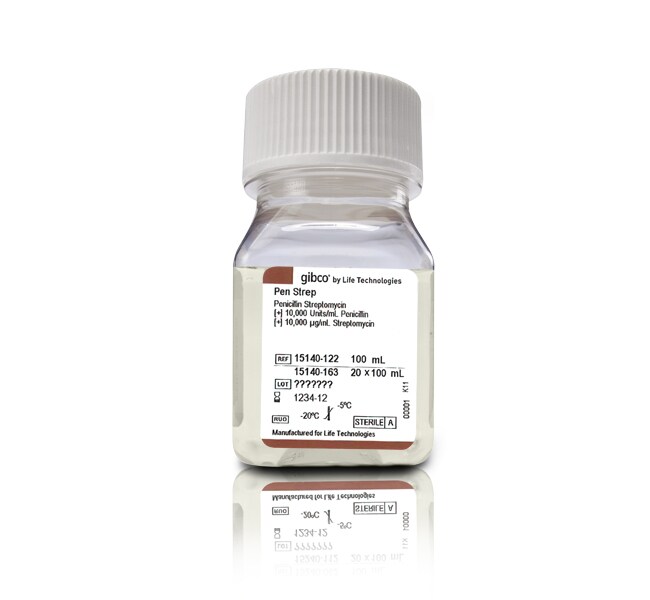
青霉素-链霉素 (10,000 U/mL)
溶液内含 10,000 单位/mL 青霉素和 10,000 μg/mL 链霉素。抗生素——青霉素和链霉素对革兰阳性细菌和革兰阴性细菌具有有效的联合抗菌作用,可用于防止细胞培养受到细菌污染。青霉素起初是从真菌 青霉菌中提纯制成,其作用机制为直接干扰细菌细胞壁的合成以及间接通过触发酶释放来进一步改变细胞壁了解更多信息
Have Questions?
更改视图

| 货号 | 数量 |
|---|---|
| 15140122 又称 15140-122 | 100 mL |
| 15140148 又称 15140-148 | 20 mL |
| 15140163 又称 15140-163 | 20 x 100 mL |
货号 15140122
又称 15140-122
价格(CNY)
273.00
飞享价
Ends: 26-Sep-2026
455.00共减 182.00 (40%)
Each
数量:
100 mL
价格(CNY)
273.00
飞享价
Ends: 26-Sep-2026
455.00共减 182.00 (40%)
Each
溶液内含 10,000 单位/mL 青霉素和 10,000 μg/mL 链霉素。抗生素——青霉素和链霉素对革兰阳性细菌和革兰阴性细菌具有有效的联合抗菌作用,可用于防止细胞培养受到细菌污染。青霉素起初是从真菌 青霉菌中提纯制成,其作用机制为直接干扰细菌细胞壁的合成以及间接通过触发酶释放来进一步改变细胞壁。链霉素起初是从灰色链霉菌中提纯制成。其作用机制为与细菌核糖体的 30S 亚单位结合,进而抑制蛋白合成,导致敏感细菌死亡。
同时提供粉末和液体形式的各种抗生素和抗真菌剂。了解更多关于以下类型产品的知识:
•细胞培养抗生素
•筛选抗生素(包括建议工作浓度)
进一步了解抗生素和抗真菌剂在细胞培养中的应用,并查看排除培养污染的相关指南。
同时提供粉末和液体形式的各种抗生素和抗真菌剂。了解更多关于以下类型产品的知识:
•细胞培养抗生素
•筛选抗生素(包括建议工作浓度)
进一步了解抗生素和抗真菌剂在细胞培养中的应用,并查看排除培养污染的相关指南。
仅供科研使用。不可用于诊断程序。
规格
最大浓度100 X
适用于(应用)防止细胞培养受到污染
数量100 mL
有效期12 个月
运输条件干冰
形式液体
产品类型Geneticin
无菌无菌过滤
灭菌方法Sterile-filtered
Unit SizeEach
内容与储存
储存条件:-5°C 至 -20°C
运输条件:干冰
有效期:自生产之日起 12 个月
运输条件:干冰
有效期:自生产之日起 12 个月
常见问题解答 (FAQ)
我该如何对我的培养物去污染?
你们提供哪些抗生素来帮助用户控制或减少细胞培养中的污染情况?
My Penicillin-Streptomycin solution is not colorless. Is this normal?
How can I decontaminate my cultures?
What antibiotics do you offer to help control or eliminate cell culture contamination?
引用和文献 (34)
引用和文献
Abstract
Identification of a novel redox-sensitive gene, Id3, which mediates angiotensin II-induced cell growth.
Journal:Circulation
PubMed ID:12021231
BACKGROUND: Reactive oxygen species, such as superoxide (O(2)(-)), are involved in the abnormal growth of various cell types. Angiotensin II (Ang II) is one of the most potent inducers of oxidative stress in the vasculature. The molecular events involved in Ang II-induced proliferation of vascular smooth muscle cells (VSMCs) are
Involvement of c-Src Tyrosine Kinase Upstream of Class I Phosphatidylinositol (PI) 3-Kinases in Salmonella Enteritidis Rck Protein-mediated Invasion.
Journal:J Biol Chem
PubMed ID:22810232
'The Salmonella outer membrane protein Rck mediates a Zipper entry mechanism controlled by tyrosine phosphorylation and class I phosphatidylinositol 3-kinase (PI 3-kinase). However, the underlying mechanism leading to this signaling cascade remains unclear. The present study showed that using Rck-coated beads or Rck-overexpressing Escherichia coli, Rck-mediated actin polymerization and invasion
Structural and energetic characteristics of the heparin-binding site in antithrombotic protein C.
Journal:J Biol Chem
PubMed ID:11316800
'Human activated protein C (APC) is a key component of a natural anticoagulant system that regulates blood coagulation. In vivo, the catalytic activity of APC is regulated by two serpins, alpha1-antitrypsin and the protein C inhibitor (PCI), the inhibition by the latter being stimulated by heparin. We have identified a
Hypoxia induces the activation of the phosphatidylinositol 3-kinase/Akt cell survival pathway in PC12 cells: protective role in apoptosis.
Journal:J Biol Chem
PubMed ID:11294857
'Hypoxia is a common environmental stress that influences signaling pathways and cell function. Several cell types, including neuroendocrine chromaffin cells, have evolved to sense oxygen levels and initiate specific adaptive responses to hypoxia. Here we report that under hypoxic conditions, rat pheochromocytoma PC12 cells are resistant to apoptosis induced by
Electrophoretic profiling of both RNA and protein from a single 250-pL sample.
Journal:Anal Chem
PubMed ID:11985318
'A novel approach is described that uses capillary electrophoresis (CE) to electrophoretically sample and separate both protein and RNA from a single injected plug of cell lysate. A 250-pL sample of lysate from Chinese hamster ovary cells (9.6 x 10(7) cells/mL) was hydrodynamically injected into a capillary containing a Tris-based