Search


引用和文献 (3)
Invitrogen™
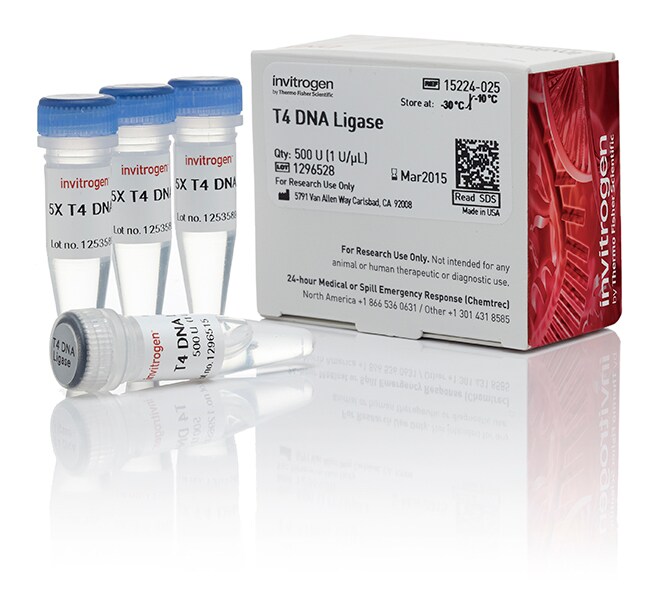
T4 DNA 连接酶 (1 U/μL)
有 ATP 存在时,T4 DNA 连接酶在双链 DNA 的 3´羟基和 5´磷酸末端之间形成磷酸二酯键。了解更多信息
Have Questions?
更改视图

| 货号 | 数量 |
|---|---|
| 15224025 | 500 U |
| 15224017 | 100 U |
| 15224090 | 4 x 500 U |
货号 15224025
价格(CNY)
1,392.00
飞享价
Ends: 31-Dec-2026
1,856.00共减 464.00 (25%)
Each
数量:
500 U
价格(CNY)
1,392.00
飞享价
Ends: 31-Dec-2026
1,856.00共减 464.00 (25%)
Each
有 ATP 存在时,T4 DNA 连接酶在双链 DNA 的 3´羟基和 5´磷酸末端之间形成磷酸二酯键。 独特的 T4 DNA 连接酶缓冲液优化了连接过程,5 分钟内即可完成连接 (1)。 单链核酸不是这种酶的底物。 提供 T4 DNA 连接酶技术公告。
应用: 克隆(平末端或粘末端连接)(2)。 向平末端 DNA 添加连接头或接头 (2)。
来源: 纯化自大肠杆菌œ溶素原 NM989。
性能和质量测试: 脱氧核糖核酸内切酶,3´ 和 5´ 脱氧核糖核酸外切酶实验;通过连接效率测试。
单位定义: 一个单位的酶量可以在 37°C 的环境中在 20 分钟内催化 1 nmol 32P-标记焦磷酸通过置换反应进入 ATP。(一个单位等于约 300 粘末端连接单位。)
单位反应条件: 66 mM Tris-HCl (pH 7.6),6.6 mM MgCl2,10 mM DTT,66 μM ATP,3.3 μM 32 P-标记焦磷酸及酶,共 0.1 ml,在 37°C 反应 20分钟。
应用: 克隆(平末端或粘末端连接)(2)。 向平末端 DNA 添加连接头或接头 (2)。
来源: 纯化自大肠杆菌œ溶素原 NM989。
性能和质量测试: 脱氧核糖核酸内切酶,3´ 和 5´ 脱氧核糖核酸外切酶实验;通过连接效率测试。
单位定义: 一个单位的酶量可以在 37°C 的环境中在 20 分钟内催化 1 nmol 32P-标记焦磷酸通过置换反应进入 ATP。(一个单位等于约 300 粘末端连接单位。)
单位反应条件: 66 mM Tris-HCl (pH 7.6),6.6 mM MgCl2,10 mM DTT,66 μM ATP,3.3 μM 32 P-标记焦磷酸及酶,共 0.1 ml,在 37°C 反应 20分钟。
仅供科研使用。不可用于诊断程序。
规格
兼容缓冲液5X 反应缓冲液
产品类型T4 DNA 连接酶
数量500 U
运输条件干冰
最大浓度1 U/μL
酶连接酶
Unit SizeEach
内容与储存
T4 DNA 连接酶随附一瓶 5X 反应缓冲液 [250 mM Tris-HCl(pH 值 7.6)、50 mM MgCl2、5 mM ATP、5 mM DTT、25% (w/v) 聚乙二醇-8000]。在 -20°C 条件下储存。
常见问题解答 (FAQ)
T4 DNA连接酶和E. coli DNA连接酶有什么区别?
我如何优化我的连接反应?
我不能立即转化我的细胞。我可以存储我的连接反应产物吗?如果可以,应该存储在什么温度?
限制性内切酶克隆需要设置哪些对照?
T4 DNA常见的抑制剂有哪些?
引用和文献 (3)
引用和文献
Abstract
Identification of novel non-phosphorylated ligands, which bind selectively to the SH2 domain of Grb7.
Journal:J Biol Chem
PubMed ID:11809769
'Grb7 is an adapter-type signaling protein, which is recruited via its SH2 domain to a variety of receptor tyrosine kinases (RTKs), including ErbB2 and ErbB3. It is overexpressed in breast, esophageal, and gastric cancers, and may contribute to the invasive potential of cancer cells. Molecular interactions involving Grb7 therefore provide
Presteady-state Analysis of Avian Sarcoma Virus Integrase. I. A SPLICING ACTIVITY AND STRUCTURE-FUNCTION IMPLICATIONS FOR COGNATE SITE RECOGNITION.
Journal:J Biol Chem
PubMed ID:11821409
'Integrase catalyzes insertion of a retroviral genome into the host chromosome. After reverse transcription, integrase binds specifically to the ends of the duplex retroviral DNA, endonucleolytically cleaves two nucleotides from each 3''-end (the processing activity), and inserts these ends into the host DNA (the joining activity) in a concerted manner.
Binding of low affinity N-formyl peptide receptors to G protein. Characterization of a novel inactive receptor intermediate.
Journal:J Biol Chem
PubMed ID:7738006
G protein-coupled seven-transmembrane-containing receptors, such as the N-formyl peptide receptor (FPR) of neutrophils, likely undergo a conformational change upon binding of ligand, which enables the receptor to transmit a signal to G proteins. We have examined the functional significance of numerous conserved charged amino acid residues proposed to be located