Search


引用和文献 (5)
Gibco™
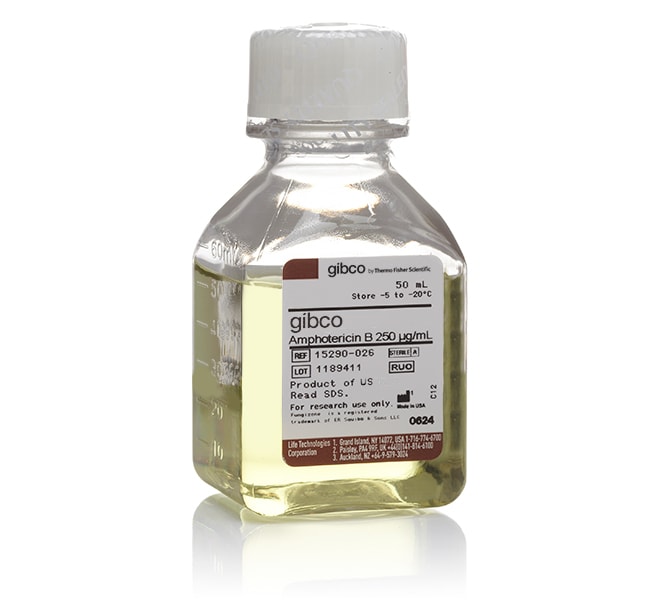
两性霉素 B
两性霉素 B 是 Fungizone 的通用版本。“Fungizone”是 E.R.Squibb & Sons, LLC了解更多信息
| 货号 | 数量 |
|---|---|
| 15290026 | 50 mL |
货号 15290026
价格(CNY)
-
数量:
50 mL
两性霉素 B 是 Fungizone 的通用版本。“Fungizone”是 E.R.Squibb & Sons, LLC 的商标。两性霉素 B 是一种由 结节链霉菌产生的抗真菌剂。它通过提高真菌细胞膜通透性防止真菌生长。它会主动与甾醇结合并导致微孔形成。它用于防止细胞培养受到酵母菌和多细胞真菌污染。Gibco 两性霉素 B 在每 mL 蒸馏水中含有 250 μg 两性霉素 B 和 205 μg 脱氧胆酸钠。建议工作浓度在 0.25 至 2.50 μg/mL 之间。
两地 cGMP 生产
为确保供应链的稳定,同时在位于纽约格兰德岛和英国苏格兰的两家独立工厂生产 Gibco 两性霉素 B。两个地点都符合 cGMP 生产要求,并通过 ISO 13485 标准认证,是在 FDA 登记的医疗器械生产商。
两地 cGMP 生产
为确保供应链的稳定,同时在位于纽约格兰德岛和英国苏格兰的两家独立工厂生产 Gibco 两性霉素 B。两个地点都符合 cGMP 生产要求,并通过 ISO 13485 标准认证,是在 FDA 登记的医疗器械生产商。
仅供科研使用。不可用于诊断程序。
规格
最大浓度0.25-2.5 μg/mL
适用于(应用)防止细胞培养受到污染
产品线Fungizone
数量50 mL
有效期12 个月
运输条件干冰
形式液体
产品类型抗真菌
无菌无菌
Unit SizeEach
内容与储存
储存条件:-5 至 -20°C
运输条件:干冰冷冻
有效期:自生产之日起12个月
运输条件:干冰冷冻
有效期:自生产之日起12个月
常见问题解答 (FAQ)
我该如何对我的培养物去污染?
你们提供哪些抗生素来帮助用户控制或减少细胞培养中的污染情况?
How many freeze/thaw cycles do you recommend for Amphotericin B?
What is the stability of Amphotericin B when stored at 4 degrees C?
What is the difference between Fungizone and Amphotericin B?
引用和文献 (5)
引用和文献
Abstract
PC12 Cell Line: Cell Types, Coating of Culture Vessels, Differentiation and Other Culture Conditions.
Journal:Cells
PubMed ID:32295099
'The PC12 cell line is one of the most commonly used in neuroscience research, including studies on neurotoxicity, neuroprotection, neurosecretion, neuroinflammation, and synaptogenesis. Two types of this line are available in the ATCC collection: traditional PC12 cells grown in suspension and well-attached adherent phenotype. PC12 cells grown in suspension tend
Analysis of HspB1 (Hsp27) Oligomerization and Phosphorylation Patterns and Its Interaction with Specific Client Polypeptides.
Journal:Methods Mol Biol
PubMed ID:29177658
Human HspB1 (also denoted as Hsp27) belongs to the family of small (or stress) proteins (sHsps). The family, which contains ten members including aA,B-crystallin polypeptides, is characterized by a conserved C-terminal a-crystallin domain and molecular weights ranging from 20 to 40 kDa. Here, procedures are described for analyzing the dynamic oligomerization
Generation of human brain region-specific organoids using a miniaturized spinning bioreactor.
Journal:Nat Protoc
PubMed ID:29470464
Human brain organoids, 3D self-assembled neural tissues derived from pluripotent stem cells, are important tools for studying human brain development and related disorders. Suspension cultures maintained by spinning bioreactors allow for the growth of large organoids despite the lack of vasculature, but commercially available spinning bioreactors are bulky in size
A protective Zika virus E-dimer-based subunit vaccine engineered to abrogate antibody-dependent enhancement of dengue infection.
Journal:Nat Immunol
PubMed ID:31477918
Infections with dengue virus (DENV) and Zika virus (ZIKV) can induce cross-reactive antibody responses. Two immunodominant epitopes-one to precursor membrane protein and one to the fusion loop epitope on envelope (E) protein-are recognized by cross-reactive antibodies
Establishment and Genetic Landscape of Precancer Cell Model Systems from the Head and Neck Mucosal Lining.
Journal:Mol Cancer Res
PubMed ID:30224542
Head and neck squamous cell carcinomas (HNSCC) develop in fields of genetically altered cells. These fields are often dysplastic and a subset can be recognized as (erythro)leukoplakia, but most are macroscopically invisible. There is a lack of adequate treatment options to eradicate these fields, whereas they underlie the development of