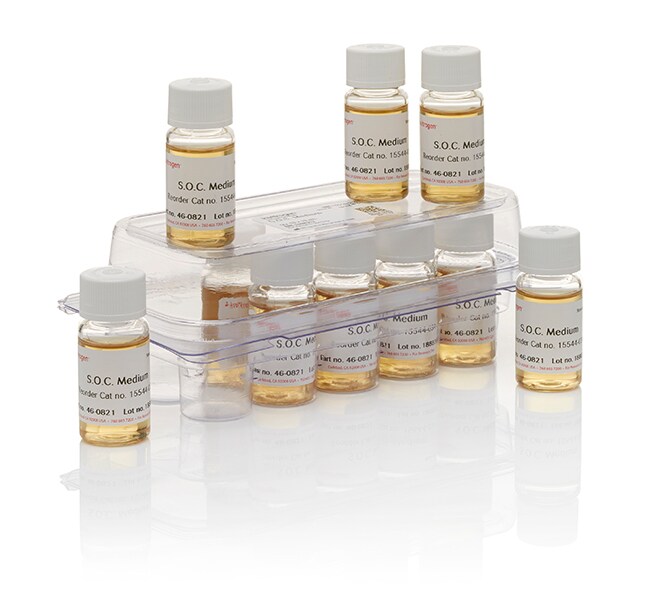
S.O.C.培养基
S.O.C.培养基
Invitrogen™

S.O.C.培养基

S.O.C.在细菌细胞转化的最后步骤使用培养基,以最大限度提高大肠杆菌的转化效率。S.O.C.培养基以 10 x10 mL 瓶装液体培养基提供,成分如下:2% 胰蛋白胨、0.5% 酵母提取物、10mM了解更多信息
Have Questions?
货号数量
1554403410 x 10 mL 瓶
货号 15544034
价格(CNY)
1,028.00
Each
添加至购物车
数量:
10 x 10 mL 瓶
价格(CNY)
1,028.00
Each
添加至购物车
S.O.C.在细菌细胞转化的最后步骤使用培养基,以最大限度提高大肠杆菌的转化效率。S.O.C.培养基以 10 x10 mL 瓶装液体培养基提供,成分如下:2% 胰蛋白胨、0.5% 酵母提取物、10mM NaCl、2.5mM KCl、10mM MgCl2、10mM MgSO4和 20mM 葡萄糖。

质量检测
各批次 S.O.C. 检测培养基以确保符合最新批准的产品质量标准。目前检测参数包括检测 pH 值、渗透压摩尔浓度、无菌性和使用 TOP10 大肠杆菌的转化效率。
仅供科研使用。不可用于诊断程序。
规格
产品规格Bottle
培养基类型S.O.C.
包装类型10 mL/瓶
制备方法随时可用
数量10 x 10 mL 瓶
运输条件经批准可在室温下或者置于湿冰或干冰上运输
产品类型Media Broth
种属Escherichia coli
无菌无菌
靶标有机物类大肠杆菌
Unit SizeEach
内容与储存
包括 10 瓶 10 ml的 SOC 培养基

常见问题解答 (FAQ)

How do you recommend that I prepare my DNA for successful electroporation of E. coli?

For best results, DNA used in electroporation must have a very low ionic strength and a high resistance. A high-salt DNA sample may be purified by either ethanol precipitation or dialysis.

The following suggested protocols are for ligation reactions of 20ul. The volumes may be adjusted to suit the amount being prepared.

Purifying DNA by Precipitation: Add 5 to 10 ug of tRNA to a 20ul ligation reaction. Adjust the solution to 2.5 M in ammonium acetate using a 7.5 M ammonium acetate stock solution. Mix well. Add two volumes of 100 % ethanol. Centrifuge at 12,000 x g for 15 min at 4C. Remove the supernatant with a micropipet. Wash the pellet with 60ul of 70% ethanol. Centrifuge at 12,000 x g for 15 min at room temperature. Remove the supernatant with a micropipet. Air dry the pellet. Resuspend the DNA in 0.5X TE buffer [5 mM Tris-HCl, 0.5 mM EDTA (pH 7.5)] to a concentration of 10 ng/ul of DNA. Use 1 ul per transformation of 20 ul of cell suspension.

Purifying DNA by Microdialysis: Float a Millipore filter, type VS 0.025 um, on a pool of 0.5X TE buffer (or 10% glycerol) in a small plastic container. Place 20ul of the DNA solution as a drop on top of the filter. Incubate at room temperature for several hours. Withdraw the DNA drop from the filter and place it in a polypropylene microcentrifuge tube. Use 1ul of this DNA for each electrotransformation reaction.

What is the formulation of the SOC medium that is provided with competent cells?

SOC (Super Optimal Catabolite) Medium Preparation (for 1 Liter):

1) To a 2 Liter flask with stir bar add the following:
- Bacto Tryptone 20 g
- Yeast Extract 5 g
- Sodium Chloride (NaCl) 0.58 g
- Potassium Chloride (KCl) 0.186 g
2) Add sterile water to a final volume of 1 Liter.
3) Mix well on magnetic stir plate for 5-10 minutes or until all of the ingredients are well mixed and completely dissolved.
4) Autoclave 30 minutes.
5) Allow to cool to room temperature.
6) Add 10 ml of sterile 2M Magnesium Solution (1M Magnesium sulfate, 1M Magnesium chloride)and mix well.
7) Add 10 ml of sterile 2M Glucose and mix well. (Final Glucose concentration is 20 mM).

Is S.O.C. medium absolutely required when recovering competent bacterial cells during transformation?

Many media can be used to grow transformed cells, including standard LB, SOB or TB broths. However, S.O.C. is the optimal choice for recovery of the cells before plating. The nutrient-rich formula with added glucose is often important for obtaining maximum transformation efficiencies.

When should DMSO, formamide, glycerol and other cosolvents be used in PCR?

Cosolvents may be used when there is a failure of amplification, either because the template contains stable hairpin-loops or the region of amplification is GC-rich. Keep in mind that all of these cosolvents have the effect of lowering enzyme activity, which will decrease amplification yield. For more information see P Landre et al (1995). The use of co-solvents to enhance amplification by the polymerase chain reaction. In: PCR Strategies, edited by MA Innis, DH Gelfand, JJ Sninsky. Academic Press, San Diego, CA, pp. 3-16.

Additionally, when amplifying very long PCR fragments (greater than 5 kb) the use of cosolvents is often recommended to help compensate for the increased melting temperature of these fragments.

Find additional tips, troubleshooting help, and resources within our PCR and cDNA Synthesis Support Center.