Search


引用和文献 (2)
Invitrogen™
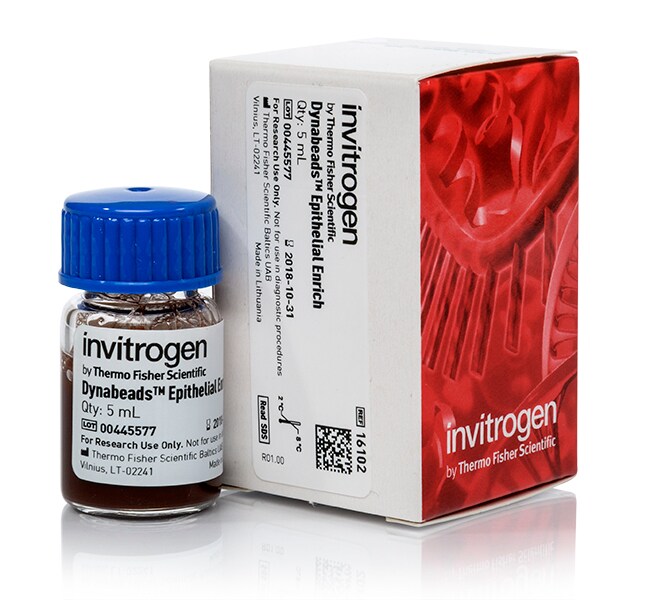
Dynabeads™ Epithelial Enrich
Dynabeads Epithelial Enrich contains 4.5-μm superparamagnetic beads coupled to a monoclonal mouse anti-human EpCAM antibody and is intended for isolation of circulating epithelial tumor cells (CTCs) from liquid biopsy samples.
Have Questions?
更改视图

| 货号 | 数量 |
|---|---|
| 16102 | 5 mL |
| 16103D | 2 mL |
货号 16102
价格(CNY)
17,834.00
Online exclusive
Ends: 31-Dec-2026
24,673.00共减 6,839.00 (28%)
Each
数量:
5 mL
价格(CNY)
17,834.00
Online exclusive
Ends: 31-Dec-2026
24,673.00共减 6,839.00 (28%)
Each
Dynabeads Epithelial Enrich consist of 4.5-μm superparamagnetic beads coupled to a monoclonal mouse anti-human EpCAM antibody and are intended for isolation of circulating epithelial tumor cells (CTCs) from liquid biopsy samples. The sensitive isolation method provided by Dynabeads Epithelial Enrich is necessary given the low number of CTCs in liquid biopsy samples. The isolated CTCs remain attached to the beads throughout the process.
For downstream molecular or proteomic analysis, the cells can be directly lysed while still attached to the beads. RT-PCR can be performed for amplification and quantification of target nucleic acids. CTC isolation and any subsequent bead-based proteomic or molecular applications can be performed manually or automated using the KingFisher Apex purification system.
Benefits of Dynabeads Epithelial Enrich include:
- High sensitivity and specificity isolation of CTCs from liquid biopsy samples
- Fast and efficient isolation of viable CTCs
- Automation user guide and script available for high-throughput enrichment using the KingFisher Apex instrument
Dynabeads-based positive isolation of circulating epithelial tumor cells
Dynabeads Epithelial Enrich are added to the sample under continuous mixing for 30 minutes to optimize the binding of the Dynabeads to the target CTCs. By placing the sample in a DynaMag magnet, the bead-bound epithelial cells are separated from the rest of the sample in l 2 minutes. The supernatant is discarded, and the bead-bound cells are washed 2 to 3 times to obtain optimal purity. The cells can be lysed while still attached to the beads and the supernatant transferred to a new tube for cell culture or downstream molecular or proteomic analysis. Gene expression analysis without pre-enrichment of RNA can easily be performed using the TaqMan Cells-to-CT Express Kit. Starting samples can be whole blood, buffy coat, bone marrow, or peripheral blood mononuclear cells (PBMCs).
High throughput positive isolation of CTCs on KingFisher Apex instrument
The entire workflow can be automated using the KingFisher Apex purification system with 96-deep-well plates. The high-throughput recovery of bead-bound CTCs can be achieved in about 50 minutes after the sample and reagents are loaded into the plates. The isolated CTCs are viable and suitable for culture and downstream molecular or proteomic analysis. Benefits of using automated CTC isolation include:
- Reduced hands-on time
- High reproducibility due to fewer manual handling errors
- Increased throughput with high purity of viable CTCs.
Alternative CTC enrichment methods
Positive isolation with release: If it is preferred to positively isolate CTCs for immunological applications such as flow cytometry, we recommend using Dynabeads CELLection Epithelial Enrich (Cat. No. 16203) where the beads are released from the cells after the isolation. The bead-free CTCs are pure, viable and can be used in any downstream application. If you are using your own biotinylated antibody, we recommend using Dynabeads MyOne Streptavidin T1.
Negative isolation of untouched CTCs: If it is preferred to isolate untouched CTCs by leukocyte depletion, we recommend using Dynabeads CD45 (Cat. No. 11153D).
Commercial supply
Our manufacturing sites are ISO 13485-certified. Bead characteristics and manufacturing conditions help ensure consistency and batch reproducibility making them well suited for commercial supply. If you are in the process of customizing Dynabeads Epithelial Enrich in a commercial product or service or need a larger bulk volume of this product, please contact us at oemdynal@lifetech.com or read more on our Dynabeads OEM page.
仅供科研使用。不可用于诊断程序。
规格
细胞类型肿瘤细胞、上皮细胞
包括5 mL Dynabeads coated with the monoclonal antibody BerEP4 against the human epithelial antigen, EpCAM
分离技术用于分子应用的去除、阳性分离
池数量处理总计∼4x10^9个细胞
输出可行性>95%
产品线DYNAL,Dynabeads
纯度或质量等级研究级
数量5 mL
反应性人
样品类型PBMC、血液
运输条件室温
原始材料细胞数量一次试验可分离 2x10^7 PBMC
目标种属人
产品类型抗体包被微球
Unit SizeEach
内容与储存
本产品含:5 mL Dynabeads™,包被抗人
上皮抗原 EpCAM 的单克隆抗体 BerEP4。
在 2-8°C 下储存
上皮抗原 EpCAM 的单克隆抗体 BerEP4。
在 2-8°C 下储存
常见问题解答 (FAQ)
我的Dynabeads磁珠不能很好地吸附到磁力架上,对此你们有什么建议吗?
我想要分离较长的双链DNA片段,你们有什么产品可以推荐?
我能否使用Dynabeads磁珠分离单链DNA模板?
什么是磁化率?
我如何确定Dynabeads磁珠的偶联效率?
引用和文献 (2)
引用和文献
Abstract
Identification of early-stage colorectal cancer patients at risk of relapse post-resection by immunobead reverse transcription-PCR analysis of peritoneal lavage fluid for malignant cells.
Journal:Clin Cancer Res
PubMed ID:16428481
PURPOSE: Colorectal cancer patients diagnosed with stage I or II disease are not routinely offered adjuvant chemotherapy following resection of the primary tumor. However, up to 10% of stage I and 30% of stage II patients relapse within 5 years of surgery from recurrent or metastatic disease. The aim of
Evaluation of a panel of tumor markers for molecular detection of circulating cancer cells in women with suspected breast cancer.
Journal:Clin Cancer Res
PubMed ID:15897569
PURPOSE: We examined the feasibility of using molecular characterization of circulating tumor cells as a method for early detection of breast cancer. RESEARCH DESIGN: Women without a prior history of cancer who had a breast abnormality detected on imaging followed by a breast biopsy were enrolled in this study. Density