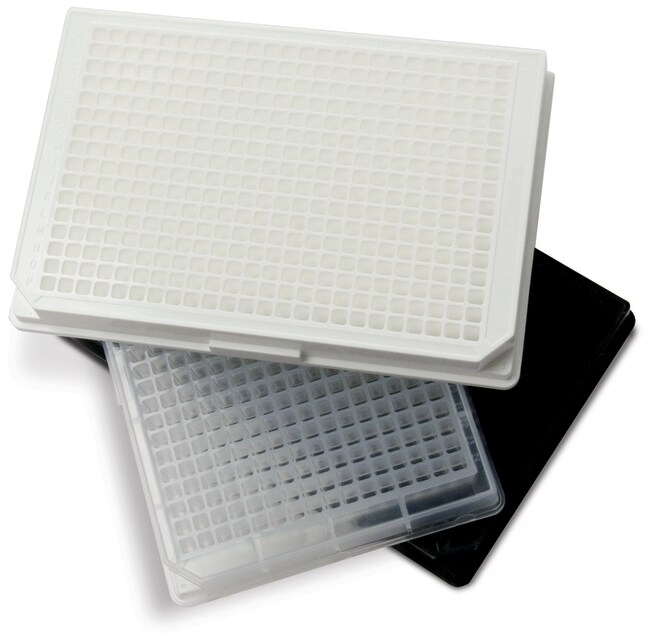
384 孔黑色板,TC 表面,每包 10 个
Thermo Scientific™

384 孔黑色板,TC 表面,每包 10 个

颜色:黑色;无菌性:无菌;盖:带盖
Have Questions?
货号 164564
价格(CNY)
3,614.00
Case of 30
添加至购物车
价格(CNY)
3,614.00
Case of 30
添加至购物车
使用 Thermo Scientific™ Nunc™ 384 孔聚苯乙烯黑色和白色微孔板,可改进背景、自发荧光和串扰。
  • 建议将黑色微孔板用于荧光测量,以使背散射光与背景荧光尽可能小
  • 建议将白色微孔板用于化学发光测量;具有较大的反射和较小的自发光
规格
认证/合规Nunc 生产的所有微孔板都满足美国国家标准学会 (ANSI) 推荐的标准 (ANSI/SBS 1-2004)。
培养面积0.084 cm2/孔
带盖
每箱数量30
每架数量10
包装10 包,30 箱
产品类型塑料、无涂层、非无菌孔板
数量Case of 30
工作容积(公制)10 至 100 μL
数组16 x 24
颜色黑色
材质聚苯乙烯
孔数量384
产品线Nunc™
无菌无菌
表面处理经细胞培养处理
孔容积(公制)120 μL
孔形
Unit SizeCase of 30

常见问题解答 (FAQ)

What is the difference between the Nunclon Delta surface and a tissue culture (TC) surface from a competitor?

Our Nunclon Delta surface for adherent cells is a standard tissue culture (TC) surface modification that makes the polystyrene surface more hydrophilic. This facilitates maximum adhesion for a broad range of cell types.

The Nunclon Delta surface is Thermo Scientific Nunclon Delta-certified, which is a Thermo Fisher proprietary certification that has a quality standard to help ensure consistency. Every lot of Thermo Scientific Nunclon Delta-certified cell cultureware is tested with Gibco media for:
- Less than 10% growth variation in L929, Hel299 and primary chick embryo cells
- Less than 15% variation colony formation of V79-4 cells

More information and all applicable products can be found in the "Product selection guide for every step of your cell culture workflow" brochure .

Do you offer Nunc Microplate Lids for the Nunc Black or White 384-Well Microplates?

We offer Nunc Microplate Lids: Cat. No. 448143, that fit both the 384-well microplates and the 1,536-well microplates.

How does cell culturing on Nunc 384-Well Microplates that have a cell culture-treated surface compare with 96-Well Microplates that have a cell culture-treated surface?

The cell culture-treated surfaces are very similar but the wells of the Nunc 384-Well Microplates are smaller than the wells of the Nunc 96-Well Microplate.
Culture recommendations for the Nunc 384-Well Microplates are:
- 15 - 50 µL media per well
- 0.5 - 2.0 x 10^4 cells per well

What are some applications of Nunc 384-Well Black or White Microplates that have a cell culture-treated surface?

We recommend using the Nunc 384-Well Black Microplates for cell-based assays using fluorescent detection. Viability stains such as fluorogenic esterases can be used for proliferation, toxicity, and drug resistance or sensitivity assays. Many types of fluorochrome-conjugated antibodies are available for performing cell-based immunoassays. Fluorescent reporter genes are widely used for determining cell transfection.
We recommend using the Nunc 384-Well White Microplates for cell-based assays using luminescent detection. Viability stains such as luciferin/luciferase can be used for proliferation, toxicity, and drug resistance or sensitivity assays. Cell-based immunoassays can be performed using a HRP-conjugated antibody with a luminol-based substrate. Luciferase reporter genes are widely used for determining cell transfection.

Why do you offer Nunc 384-Well Black or White Microplates when the cells cannot be observed using an inverted light microscope?

We offer Nunc Black or White 384-Well microplates that are intended for use in conjunction with 384-well microplate luminometers and fluorometers that have excitation and detection systems located above the plate. Due to the opaque quality of these microplates, all detection systems must rely on either luminescent or fluorescent reagents, such as viability stains that report cell activity and membrane integrity.