Search


引用和文献 (5)
Gibco™
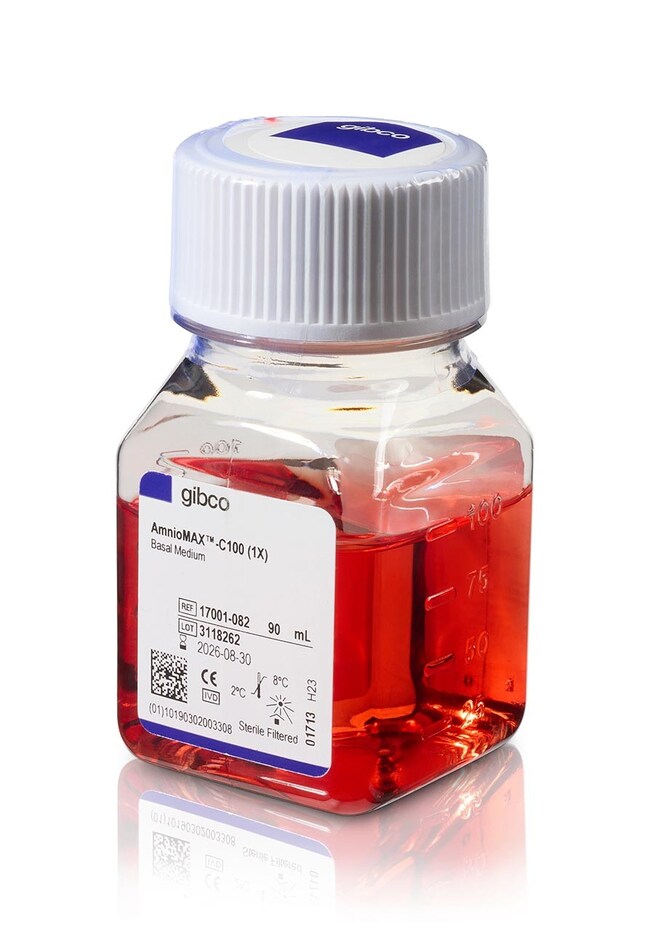
AmnioMAX™ C-100 基础培养基
Gibco™ AmnioMAX™ C-100 基础培养基是一种试剂盒,用于制备针对细胞遗传学研究和体外诊断程序的人羊水细胞短期培养而开发的完全补充 Gibco™ AmnioMAX™ C-100 完全培养基。Gibco™ AmnioMAX™了解更多信息
Have Questions?
更改视图

| 货号 | 数量 |
|---|---|
| 17001082 | 90 mL |
| 17001074 | 450 mL |
货号 17001082
价格(CNY)
473.00
Each
数量:
90 mL
价格(CNY)
473.00
Each
Gibco™ AmnioMAX™ C-100 基础培养基是一种试剂盒,用于制备针对细胞遗传学研究和体外诊断程序的人羊水细胞短期培养而开发的完全补充 Gibco™ AmnioMAX™ C-100 完全培养基。
Gibco™ AmnioMAX™ C-100 完全培养基的特点:
• 易于使用规格
• 质量和性能检测
• 独特、优化配方
易于使用规格
Gibco™ AmnioMAX™ C-100 完全培养基为两件式试剂盒,不需要额外补充剂即可制备完全培养基。该完全培养基在 2–8°C 条件下可储存长达 10 天。
质量和性能检测
每批 Gibco™ AmnioMAX™ C-100 完全培养基的性能均由经认证的美国参考细胞遗传学实验室进行检测,可确保始终如一的卓越性能。合并原代人羊水样品在 Gibco™ AmnioMAX™ C-100 完全培养基中培养 6 天,然后测量菌落总数和有丝分裂菌落总数。此外,每批均经过无菌性、pH 值和渗透压检测。
独特、优化配方
Gibco™ AmnioMAX™ C-100 完全培养基包含胎牛血清 (FBS)、庆大霉素和 L-谷氨酰胺,可尽可能提高细胞贴壁和生长效果。这种优化的培养基还具有增强的缓冲系统,可在培养操作过程中提供更高的 pH 值稳定性。
cGMP 生产和质量体系
Gibco™ AmnioMAX™ C-100 基础培养基在位于纽约格兰德岛的符合 cGMP 要求的工厂内生产。该工厂是在FDA登记的医疗器械生产商,且通过ISO 13485标准认证。
Gibco™ AmnioMAX™ C-100 完全培养基的特点:
• 易于使用规格
• 质量和性能检测
• 独特、优化配方
易于使用规格
Gibco™ AmnioMAX™ C-100 完全培养基为两件式试剂盒,不需要额外补充剂即可制备完全培养基。该完全培养基在 2–8°C 条件下可储存长达 10 天。
质量和性能检测
每批 Gibco™ AmnioMAX™ C-100 完全培养基的性能均由经认证的美国参考细胞遗传学实验室进行检测,可确保始终如一的卓越性能。合并原代人羊水样品在 Gibco™ AmnioMAX™ C-100 完全培养基中培养 6 天,然后测量菌落总数和有丝分裂菌落总数。此外,每批均经过无菌性、pH 值和渗透压检测。
独特、优化配方
Gibco™ AmnioMAX™ C-100 完全培养基包含胎牛血清 (FBS)、庆大霉素和 L-谷氨酰胺,可尽可能提高细胞贴壁和生长效果。这种优化的培养基还具有增强的缓冲系统,可在培养操作过程中提供更高的 pH 值稳定性。
cGMP 生产和质量体系
Gibco™ AmnioMAX™ C-100 基础培养基在位于纽约格兰德岛的符合 cGMP 要求的工厂内生产。该工厂是在FDA登记的医疗器械生产商,且通过ISO 13485标准认证。
产品预期用途:用于体外诊断。注意:不可用于人类或动物的治疗。除产品用途之外的使用,可能违反当地法规。
规格
环保功能ACT Ecolabel (Silver)
产品类型C-100 基础培养基
数量90 mL
有效期自生产之日起 16 个月
形式液体
无菌无菌过滤
灭菌方法无菌过滤
加有添加剂谷氨酰胺
Unit SizeEach
引用和文献 (5)
引用和文献
Abstract
Induced pluripotent stem cells offer new approach to therapy in thalassemia and sickle cell anemia and option in prenatal diagnosis in genetic diseases.
Journal:Proc Natl Acad Sci U S A
PubMed ID:19482945
'The innovation of reprogramming somatic cells to induced pluripotent stem cells provides a possible new approach to treat beta-thalassemia and other genetic diseases such as sickle cell anemia. Induced pluripotent stem (iPS) cells can be made from these patients'' somatic cells and the mutation in the beta-globin gene corrected by
Reactivation of XIST in normal fibroblasts and a somatic cell hybrid: abnormal localization of XIST RNA in hybrid cells.
Journal:Proc Natl Acad Sci U S A
PubMed ID:9560241
'The XIST gene, expressed only from the inactive X chromosome, is a critical component of X inactivation. Although apparently unnecessary for maintenance of inactivation, XIST expression is thought to be sufficient for inactivation of genes in cis even when XIST is located abnormally on another chromosome. This repression appears to
Specific tumour-associated methylation in normal human term placenta and first-trimester cytotrophoblasts.
Journal:Mol Hum Reprod
PubMed ID:18708652
'Human placentation displays many similarities with tumourigenesis, including rapid cell division, migration and invasion, overlapping gene expression profiles and escape from immune detection. Recent data have identified promoter methylation in the Ras association factor and adenomatous polyposis coli tumour suppressor genes as part of this process. However, the extent of
Placenta-specific methylation of the vitamin D 24-hydroxylase gene: implications for feedback autoregulation of active vitamin D levels at the fetomaternal interface.
Journal:J Biol Chem
PubMed ID:19237542
'Plasma concentrations of biologically active vitamin D (1,25-(OH)(2)D) are tightly controlled via feedback regulation of renal 1alpha-hydroxylase (CYP27B1; positive) and 24-hydroxylase (CYP24A1; catabolic) enzymes. In pregnancy, this regulation is uncoupled, and 1,25-(OH)(2)D levels are significantly elevated, suggesting a role in pregnancy progression. Epigenetic regulation of CYP27B1 and CYP24A1 has previously
Development of transgenic cloned pig models of skin inflammation by DNA transposon-directed ectopic expression of human ß1 and a2 integrin.
Journal:PLoS One
PubMed ID:22590584
Integrins constitute a superfamily of transmembrane signaling receptors that play pivotal roles in cutaneous homeostasis by modulating cell growth and differentiation as well as inflammatory responses in the skin. Subrabasal expression of integrins a2 and/or ß1 entails hyperproliferation and aberrant differentiation of keratinocytes and leads to dermal and epidermal influx