Search


引用和文献 (15)
Invitrogen™
DNase I,扩增级
DNase I(扩增级)将单链和双链 DNA 酶切成含 5' 磷酸的寡脱氧核糖核苷酸。DNase I了解更多信息
| 货号 | 数量 |
|---|---|
| 18068015 | 100 U |
货号 18068015
价格(CNY)
1,149.00
飞享价
Ends: 31-Dec-2026
2,298.00共减 1,149.00 (50%)
Each
数量:
100 U
价格(CNY)
1,149.00
飞享价
Ends: 31-Dec-2026
2,298.00共减 1,149.00 (50%)
Each
DNase I(扩增级)将单链和双链 DNA 酶切成含 5' 磷酸的寡脱氧核糖核苷酸。DNase I(扩增级)适用于在关键 RNA 净化程序(如 RNA-PCR 扩增前的程序)中消除 DNA。经纯化和检测,RNase 污染水平无法检出。通过使用 RNA 分子量标准品进行核糖核酸酶检测确定无 RNase。
应用
从 RNA 和蛋白制备物中去除 DNA。
比活度
比活度 > 10,000 单位/mg。
来源
从牛胰腺中纯化而来
性能和质量检测
确定使用 RNA 分子量标准品进行核糖核酸酶检测以及将单链和双链 DNA 酶切成寡核苷酸的能力。
单位定义
一单位酶量可在 25°C 下以 0.001 A260 单位/min./mL 反应混合物的速率增加高分子量 DNA 溶液的吸光度。
单位反应条件
0.1 M 醋酸钠(pH 值 5.0)、5 mM MgCl2、50 µg/mL 小牛胸腺 DNA 和 1 mL 酶,25°C 下 10 min。
应用
从 RNA 和蛋白制备物中去除 DNA。
比活度
比活度 > 10,000 单位/mg。
来源
从牛胰腺中纯化而来
性能和质量检测
确定使用 RNA 分子量标准品进行核糖核酸酶检测以及将单链和双链 DNA 酶切成寡核苷酸的能力。
单位定义
一单位酶量可在 25°C 下以 0.001 A260 单位/min./mL 反应混合物的速率增加高分子量 DNA 溶液的吸光度。
单位反应条件
0.1 M 醋酸钠(pH 值 5.0)、5 mM MgCl2、50 µg/mL 小牛胸腺 DNA 和 1 mL 酶,25°C 下 10 min。
仅供科研使用。不可用于诊断程序。
规格
兼容缓冲液反应缓冲液
数量100 U
运输条件经批准可置于湿冰或干冰上运输
酶DNase
Unit SizeEach
内容与储存
内容物:
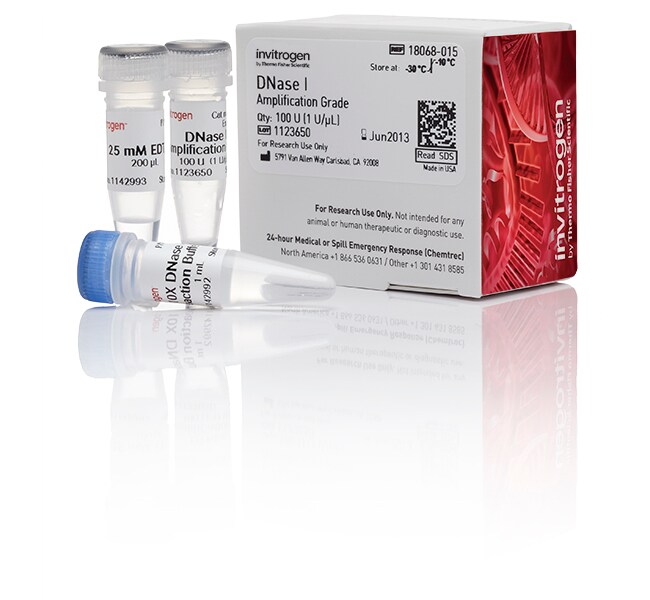
1 样品瓶 DNase I,扩增级 (100 U)
1 样品瓶 10X DNase I 反应缓冲液 (1000 µL)
1 样品瓶 25 mM EDTA(pH 值 8.0)(200 µL)
储存在 -20°C 非自动除霜冷冻冰箱中。
1 样品瓶 DNase I,扩增级 (100 U)
1 样品瓶 10X DNase I 反应缓冲液 (1000 µL)
1 样品瓶 25 mM EDTA(pH 值 8.0)(200 µL)
储存在 -20°C 非自动除霜冷冻冰箱中。
常见问题解答 (FAQ)
如何处理RNA才能去除残留的DNA?
How can RNA be treated to remove residual DNA?
Does Thermo Fisher Scientific offer a protease-free DNase?
How should I treat my RNA sample prior to RT-PCR to ensure that I have no DNA contamination?
What is the difference between DNase I and Amplification Grade DNase I?
引用和文献 (15)
引用和文献
Abstract
Mapping of multidrug resistance gene 1 and multidrug resistance-associated protein isoform 1 to 5 mRNA expression along the human intestinal tract.
Journal:Drug metabolism and disposition: the biological fate of chemicals
PubMed ID:15523049
Gata factor translation is the final downstream step in the amino acid/tor-mediated vitellogenin gene expression in the anautogenous mosquito aedes aegypti.
Journal:J Biol Chem
PubMed ID:16490782
'Ingestion of blood is required for vector mosquitoes to initiate reproductive cycles determining their role as vectors of devastating human diseases. Nutritional signaling plays a pivotal role in regulating mosquito reproduction. Transcription of yolk protein precursor genes is repressed until mosquitoes take blood. Previously, we have shown that to signal
Transcriptional effects of chronic Akt activation in the heart.
Journal:J Biol Chem
PubMed ID:11956204
'Akt activation reduces cardiomyocyte death and induces cardiac hypertrophy. To help identify effector mechanisms, gene expression profiles in hearts from transgenic mice with cardiac-specific expression of activated Akt (myr-Akt) were compared with littermate controls. 40 genes were identified as differentially expressed. Quantitative reverse transcription-PCR confirmed qualitative results of transcript profiling
CCAAT/Enhancer Binding Protein alpha Binds to the Epstein-Barr Virus (EBV) ZTA Protein through Oligomeric Interactions and Contributes to Cooperative Transcriptional Activation of the ZTA Promoter through Direct Binding to the ZII and ZIIIB Motifs during Induction of the EBV Lytic Cycle.
Journal:J Virol
PubMed ID:15078966
'The Epstein-Barr virus (EBV)-encoded ZTA protein interacts strongly with and stabilizes the cellular CCAAT/enhancer binding protein alpha (C/EBPalpha), leading to the induction of p21-mediated G(1) cell cycle arrest. Despite the strong interaction between these two basic leucine zipper (bZIP) family proteins, the ZTA and C/EBPalpha subunits do not heterodimerize, as
Transcriptional Regulation of the Pituitary Vasopressin V1b Receptor Involves a GAGA-binding Protein.
Journal:J Biol Chem
PubMed ID:12023277
'The role of CT repeats (inverted GAGA box) in the rat vasopressin V1b receptor (V1bR) promoter in the transcriptional regulation of this gene was studied in H32 hypothalamic cells, which express endogenous V1bR. Transfection of a 2.5-kb V1bR fragment (2161 bp upstream and 377 bp downstream of the proximal transcriptional