Search


引用和文献 (26)
Thermo Scientific™
LightShift™ 化学发光 EMSA 试剂盒
Thermo Scientific LightShift 化学发光 EMSA 试剂盒是一种非常可靠、灵敏的电泳迁移率变动实验 (EMSA) 系统,用于鉴定和表征蛋白-DNA 结合相互作用了解更多信息
货号 20148
价格(CNY)
4,589.00
飞享价
Ends: 26-Sep-2026
6,686.00共减 2,097.00 (31%)
100 reactions
价格(CNY)
4,589.00
飞享价
Ends: 26-Sep-2026
6,686.00共减 2,097.00 (31%)
100 reactions
Thermo Scientific LightShift 化学发光 EMSA 试剂盒是一种非常可靠、灵敏的电泳迁移率变动实验 (EMSA) 系统,用于鉴定和表征蛋白-DNA 结合相互作用。该试剂盒包括用于设置和定制 DNA 结合反应的试剂、用于检测试剂盒系统的一组 DNA 和蛋白提取物、用于生物素标记 DNA 靶标的稳定链霉素亲和素-HRP 偶联物以及用于检测的一种极其灵敏的化学发光底物模块。
LightShift 化学发光 EMSA 试剂盒的特点:
•非常适合检测细胞核提取物中的低丰度蛋白
• 灵敏度超过放射性和地高辛方法
• 与先前为常用 DNA-蛋白相互作用建立的结合条件兼容
• 包括 EBNA 控制系统以帮助新用户开发工作检测方法并了解用于确认结合相互作用特异性的方法
LightShift EMSA 检测的原理类似于 Western 印迹。生物素末端标记的双螺旋 DNA 与细胞核提取物或纯化因子一起孵育并在天然凝胶上电泳。然后快速(30 分钟)将 DNA 转印到阳性尼龙膜上,进行紫外交联,用链霉素亲和素-HRP 偶联物进行探测,并与底物一起孵育。可在一天内完成从标记到得出结果。
蛋白与 DNA 的相互作用是控制许多细胞过程的关键,包括 DNA 复制、重组和修复、转录和病毒组装。研究基因调控和确定蛋白:DNA 相互作用的核心技术是电泳迁移率实验 (EMSA)。
EMSA 技术基于以下观察结果:在进行非变性聚丙烯酰胺或琼脂糖凝胶电泳时,蛋白:DNA 复合物的迁移速度比无 DNA 分子慢。因为 DNA 迁移率会根据蛋白结合率发生偏移或速度减慢,因此,该实验也被称为凝胶偏移或凝胶延迟实验。直至 EMSA 蛋白:DNA 相互作用主要通过硝酸纤维素过滤柱结合试验进行研究。
进行试验所需的全部是纯化的 DNA 靶标,该靶标已用生物素、待测蛋白提取物、尼龙膜和碱性电泳设备进行末端标记。DNA 靶标可以在合成时加上 5' 或 3' 生物素标记,或者在合成后使用 Thermo Scientific 生物素 3' 末端 DNA 标记试剂盒(产品编号 89818)进行标记。细胞核、细胞溶质或全细胞蛋白提取物可以通过多种方法获得,包括 Thermo Scientific NE-PER 核和细胞质提取试剂盒(产品编号 78833)。
更多产品数据
•使用 Pierce G2 Fast Blotter 转印 EMSA 凝胶
相关产品
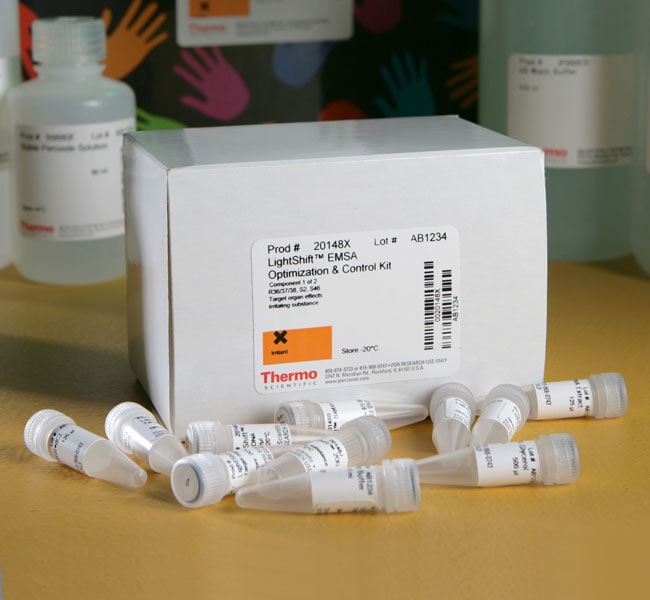
LightShift™ EMSA 优化和对照试剂盒
LightShift™ Poly (dI-dC)
LightShift 化学发光 EMSA 试剂盒的特点:
•非常适合检测细胞核提取物中的低丰度蛋白
• 灵敏度超过放射性和地高辛方法
• 与先前为常用 DNA-蛋白相互作用建立的结合条件兼容
• 包括 EBNA 控制系统以帮助新用户开发工作检测方法并了解用于确认结合相互作用特异性的方法
LightShift EMSA 检测的原理类似于 Western 印迹。生物素末端标记的双螺旋 DNA 与细胞核提取物或纯化因子一起孵育并在天然凝胶上电泳。然后快速(30 分钟)将 DNA 转印到阳性尼龙膜上,进行紫外交联,用链霉素亲和素-HRP 偶联物进行探测,并与底物一起孵育。可在一天内完成从标记到得出结果。
蛋白与 DNA 的相互作用是控制许多细胞过程的关键,包括 DNA 复制、重组和修复、转录和病毒组装。研究基因调控和确定蛋白:DNA 相互作用的核心技术是电泳迁移率实验 (EMSA)。
EMSA 技术基于以下观察结果:在进行非变性聚丙烯酰胺或琼脂糖凝胶电泳时,蛋白:DNA 复合物的迁移速度比无 DNA 分子慢。因为 DNA 迁移率会根据蛋白结合率发生偏移或速度减慢,因此,该实验也被称为凝胶偏移或凝胶延迟实验。直至 EMSA 蛋白:DNA 相互作用主要通过硝酸纤维素过滤柱结合试验进行研究。
进行试验所需的全部是纯化的 DNA 靶标,该靶标已用生物素、待测蛋白提取物、尼龙膜和碱性电泳设备进行末端标记。DNA 靶标可以在合成时加上 5' 或 3' 生物素标记,或者在合成后使用 Thermo Scientific 生物素 3' 末端 DNA 标记试剂盒(产品编号 89818)进行标记。细胞核、细胞溶质或全细胞蛋白提取物可以通过多种方法获得,包括 Thermo Scientific NE-PER 核和细胞质提取试剂盒(产品编号 78833)。
更多产品数据
•使用 Pierce G2 Fast Blotter 转印 EMSA 凝胶
相关产品
LightShift™ EMSA 优化和对照试剂盒
LightShift™ Poly (dI-dC)
For Research Use Only. Not for use in diagnostic procedures.
规格
检测EMSA 测定
反应次数100
产品线LightShift™
产品类型Protein-DNA binding Interaction Assay Kit
数量100 Reactions
靶标特异性无靶标特异性
技术增强的化学发光、膜印迹、凝胶迁移
检测方法化学发光
产品规格Kit
Unit Size100 reactions
常见问题解答 (FAQ)
能否使用NativePAGE凝胶进行EMSA(电泳迁移率变动分析)?
If the LightShift Chemiluminescent EMSA kit has been improperly stored (i.e., at room temperature, -20°C or +4°C), will it still work correctly?
I am using the LightShift Chemiluminescent EMSA kit. Can I probe for the proteins by performing a Western blot?
I am using the LightShift Chemiluminescent EMSA kit. How much protein do I need for each reaction?
What is a "supershift"?
引用和文献 (26)
引用和文献
Abstract
Salidroside inhibits migration, invasion and angiogenesis of MDA‑MB 231 TNBC cells by regulating EGFR/Jak2/STAT3 signaling via MMP2.
Journal:International journal of oncology
PubMed ID:29901185
The major hallmarks of tumor progression are angiogenesis, migration and metastasis. Among the components of Rhodiola rosea, salidroside (p‑hydroxyphenethyl-β‑d-glucoside) is one of the most potent, and is present in all Rhodiola species. Recent data have revealed the anticancer effects of salidroside; however, the mechanism underlying its ability to inhibit tumor
Exo70 is transcriptionally up-regulated by hepatic nuclear factor 4α and contributes to cell cycle control in hepatoma cells
Journal:Oncotarget
PubMed ID:26848864
Exo70, a member of the exocyst complex, is involved in cell exocytosis, migration, invasion and autophagy. However, the expression regulation and function of Exo70 in hepatocellular carcinoma are still poorly understood. In this study, we found Exo70 expression in human hepatoma cells was greatly reduced after knocking down hepatic nuclear
Disruption of chaperone-mediated autophagy-dependent degradation of MEF2A by oxidative stress-induced lysosome destabilization.
Journal:Autophagy
PubMed ID:24879151
Oxidative stress has been implicated in both normal aging and various neurodegenerative disorders and it may be a major cause of neuronal death. Chaperone-mediated autophagy (CMA) targets selective cytoplasmic proteins for degradation by lysosomes and protects neurons against various extracellular stimuli including oxidative stress. MEF2A (myocyte enhancer factor 2A), a
Estrogen Regulates Angiotensin II Receptor Expression Patterns and Protects the Heart from Ischemic Injury in Female Rats.
Journal:
PubMed ID:25972014
'Previous studies have shown that female offspring are resistant to fetal stress-induced programming of ischemic-sensitive phenotype in the heart; however, the mechanisms responsible remain unclear. The present study tested the hypothesis that estrogen plays a role in protecting females in fetal programming of increased heart vulnerability. Pregnant rats were divided
The solution structure of the forkhead box-O DNA binding domain of Brugia malayi DAF-16a.
Journal:
PubMed ID:25297652
Brugia malayi is a parasitic nematode that causes lymphatic filariasis in humans. Here the solution structure of the forkhead DNA binding domain of Brugia malayi DAF-16a, a putative ortholog of Caenorhabditis elegans DAF-16, is reported. It is believed to be the first structure of a forkhead or winged helix domain