Search


引用和文献 (2)
Thermo Scientific™
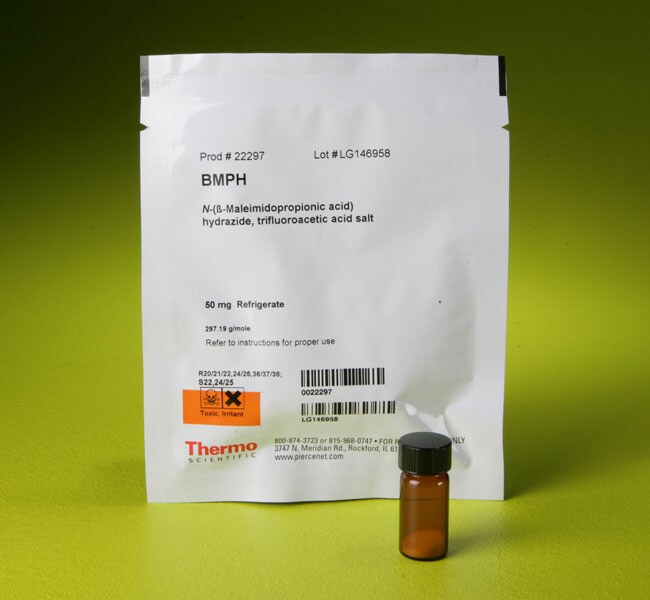
BMPH(N-β-马来酰亚胺基丙酸酰肼)
Thermo Scientific Pierce BMPH 是一种短的马来酰亚胺和酰肼交联剂,用于将巯基(半胱氨酸)与羰基(醛或酮、如糖蛋白碳水化合物氧化形成的物质)偶联了解更多信息
| 货号 | 数量 |
|---|---|
| 22297 | 50 mg |
货号 22297
价格(CNY)
2,396.00
Online exclusive
Ends: 31-Dec-2026
3,237.00共减 841.00 (26%)
Each
数量:
50 mg
价格(CNY)
2,396.00
Online exclusive
Ends: 31-Dec-2026
3,237.00共减 841.00 (26%)
Each
Thermo Scientific Pierce BMPH 是一种短的马来酰亚胺和酰肼交联剂,用于将巯基(半胱氨酸)与羰基(醛或酮、如糖蛋白碳水化合物氧化形成的物质)偶联。
BMPH 的特点:
•反应性基团:马来酰亚胺和酰肼
•可与以下基团发生反应:巯基和羰(醛)基
•短 (8.1A) 的,具有简单间隔臂(不可裂解)的巯基-醛交联剂,
•马来酰亚胺基团与巯基反应形成稳定硫醚键
•酰肼基团与糖蛋白和碳水化合物的氧化糖偶联
•使用偏高碘酸钠氧化糖基化(如唾液酸)为反应性醛基
•与 EDC 配合使用将酰肼基团的伯胺与羧基偶联
产品参考:
交联剂应用指南 -- 检索本产品的最新参考文献
相关产品
EMCH
MPBH
KMUH
BMPH 的特点:
•反应性基团:马来酰亚胺和酰肼
•可与以下基团发生反应:巯基和羰(醛)基
•短 (8.1A) 的,具有简单间隔臂(不可裂解)的巯基-醛交联剂,
•马来酰亚胺基团与巯基反应形成稳定硫醚键
•酰肼基团与糖蛋白和碳水化合物的氧化糖偶联
•使用偏高碘酸钠氧化糖基化(如唾液酸)为反应性醛基
•与 EDC 配合使用将酰肼基团的伯胺与羧基偶联
产品参考:
交联剂应用指南 -- 检索本产品的最新参考文献
相关产品
EMCH
MPBH
KMUH
仅供科研使用。不可用于诊断程序。
规格
细胞渗透性是
描述BMPH
形式实心
标记方法化学标记
分子量297.19
聚乙二醇化否
产品线Pierce
数量50 mg
反应一部分胺、酰肼、马来酰亚胺
运输条件环境
溶解度水
间隔臂长8.1 Å
水溶性是
化学反应性碳水化合物-巯基
可裂解否
交联剂类型异型双功能团试剂
产品规格标准
产品类型交联剂
间隔子短 (<10 Å)
Unit SizeEach
内容与储存
接收后,请在 4°C 下干燥储存。
引用和文献 (2)
引用和文献
Abstract
Protease domain glycans affect oligomerization, disulfide bond formation, and stability of the meprin A metalloprotease homo-oligomer.
Journal:J Biol Chem
PubMed ID:17040911
'The meprin A homo-oligomer is a highly glycosylated, secreted zinc metalloprotease of the astacin family and metzincin superfamily. This isoform of meprin is composed of disulfide-bonded dimers of alpha subunits that further associate to form large, secreted megadalton complexes of 10 or more subunits. The aim of this study was
Interaction with the 5D3 monoclonal antibody is regulated by intramolecular rearrangements but not by covalent dimer formation of the human ABCG2 multidrug transporter.
Journal:J Biol Chem
PubMed ID:18644784
Human ABCG2 is a plasma membrane glycoprotein working as a homodimer or homo-oligomer. The protein plays an important role in the protection/detoxification of various tissues and may also be responsible for the multidrug-resistant phenotype of cancer cells. In our previous study we found that the 5D3 monoclonal antibody shows a