Search


引用和文献 (3)
Thermo Scientific™
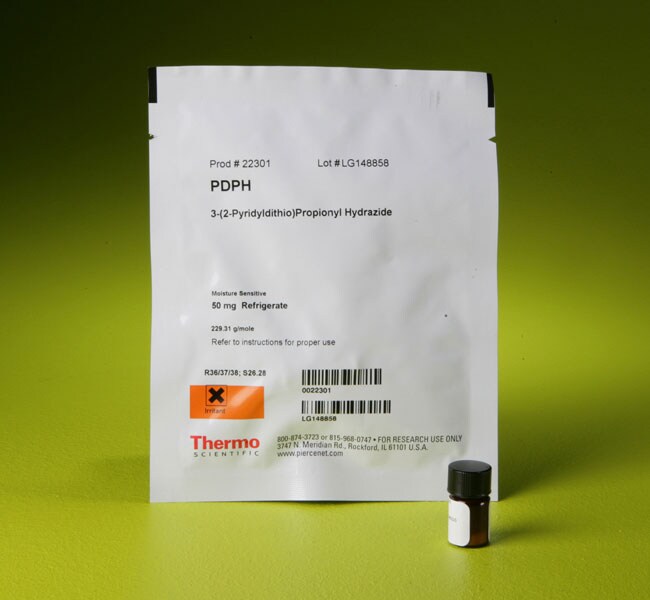
PDPH(3-(2-吡啶基二硫基)丙酰肼)
Thermo Scientific Pierce PDPH is a short, pyridyldithiol-and-hydrazide crosslinker for reversibly conjugating sulfhydryls (cysteines) to carbonyls (aldehyde or ketones, such了解更多信息
| 货号 | 数量 |
|---|---|
| 22301 | 50 mg |
货号 22301
价格(CNY)
4,164.00
Each
数量:
50 mg
价格(CNY)
4,164.00
Each
Thermo Scientific Pierce PDPH is a short, pyridyldithiol-and-hydrazide crosslinker for reversibly conjugating sulfhydryls (cysteines) to carbonyls (aldehyde or ketones, such as those formed by oxidation of glycoprotein carbohydrates).
Features of PDPH :
• Reactive groups: pyridyldisulfide and hydrazide
• Reactive toward: sulfhydryl groups and carbonyl (aldehyde) groups
• Short (9.2A), sulfhydryl-to-aldehyde crosslinker with disulfide bond spacer arm (cleavable)
• Pyridyldithiol group results in attachment to sulfhydryls via disulfide bond, which can be cleaved with DTT, TCEP or other reducing agents
• Hydrazide group conjugates to oxidized sugars of glycoproteins and carbohydrates
• Use sodium meta-periodate to oxidize glycosylation (e.g., sialic acid) to reactive aldehyde groups
• Use with EDC to conjugate primary amine of hydrazide group to carboxyl groups
Product References:
Crosslinker Application Guide -- search for recent literature references for this product
Features of PDPH :
• Reactive groups: pyridyldisulfide and hydrazide
• Reactive toward: sulfhydryl groups and carbonyl (aldehyde) groups
• Short (9.2A), sulfhydryl-to-aldehyde crosslinker with disulfide bond spacer arm (cleavable)
• Pyridyldithiol group results in attachment to sulfhydryls via disulfide bond, which can be cleaved with DTT, TCEP or other reducing agents
• Hydrazide group conjugates to oxidized sugars of glycoproteins and carbohydrates
• Use sodium meta-periodate to oxidize glycosylation (e.g., sialic acid) to reactive aldehyde groups
• Use with EDC to conjugate primary amine of hydrazide group to carboxyl groups
Product References:
Crosslinker Application Guide -- search for recent literature references for this product
仅供科研使用。不可用于诊断程序。
规格
细胞渗透性是
描述PDPH
形式粉末
标记方法化学标记
分子量229.32
聚乙二醇化否
产品线Pierce
数量50 mg
反应一部分酰肼、吡啶二硫化物
运输条件环境
溶解度DMF、DMSO
间隔臂长9.2 Å
水溶性否
化学反应性碳水化合物-巯基
可裂解用硫醇
交联剂类型异型双功能团试剂
产品规格标准
产品类型交联剂
间隔子短 (<10 Å)
Unit SizeEach
内容与储存
接收后,请在 4°C 下干燥储存。
常见问题解答 (FAQ)
Can you provide the shelf-life for PDPH (3-(2-pyridyldithio)propionyl hydrazide)?
We are using EDC to crosslink a protein onto carboxyl-modified beads. We would like to add in a linker molecule to extend the radius of beads to increase the surface area so more proteins can be immobilized. Is this possible?
引用和文献 (3)
引用和文献
Abstract
Systemic administration of a nerve growth factor conjugate reverses age-related cognitive dysfunction and prevents cholinergic neuron atrophy.
Journal:J Neurosci
PubMed ID:8757256
'Intraventricular administration of nerve growth factor (NGF) in rats has been shown to reduce age-related atrophy of central cholinergic neurons and the accompanying memory impairment. Intraventricular administration of NGF is necessary because NGF will not cross the blood-brain barrier (BBB). Here we have used a novel carrier system, consisting of
Conjugation of folate via gelonin carbohydrate residues retains ribosomal-inactivating properties of the toxin and permits targeting to folate receptor positive cells.
Journal:J Biol Chem
PubMed ID:11359781
Conjugation of folate to proteins permits receptor-mediated endocytosis via the folate receptor (FR) and delivery of the conjugate into the cytoplasm of cells. Since many cancers up-regulate the FR it has enabled the targeting of toxins to tumor cells resulting in specific cell death. However, current conjugation methods rely on
Site-specific modifications of light chain glycosylated antilymphoma (LL2) and anti-carcinoembryonic antigen (hImmu-14-N) antibody divalent f1agments.
Journal:Cancer Res
PubMed ID:7493334
Site-specific introduction of metal-chelating groups into F(ab')2 fragments of an antilymphoma antibody (LL2) possessing a natural Asn-linked light chain carbohydrate and an anti-carcinoembryonic antigen antibody (hImmu-14-N) grafted with a light chain carbohydrate site is described. For this purpose, four yttrium- (and indium)-chelating agents were used, containing a primary amino group