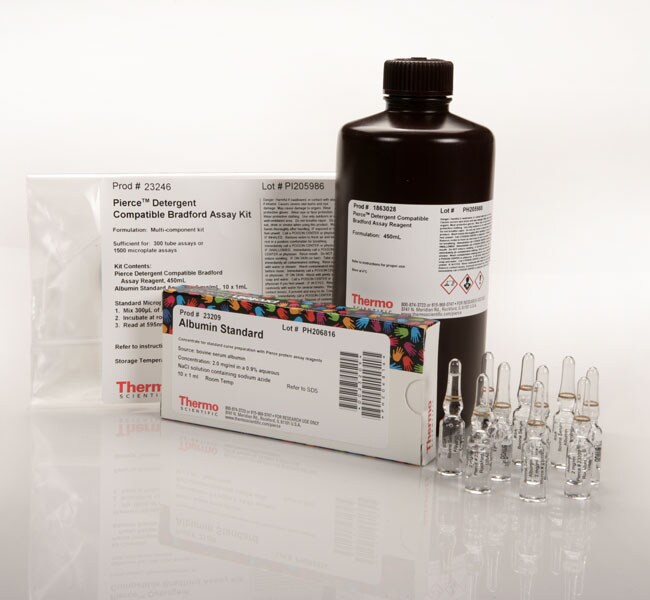
What is the recommended shelf life of the Pierce Detergent Compatible Bradford Assay Kit (Cat. No. 23246)?
The Pierce Detergent Compatible Bradford Assay Kit (Cat. No. 23246) does not have a real expiry date. We rather established a functional warranty which means that we guarantee the functionality of the product for one year from date of shipment, if stored correctly. This is valid unless a different written warranty is included with the product literature. Please refer to the following Terms & Conditions of Sales document from our website:
https://www.thermofisher.com/content/dam/LifeTech/Documents/PDFs/Life-Technologies-General-Terms-Conditions-Sale.pdf
Find additional tips, troubleshooting help, and resources within our Protein Assays and Analysis Support Center.
Can you provide the shelf-life for the Pierce Detergent Compatible Bradford Assay Kit?
The Pierce Detergent Compatible Bradford Assay Kit is covered under our general 1-year warranty and is guaranteed to be fully functional for 12 months from the date of shipment, if stored as recommended. Please see section 8.1 of our Terms & Conditions of Sale (https://www.thermofisher.com/content/dam/LifeTech/Documents/PDFs/Terms-and-Conditions-of-Sale.pdf) for more details.
Find additional tips, troubleshooting help, and resources within our Protein Assays and Analysis Support Center.
I assayed two protein samples, each containing a different mixture of proteins of same concentration and observed very different color responses in the assay. What is the cause?
Each of the commonly used total protein assay methods exhibits some degree of varying response toward different proteins. These differences relate to amino acid sequence, pI, structure and the presence of certain side chains or prosthetic groups that can dramatically alter the protein’s color response. Most protein assay methods use BSA or immunoglobulin (IgG) as the standard against which the concentration of protein in the sample is determined. However, if great accuracy is required, prepare the standard curve from a pure sample of the target protein.
Find additional tips, troubleshooting help, and resources within our Protein Assays and Analysis Support Center.
My buffer or components of my buffer are not listed in the compatibility table for my protein assay. What should I do?
You can test the tolerance of the assay for your specific buffer formulation. For in-house generated compatibility information, substances were considered compatible at the indicated concentration in the Standard Test Tube Protocol (found in the manual for each protein assay) if the error in protein concentration estimation caused by the presence of the substance was less than or equal to 10%. The substances were tested using WR prepared immediately before each experiment. Blank-corrected 562nm absorbance measurements (for a 1000µg/mL BSA standard + substance) were compared to the net 562nm measurements of the same standard prepared in 0.9% saline.
Find additional tips, troubleshooting help, and resources within our Protein Assays and Analysis Support Center.
All the components of my sample buffer are at or below the indicated compatible concentration for my protein assay, but I am still seeing too much/too little color development. What could be the problem?
It is possible to have a substance additive affect such that even though a single component is present at a concentration below its listed compatibility, a sample buffer containing a combination of substances could interfere with the assay. You should take steps to eliminate or minimize the effects of the interfering substance(s) by diluting or removing the substance.
Find additional tips, troubleshooting help, and resources within our Protein Assays and Analysis Support Center.