Search


引用和文献 (10)
Gibco™
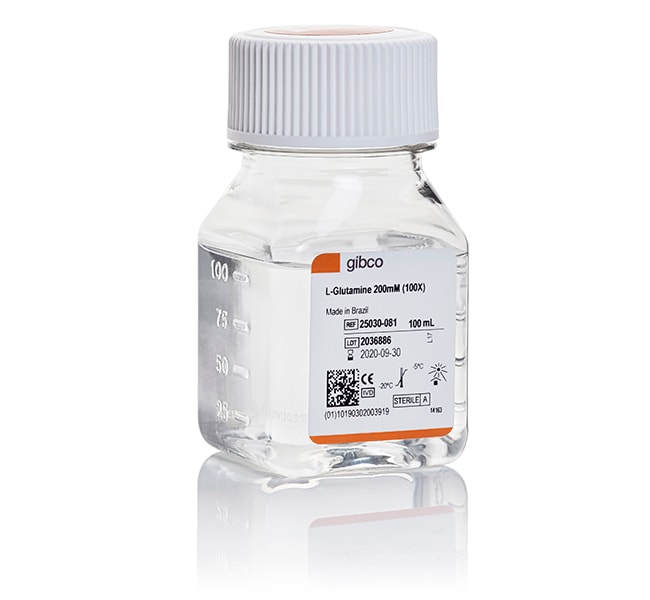
L-谷氨酰胺 (200 mM)
L-谷氨酰胺是细胞培养所必需的一种氨基酸。L-谷氨酰胺参与嘌呤和嘧啶核苷酸、氨基糖类、谷胱甘肽、L-谷氨酸和其他氨基酸的形成,并参与蛋白质的合成和葡萄糖的产生。与大多数其他氨基酸不同,L-谷氨酰胺在溶液中不稳定。降解速率是时间、温度和 pH 的函数了解更多信息
Have Questions?
更改视图

| 货号 | 数量 |
|---|---|
| 25030081 | 100 mL |
| 25030149 | 20 mL |
| 25030164 | 20 x 100 mL |
货号 25030081
价格(CNY)
539.00
飞享价
Ends: 31-Dec-2026
700.00共减 161.00 (23%)
Each
数量:
100 mL
价格(CNY)
539.00
飞享价
Ends: 31-Dec-2026
700.00共减 161.00 (23%)
Each
L-谷氨酰胺是细胞培养所必需的一种氨基酸。L-谷氨酰胺参与嘌呤和嘧啶核苷酸、氨基糖类、谷胱甘肽、L-谷氨酸和其他氨基酸的形成,并参与蛋白质的合成和葡萄糖的产生。与大多数其他氨基酸不同,L-谷氨酰胺在溶液中不稳定。降解速率是时间、温度和 pH 的函数。Gibco™ L-谷氨酰胺是一种即用型 200 mM 储备液,可作为细胞培养补充剂。较佳浓度取决于用于培养细胞的细胞类型和培养基,但通常在 2–6 mM 范围内。
我们还提供 Gibco™ GlutaMAX™ 补充剂作为 L-谷氨酰胺的稳定替代产品。
双生产现场 cGMP 生产和质量体系
Gibco™ L-谷氨酰胺是在位于英国苏格兰佩斯利的一家符合 cGMP 要求的工厂内生产的。该工厂是在 FDA 注册的医疗器械生产商,且通过 ISO 13485 标准认证。为确保供应链连续性,我们同时提供由我们格兰德岛工厂生产的等同 Gibco™ L-谷氨酰胺产品 (25030-081)。本工厂者亦是在 FDA 登记的医疗器械生产商,且符合 ISO 13485 标准。
我们还提供 Gibco™ GlutaMAX™ 补充剂作为 L-谷氨酰胺的稳定替代产品。
双生产现场 cGMP 生产和质量体系
Gibco™ L-谷氨酰胺是在位于英国苏格兰佩斯利的一家符合 cGMP 要求的工厂内生产的。该工厂是在 FDA 注册的医疗器械生产商,且通过 ISO 13485 标准认证。为确保供应链连续性,我们同时提供由我们格兰德岛工厂生产的等同 Gibco™ L-谷氨酰胺产品 (25030-081)。本工厂者亦是在 FDA 登记的医疗器械生产商,且符合 ISO 13485 标准。
规格
CAS56-85-9
化学名称或材料添加剂
浓度或成分(按分析物或组分)100 X
包装Bottle
物理形态液体
产品线Gibco
建议的储存条件储存条件:-5°C 至 -20°C。避光。, 运输条件:干冰, 有效期:自生产之日起 24 个月
有效期24个月
运输条件干冰
分级Cell Culture
分子量 (g/mol)146.14 g/mol
数量100 mL
pH5 – 6
Unit SizeEach
常见问题解答 (FAQ)
为何我的200 mM L-谷氨酰胺在化冻后出现沉淀?
Why did my 200 mM L-Glutamine precipitate out of solution when I thawed it?
Why does L-Glutamine (200 mM) (Cat. No. 25050149, 25030081, 25030164) solution have “Product of Brazil” on the label?
My order of L-Glutamine (Cat. No. 25030081) arrived frozen. Is it stable?
What is your recommended method for thawing L-Glutamine before adding to cell culture media?
引用和文献 (10)
引用和文献
Abstract
Structural and energetic characteristics of the heparin-binding site in antithrombotic protein C.
Journal:J Biol Chem
PubMed ID:11316800
'Human activated protein C (APC) is a key component of a natural anticoagulant system that regulates blood coagulation. In vivo, the catalytic activity of APC is regulated by two serpins, alpha1-antitrypsin and the protein C inhibitor (PCI), the inhibition by the latter being stimulated by heparin. We have identified a
FRET measurements of intracellular cAMP concentrations and cAMP analog permeability in intact cells.
Journal:Nat Protoc
PubMed ID:21412271
'Real-time measurements of second messengers in living cells, such as cAMP, are usually performed by ratiometric fluorescence resonance energy transfer (FRET) imaging. However, correct calibration of FRET ratios, accurate calculations of absolute cAMP levels and actual permeabilities of different cAMP analogs have been challenging. Here we present a protocol that
A critical role for choline kinase-alpha in the aggressiveness of bladder carcinomas.
Journal:Oncogene
PubMed ID:19448670
'Bladder cancer is one of the most common causes of death in industrialized countries. New tumor markers and therapeutic approaches are still needed to improve the management of bladder cancer patients. Choline kinase-alpha (ChoKalpha) is a metabolic enzyme that has a role in cell proliferation and transformation. Inhibitors of ChoKalpha
Delivery of proteins into living cells by reversible membrane permeabilization with streptolysin-O.
Journal:Proc Natl Acad Sci U S A
PubMed ID:11248053
'The pore-forming toxin streptolysin O (SLO) can be used to reversibly permeabilize adherent and nonadherent cells, allowing delivery of molecules with up to 100 kDa mass to the cytosol. Using FITC-labeled albumin, 10(5)-10(6) molecules were estimated to be entrapped per cell. Repair of toxin lesions depended on Ca(2+)-calmodulin and on
Fabrication of synthetic polymer coatings and their use in feeder-free culture of human embryonic stem cells.
Journal:Nat Protoc
PubMed ID:21720316
The culture of human embryonic stem (hES) cells in defined and xenogeneic-free conditions will contribute substantially to future biotechnological and medical applications. To achieve this goal, we developed the first fully defined synthetic polymer coating poly[2-(methacryloyloxy)ethyl dimethyl-(3-sulfopropyl)ammonium hydroxide] (PMEDSAH) that sustains long-term growth of hES cells in different culture media.