Search


引用和文献 (10)
Gibco™
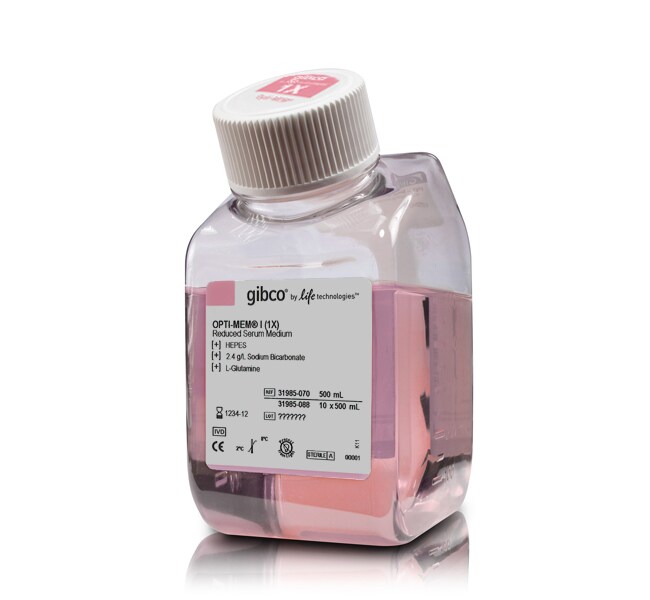
Opti-MEM™ I 减血清培养基
Opti-MEM™ I 减血清培养基是一种经过改良的MEM,能够使胎牛血清添加量减少至少 50%,而生长速率或形态无变化。还推荐 Opti-MEM™ I 培养基与阳离子脂质体转染试剂(如 Lipofectamine™了解更多信息
Have Questions?
更改视图

| 货号 | 数量 |
|---|---|
| 31985070 | 500 mL |
| 31985088 | 10 x 500 mL |
| 31985062 | 100 mL |
货号 31985070
价格(CNY)
584.00
飞享价
Ends: 26-Sep-2026
834.00共减 250.00 (30%)
Each
数量:
500 mL
价格(CNY)
584.00
飞享价
Ends: 26-Sep-2026
834.00共减 250.00 (30%)
Each
Opti-MEM™ I 减血清培养基是一种经过改良的MEM,能够使胎牛血清添加量减少至少 50%,而生长速率或形态无变化。还推荐 Opti-MEM™ I 培养基与阳离子脂质体转染试剂(如 Lipofectamine™ 试剂)配套使用。Opti-MEM™ I 培养基可用于各种悬浮和贴壁的哺乳动物细胞,包括 Sp2、AE-1、CHO、BHK-21、HEK 和原代成纤维细胞。针对广泛的细胞培养应用,提供了多种组分的 Opti-MEM™ I 改良培养基。
这种 Opti-MEM™ I 的改良方式如下:
完整配方保密。有关更多信息,请联系技术服务部。
Opti-MEM™ I 培养基的使用
Opti-MEM™ I 减血清培养基是一种内含胰岛素、转铁蛋白、次黄嘌呤、胸苷和微量元素的独特培养基。这些附加组分可使血清添加量减少至少 50%。Opti-MEM™ I 培养基使用碳酸氢钠缓冲系统 (2.4 g/L),因此需要 5–10% CO2 环境来维持生理 pH 值。
cGMP 生产和质量体系
Opti-MEM™ I 在位于纽约格兰德岛的符合 cGMP 要求的工厂内生产。该工厂是在FDA登记的医疗器械生产商,且通过ISO 13485标准认证。为确保供应链的稳定,我们同时提供由我们的苏格兰工厂生产的相同 Opti-MEM™ I 产品 (31985-047)。该工厂也是在 FDA 注册的医疗器械生产商,且通过 ISO 13485 标准认证。
这种 Opti-MEM™ I 的改良方式如下:
| 包含 |
| •L-谷氨酰胺 |
| • 酚红 |
完整配方保密。有关更多信息,请联系技术服务部。
Opti-MEM™ I 培养基的使用
Opti-MEM™ I 减血清培养基是一种内含胰岛素、转铁蛋白、次黄嘌呤、胸苷和微量元素的独特培养基。这些附加组分可使血清添加量减少至少 50%。Opti-MEM™ I 培养基使用碳酸氢钠缓冲系统 (2.4 g/L),因此需要 5–10% CO2 环境来维持生理 pH 值。
cGMP 生产和质量体系
Opti-MEM™ I 在位于纽约格兰德岛的符合 cGMP 要求的工厂内生产。该工厂是在FDA登记的医疗器械生产商,且通过ISO 13485标准认证。为确保供应链的稳定,我们同时提供由我们的苏格兰工厂生产的相同 Opti-MEM™ I 产品 (31985-047)。该工厂也是在 FDA 注册的医疗器械生产商,且通过 ISO 13485 标准认证。
仅用于研究和生产用途。不可用于临床诊断或直接用于人类或动物。
规格
细胞系Sp2、AE-1、CHO、BHK-21 和 HEK
细胞类型原代成纤维细胞
最大浓度1 X
培养环境CO2
适用于(应用)Mammalian Cell Culture, Lipid-Based Transfection
产品规格Bottle
生产质量cGMP-compliant under the ISO 13485 standard
产品线Gibco、Opti-MEM
产品类型Opti-MEM I
数量500 mL
有效期自生产之日起 18 个月
运输条件室温
分类人源
培养类型Mammalian Cell Culture
形式液体
血清水平Reduced Serum
无菌无菌过滤
灭菌方法无菌过滤
加有添加剂谷氨酰胺, 酚红
不加添加剂No FBS
Unit SizeEach
内容与储存
储存条件:2-8°C。避光
运输条件:环境
有效期:自生产之日起18个月
运输条件:环境
有效期:自生产之日起18个月
常见问题解答 (FAQ)
在配制复合物之前,应使用何种溶液稀释我的RNAi双链和Lipofectamine RNAiMAX?
加入血清后的培养基可以使用多久?
我的培养基是室温条件下运送来的,但注明应保存于冷藏条件下。这会有影响么?
我该如何去除细胞培养基中的支原体污染?
我发现培养物的生长速率变缓。我该如何处理?
引用和文献 (10)
引用和文献
Abstract
Regulation of cortical dendrite development by Slit-Robo interactions.
Journal:Neuron
PubMed ID:11779471
Slit proteins have previously been shown to regulate axon guidance, branching, and neural migration. Here we report that, in addition to acting as a chemorepellant for cortical axons, Slit1 regulates dendritic development. Slit1 is expressed in the developing cortex, and exposure to Slit1 leads to increased dendritic growth and branching.
Identification of a novel redox-sensitive gene, Id3, which mediates angiotensin II-induced cell growth.
Journal:Circulation
PubMed ID:12021231
BACKGROUND: Reactive oxygen species, such as superoxide (O(2)(-)), are involved in the abnormal growth of various cell types. Angiotensin II (Ang II) is one of the most potent inducers of oxidative stress in the vasculature. The molecular events involved in Ang II-induced proliferation of vascular smooth muscle cells (VSMCs) are
Non-viral-mediated gene transfer of OX40 ligand for tumor immunotherapy.
Journal:Frontiers in immunology
PubMed ID:39007148
BACKGROUND: Immune checkpoint blockade (ICB) is rapidly becoming a standard of care in the treatment of many cancer types. However, the subset of patients who respond to this type of therapy is limited. Another way to promote antitumoral immunity is the use of immunostimulatory molecules, such as cytokines or T
Effects of an indole derivative on cell proliferation, transfection, and alternative splicing in production of lentiviral vectors by transient co-transfection.
Journal:PloS one
PubMed ID:38833479
Lentiviral vectors derived from human immunodeficiency virus type I are widely used to deliver functional gene copies to mammalian cells for research and gene therapies. Post-transcriptional splicing of lentiviral vector transgene in transduced host and transfected producer cells presents barriers to widespread application of lentiviral vector-based therapies. The present study
Aldose reductase mediates mitogenic signaling in vascular smooth muscle cells.
Journal:J Biol Chem
PubMed ID:12063254
'Abnormal vascular smooth muscle cell (VSMC) proliferation is a key feature of atherosclerosis and restenosis; however, the mechanisms regulating growth remain unclear. Herein we show that inhibition of the aldehyde-metabolizing enzyme aldose reductase (AR) inhibits NF-kappa B activation during restenosis of balloon-injured rat carotid arteries as well as VSMC proliferation