Search


引用和文献 (5)
Invitrogen™
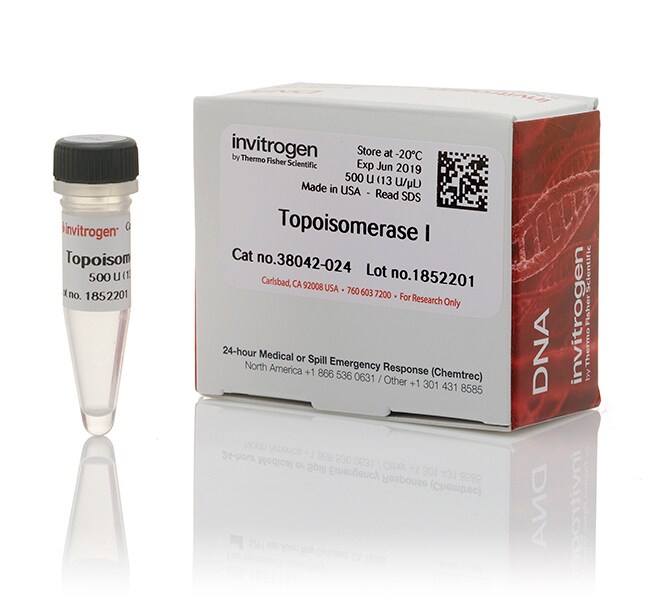
Topoisomerase I
Topoisomerase I(DNA 松弛酶)通过瞬时断裂并重新连接磷酸二酯键,催化去除共价闭合 DNA 的超螺旋圈。Topoisomerase I 在存在了解更多信息
| 货号 | 数量 |
|---|---|
| 38042024 | 500 U |
货号 38042024
价格(CNY)
3,121.00
Each
数量:
500 U
价格(CNY)
3,121.00
Each
Topoisomerase I(DNA 松弛酶)通过瞬时断裂并重新连接磷酸二酯键,催化去除共价闭合 DNA 的超螺旋圈。Topoisomerase I 在存在 EDTA 时保持活性。
应用:松弛正负超螺旋 DNA (1)。产生 DNA 苷酶异构体 (2)。
来源:从小牛胸腺纯化。
性能和质量测试:脱氧核糖核酸内切酶、3´ 和5´ 外切脱氧核糖核酸酶及磷酸酶分析;超螺旋 DNA 转化为松弛 DNA。
单位定义:一个单位在37°C 下、30分钟内将0.5μg 的超螺旋 Φ X174 RF DNA 催化转换为松弛状态。
单位反应条件:50 mM Tris-HCl (pH 7.5),50 mM KCl,10 mM MgCl2,0.1 mM EDTA,0.5 mM DTT,30 μg/ml/BSA,0.5 μg
Φ X174 RF DNA 和酶,50 μl,30分钟,37°C 下。
应用:松弛正负超螺旋 DNA (1)。产生 DNA 苷酶异构体 (2)。
来源:从小牛胸腺纯化。
性能和质量测试:脱氧核糖核酸内切酶、3´ 和5´ 外切脱氧核糖核酸酶及磷酸酶分析;超螺旋 DNA 转化为松弛 DNA。
单位定义:一个单位在37°C 下、30分钟内将0.5μg 的超螺旋 Φ X174 RF DNA 催化转换为松弛状态。
单位反应条件:50 mM Tris-HCl (pH 7.5),50 mM KCl,10 mM MgCl2,0.1 mM EDTA,0.5 mM DTT,30 μg/ml/BSA,0.5 μg
Φ X174 RF DNA 和酶,50 μl,30分钟,37°C 下。
仅供科研使用。不可用于诊断程序。
规格
产品类型Topoisomerase I
数量500 U
运输条件湿冰
酶Topoisomerase
Unit SizeEach
内容与储存
在冰箱(-5 至 -30°C)中储存。
常见问题解答 (FAQ)
What are the applications and recommended protocols for Topoisomerase I?
Do you offer a pre-made buffer for use with Topoisomerase I (Cat. No. 38042024)?
When editing a cycle on the Procise System, I can readily delete a step, but cannot seem to insert a function into the cycle. What am I doing wrong?
引用和文献 (5)
引用和文献
Abstract
Prominent mitochondrial DNA recombination intermediates in human heart muscle.
Journal:EMBO Rep
PubMed ID:11713192
'Recombination intermediates containing four-way (Holliday) junctions are generated during DNA repair and replication in many systems, including yeast mitochondrial DNA (mtDNA). In contrast, convincing evidence for recombination in mammalian mtDNA is lacking. We have used two-dimensional agarose-gel electrophoresis to analyse non-linear forms of mtDNA in human heart muscle. Replication intermediates
FtsK Is a DNA motor protein that activates chromosome dimer resolution by switching the catalytic state of the XerC and XerD recombinases.
Journal:Cell
PubMed ID:11832210
'FtsK acts at the bacterial division septum to couple chromosome segregation with cell division. We demonstrate that a truncated FtsK derivative, FtsK(50C), uses ATP hydrolysis to translocate along duplex DNA as a multimer in vitro, consistent with FtsK having an in vivo role in pumping DNA through the closing division
Sequence-specific trapping of topoisomerase I by DNA binding polyamide-camptothecin conjugates.
Journal:J Am Chem Soc
PubMed ID:11535069
Hairpin pyrrole-imidazole polyamides are synthetic ligands that bind in the minor groove of DNA with affinities and specificities comparable to those of DNA binding proteins. Three polyamide-camptothecin conjugates 1-3 with linkers varying in length between 7, 13, and 18 atoms were synthesized to trap the enzyme Topoisomerase I and induce
Biological characterization of MLN944: a potent DNA binding agent.
Journal:Mol Cancer Ther
PubMed ID:14749475
MLN944 (XR5944) is a novel bis-phenazine that has demonstrated exceptional efficacy against a number of murine and human tumor models. The drug was reported originally as a dual topoisomerase I/II poison, but a precise mechanism of action for this compound remains to be determined. Several lines of evidence, including the
Sticky DNA, a long GAA.GAA.TTC triplex that is formed intramolecularly, in the sequence of intron 1 of the frataxin gene.
Journal:J Biol Chem
PubMed ID:12161437
Friedreich's ataxia is caused by the massive expansion of GAA.TTC repeats in intron 1 of the frataxin (X25) gene. Our prior investigations showed that long GAA.TTC repeats formed very stable triplex structures which caused two repeat tracts to adhere to each other (sticky DNA). This process was dependent on negative