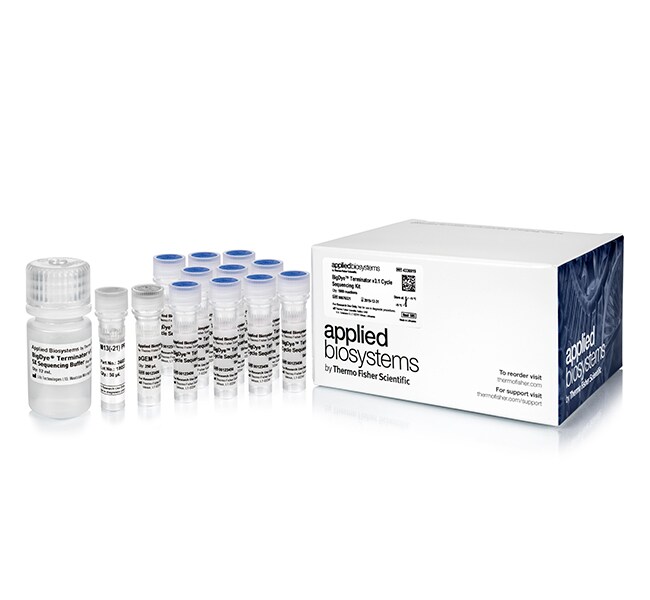
What information should I include when submitting data to Genetic Analysis Technical Support?
When contacting Genetic Analysis Support (FAS, FSE, Technical Support), please have (if possible):
Instrument model and serial numbers
Version of the software are you using
Application and/or kit information
Kit lot number
Number of runs on the capillary or array
Polymer type and lot number
Buffer lot number
Hi-Di Formamide lot number or loading solution information
Sample data that can be sent to the support person
Details on:
-Reaction setup (i.e., how much DNA was used, primer, etc.)
-How the reactions were cleaned up (alcohol precipitation, columns, etc)
-What template DNA was used (i.e. plasmid, PCR product)
-How the template DNA was prepared?
All of this information will help the support person quickly and accurately assess the problem and provide you with recommendations for resolution.
Find additional tips, troubleshooting help, and resources within our Capillary Electrophoresis Applications Support Center.
I have a long homopolymer stretch in my sample that I cannot get through. Do you have any tips for getting through it?
In order to get through homopolymeric regions, you can either use anchored sequencing primers or try using the dRhodamine Terminator Cycle Sequencing Kit since it uses ddTTP instead of ddUTP and has been shown to be less prone to producing stutters, specifically with poly-T regions.
For more information on sequencing through homopolymer stretches, please refer to the DNA Sequencing by Capillary Electrophoresis: Applied Biosystems Chemistry Guide: Second Edition (Cat. No. 4305080, Rev. C). The guide can be found by searching the Thermo Fisher Scientific website with the catalog number 4305080.
Find additional tips, troubleshooting help, and resources within our Capillary Electrophoresis Applications Support Center.
I am trying to sequence GC-rich DNA without success. Do you have any tips for getting through this?
When trying to sequence through GC-rich regions, the following tips may improve your success:
• Set the reaction up at 1X or 0.5X strength. Heavily diluting the BigDye Terminator Ready Reaction mix can reduce the success of the sequecing reaction through long GC stretches.
• Perform a hot start at 98–99°C for 5 minutes.
• Use 5% (w/v) DMSO or freshly made betaine in the reaction.
• Use the dGTP BigDye Terminator Cycle Sequencing Kit. G peaks will appear compressed due to the presence of ddGTP, but sequencing through long GC stretches using the dGTP kit is typically more successful than with the standard BigDye Terminator Cycle Sequencing Kits (containing ddITP).
For more information on sequencing GC-rich DNA, please refer to the DNA Sequencing by Capillary Electrophoresis: Applied Biosystems Chemistry Guide: Second Edition (Cat. No. 4305080, Rev. C). The guide can be found by searching the Thermo Fisher Scientific website with the catalog number 4305080.
Find additional tips, troubleshooting help, and resources within our Capillary Electrophoresis Applications Support Center.
I see another sequence running under mine. What can cause this?
Some of the causes of another sequence appearing under the primary sequence are:
• Contamination: There is more than one species of DNA present (e.g., multiple PCR products).
• Primers: Primer is annealing in more than one location on the template, primer dimer, primer degradation or not manufactured properly resulting in N+1 or N-1, carry over from PCR reaction, or primers pairs in a multiplex reaction that are not appropriate for multiplexing (i.e., primers anneal inappropriately).
• Spectral/Matrix: If the raw data signal intensity of the sample is too high or saturated it can exceed the amount of color bleedthrough (or spectral overlap) that the matrix (310) or spectral (3130, 3730, 3500) are removing, resulting in secondary peaks appearing in a very specific pattern (e.g., a red peak always appearing under a green peak). A change in the camera, laser, or optical alignment requires that a new matrix be made or a new spectral calibration be performed.
For more information on more than one sequence or set of peaks in a sequencing run, please refer to the DNA Sequencing by Capillary Electrophoresis: Applied Biosystems Chemistry Guide: Second Edition (Cat. No. 4305080, Rev. C). The guide can be found by searching the Thermo Fisher Scientific website with the catalog number 4305080.
Find additional tips, troubleshooting help, and resources within our Capillary Electrophoresis Applications Support Center.
My data seems top heavy. It starts out strong and then gets weaker. What can cause this?
The cause of this is usually an overabundance of template DNA relative to the amount of BigDye Terminator Ready Reaction mix being used in the reaction. This can drive the reaction to incorporate the labeled ddNTPs closer to the 5’ end of the sequence. To balance the signal, either increase the amount of BigDye Terminator Ready Reaction mix being used in the reaction or decrease the concentration of the template DNA.
For more information on other causes of short reads and how to address each issue, please refer to the DNA Sequencing by Capillary Electrophoresis: Applied Biosystems Chemistry Guide: Second Edition (Cat. No. 4305080, Rev. C). The guide can be found by searching the Thermo Fisher Scientific website with the catalog number 4305080.
Find additional tips, troubleshooting help, and resources within our Capillary Electrophoresis Applications Support Center.