Search


引用和文献 (1421)
Applied Biosystems™
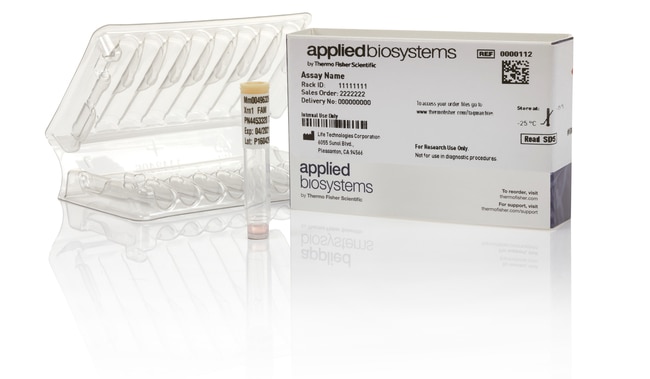
TaqMan™ SNP 基因分型试剂盒,小鼠
Applied Biosystems TaqMan SNP 基因分型检测试剂盒使用 TaqMan 5´‑核酸酶化学试剂扩增和检测纯化基因组 DNA 样品中的特定多态性。每项测定可对个体进行单核苷酸多态性了解更多信息
Have Questions?
更改视图

| 货号 | 数量 |
|---|---|
| 4351384 | S (300 reactions), Made to Order |
| 4351382 | M (1000 reactions), Made to Order |
| 4351380 | L (2400 reactions), Made to Order |
货号 4351384
价格(CNY)
4,235.00
Each
数量:
S (300 reactions), Made to Order
Applied Biosystems TaqMan SNP 基因分型检测试剂盒使用 TaqMan 5´‑核酸酶化学试剂扩增和检测纯化基因组 DNA 样品中的特定多态性。每项测定可对个体进行单核苷酸多态性 (SNP) 基因分型,包括两个序列特异性引物和两个 TaqMan 小沟结合物 (MGB) 探针以及非荧光淬灭剂 (NFQ)。一个探针用 VIC 染料标记以检测等位基因 1 序列;第二个探针用 FAM 染料标记以检测等位基因2序列。
预设计的 TaqMan SNP 基因分型小鼠检测试剂盒系列包含超过10000次检测。对于未包含在预设计检测试剂盒系列范围内的靶标,可使用定制 TaqMan SNP 基因分型检测试剂盒来满足您的研究需求。
优点:
•技术成熟可靠 — 此款金标准的 TaqMan 化学试剂和稳健的检测产品设计能够提供准确、可重现且可靠的结果
• 操作简单 — 单管规格方便易用,工作流程简单易懂,为得出可靠结果提供了一种简便途径;无需优化
• 保证 — 如果您对 TaqMan 测定试剂盒的性能不满意,我们将免费更换该试剂盒,或者将退款打入您的账户*
大致运输时间
北美4–6天、欧洲6–10天
TaqMan SNP 基因分型测定试剂盒仅需三个反应组分进行 PCR:纯化基因组 DNA (1–20 ng)、检测溶液和 TaqMan 基因分型预混液(或其他兼容的预混液)(单独出售)。
所有检测的设计都是来源于生物信息学流程,在过去十年中不断通过生产和检测性能数据进行优化。 TaqMan 试剂盒已被超过40000份出版物引用,并且拥有超过350项专利。
我们所有的预设计 TaqMan 试剂盒均具备 TaqMan 试剂盒 qPCR 保证。*
推荐的预混液(单独销售):TaqMan 基因分型预混液
*适用条款和条件。有关完整详细信息,请访问 www.thermofisher.cn/taqmanguarantee。
预设计的 TaqMan SNP 基因分型小鼠检测试剂盒系列包含超过10000次检测。对于未包含在预设计检测试剂盒系列范围内的靶标,可使用定制 TaqMan SNP 基因分型检测试剂盒来满足您的研究需求。
优点:
•技术成熟可靠 — 此款金标准的 TaqMan 化学试剂和稳健的检测产品设计能够提供准确、可重现且可靠的结果
• 操作简单 — 单管规格方便易用,工作流程简单易懂,为得出可靠结果提供了一种简便途径;无需优化
• 保证 — 如果您对 TaqMan 测定试剂盒的性能不满意,我们将免费更换该试剂盒,或者将退款打入您的账户*
大致运输时间
北美4–6天、欧洲6–10天
TaqMan SNP 基因分型测定试剂盒仅需三个反应组分进行 PCR:纯化基因组 DNA (1–20 ng)、检测溶液和 TaqMan 基因分型预混液(或其他兼容的预混液)(单独出售)。
所有检测的设计都是来源于生物信息学流程,在过去十年中不断通过生产和检测性能数据进行优化。 TaqMan 试剂盒已被超过40000份出版物引用,并且拥有超过350项专利。
我们所有的预设计 TaqMan 试剂盒均具备 TaqMan 试剂盒 qPCR 保证。*
推荐的预混液(单独销售):TaqMan 基因分型预混液
*适用条款和条件。有关完整详细信息,请访问 www.thermofisher.cn/taqmanguarantee。
仅供科研使用。不可用于诊断程序。
规格
3' 引物修改无
5' 引物修改无
描述VIC™ - MGB 探针检测等位基因 1、FAM - MGB 探针检测等位基因 2
适用于(设备)7500 系统、7500 Fast 系统、7900HT 系统、StepOne™、StepOnePlus™、ViiA™ 7 系统、QuantStudio™ 3、QuantStudio™ 5、QuantStudio™ 6 Flex、QuantStudio™ 7 Flex、QuantStudio 6 Pro、QuantStudio 7 Pro、QuantStudio™ 12k Flex ProFlex PCR 系统*、VeritiPro*、SimpliAmp*、MiniAmp*、自动热循环仪*
* 如果使用热循环仪进行 PCR 扩增,为检测和记录荧光信号,必须在实时荧光定量 PCR系统上分别执行可选的预读和后读操作。
* 如果使用热循环仪进行 PCR 扩增,为检测和记录荧光信号,必须在实时荧光定量 PCR系统上分别执行可选的预读和后读操作。
产品规格Made to Order
内部探针修改VIC™ (5')、FAM (5')、MGB(小沟结合物)(3')
反应次数300 次反应
产品线TaqMan
纯化方法固相萃取 (SPE)
纯度或质量等级不含 RNase 和 DNase
数量S (300 reactions), Made to Order
运输条件室温
种属小鼠
靶标目前已有超过10000种小鼠测定试剂可供选择
最大浓度40X
适用于(应用)基因分型
形式冰冻
标签或染料FAM, VIC:
Unit SizeEach
内容与储存
1 管含 40X(S 和 M 规格)或 80X(L 规格)预配制测定试剂(2 探针和 2 引物)混合物的试管。
储存于 -15 到 -25°C。
储存于 -15 到 -25°C。
常见问题解答 (FAQ)
What is the maximum size of insertion/deletion that can be detected by a TaqMan SNP Genotyping Assay?
What can I do if there are no predesigned assays to my SNP?
How do I find an assay to my SNP?
Can the TaqMan SNP Genotyping Assays be used for allele quantification?
In my TaqMan SNP Genotyping Assay, which base is labeled with FAM or VIC dye?
引用和文献 (1421)
引用和文献
Abstract
Determination, mechanism and monitoring of knockdown resistance in permethrin-resistant human head lice, Pediculus humanus capitis
Journal:JOURNAL OF ASIA-PACIFIC ENTOMOLOGY
PubMed ID:
Permethrin resistance has been reported worldwide and clinical failures to commercial pediculicides containing permethrin have likewise occurred. Permethrin resistance in head lice populations from the U.S. is widespread but is not yet uniform and the level of resistance is relatively low (∼4-8 fold). Permethrin-resistant lice are cross-resistant to pyrethrins, PBO-synergized
Geographical mapping of a multifocal thyroid tumour using genetic alteration analysis & miRNA profiling
Journal:Molecular Cancer
PubMed ID:
Background: Papillary thyroid carcinoma (PTC) frequently presents as multiple tumour-foci within a single thyroid gland or pluriform, with synchronous tumours comprising different histological variants, raising questions regarding its clonality. Among the genetic aberrations described in PTC, the BRAF V600E mutation and ret/PTC activation occur most commonly. Several studies have investigated
Risk haplotype analysis for bovine paratuberculosis
Journal:JOURNAL OF NEURAL TRANSMISSION
PubMed ID:
Paratuberculosis (Johne's disease), caused by Mycobacterium avium subsp. paratuberculosis, is an important disease for bovines, although its genetic basis is poorly understood. In this study, three candidate genes were typed to study the associations between single nucleotide polymorphisms (SNPs) and paratuberculosis susceptibility (measured in a 1 or 0 form) at
Risk haplotype analysis for bovine paratuberculosis
Journal:MAMMALIAN GENOME
PubMed ID:
Paratuberculosis (Johne's disease), caused by Mycobacterium avium subsp. paratuberculosis, is an important disease for bovines, although its genetic basis is poorly understood. In this study, three candidate genes were typed to study the associations between single nucleotide polymorphisms (SNPs) and paratuberculosis susceptibility (measured in a 1 or 0 form) at
Association of Polymorphisms in Genes of the Homologous Recombination DNA Repair Pathway and Thyroid Cancer Risk
Journal:THYROID
PubMed ID:
Background: Ionizing radiation exposure has been pointed out as a risk factor for thyroid cancer. The double-strand breaks induced by this carcinogen are usually repaired by homologous recombination repair pathway, a pathway that includes several polymorphic genes. Since there is a scarcity of data about the involvement of these gene