Search


引用和文献 (20)
Applied Biosystems™
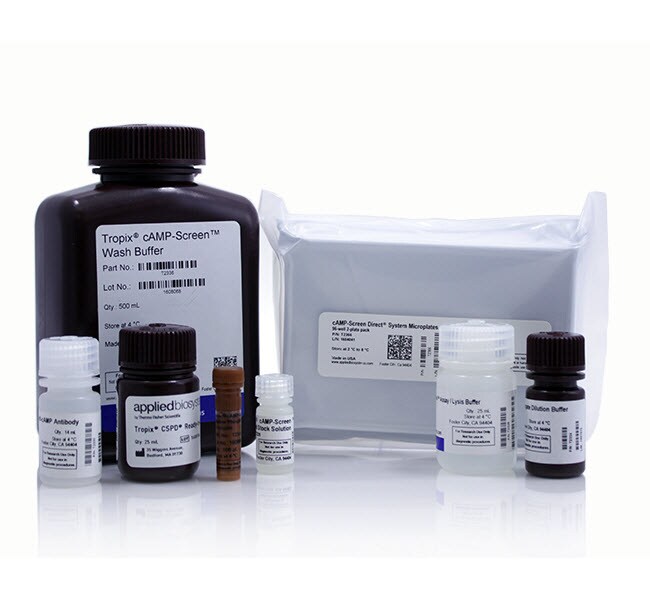
cAMP-Screen Direct™ 环状 AMP 免疫检测系统
cAMP-Screen Direct™ 96孔环状 AMP 免疫检测系统可对细胞裂解物中的环状 AMP (cAMP) 水平进行超灵敏测定。该竞争性化学发光免疫检测在规格方面具有较大的灵活性,可以手动添加试剂或进行自动高通量处理。cAMP了解更多信息
Have Questions?
更改视图

| 货号 | 数量 |
|---|---|
| 4412186 | 192项测定 (2 x 96) |
| 4412187 | 960 次检测 |
货号 4412186
价格(CNY)
14,355.00
Each
数量:
192项测定 (2 x 96)
价格(CNY)
14,355.00
Each
cAMP-Screen Direct™ 96孔环状 AMP 免疫检测系统可对细胞裂解物中的环状 AMP (cAMP) 水平进行超灵敏测定。该竞争性化学发光免疫检测在规格方面具有较大的灵活性,可以手动添加试剂或进行自动高通量处理。cAMP 检测使用高度灵敏的化学发光 CSPD™ 底物和 Sapphire-II™ 增强剂(由结合碱性磷酸酶的 cAMP (cAMP-AP) 组成的酶偶联物引发)。化学发光底物/增强剂制剂是一种即用型试剂,添加后30分钟就可以产生持续的辉光发射。该检测主要用于二次筛选和临床前研究,其中灵敏度和无假阳性十分重要。
•所有市售 cAMP 检测的较高灵敏度
•数小时的读取时间,信号几乎或根本不会降低
•方案简单,细胞可直接在检测板上生长
•可用于多种受体激活研究
高灵敏度和数小时稳定的辉光时间
这一化学发光检测设计用于提供所有市售 cAMP 检测的较高灵敏度。可检测到少至60飞克分子的 cAMP。该检测具有较宽的动态范围,可检测 0.06 至 6,000 皮克分子的 cAMP 而无需进行样品稀释或乙酰化等操作。其在基于细胞的检测中测定 Gs 或 Gi 耦合激动剂或拮抗剂刺激和/或抑制时,尤为有用。重复样品的测定内精度通常为 5% 或更少。一旦底物/增强剂制剂达到辉光信号,则可读取板数小时,且信号几乎或根本不会降低。这在进行几个板互相比较的筛选中很有用。此外,该检测还表现出与其他含腺苷的核苷酸或环核苷酸的超低交叉反应性。
适用于受体激活研究
cAMP-Screen Direct™ 系统设计用于定量分析受体激活功能检测的细胞 cAMP。该检测与已建立的细胞系结合用于以下各项的功能测量:内源性受体、在细胞表面具有外源性表达配体受体的细胞系、原代细胞培养物和响应适当配体处理的组织。此外,它还用于受体表征、孤立受体配体鉴别及新型嵌合受体的表征。该检测可用于刺激或干扰这些信号转导通路的化合物的高通量筛选。
方案简单—无需转移裂解物
该检测采用简单的方案。将细胞接种到平板中,进行培养并根据需要用测试化合物处理。细胞裂解物是在存在或不存在培养基的情况下制备的。将裂解物与 cAMP-AP 偶联物和抗 cAMP 抗体在包被微孔板中一起孵育;在板中捕获产生的免疫复合物。在不含 cAMP 的样品中,所有 cAMP-AP 偶联物均可在包被表面捕获,从而产生高信号。存在 cAMP 时,由于与未标记 cAMP 结合的竞争,导致捕获的 cAMP-AP 偶联物的量减少,从而使信号降低;信号降低与细胞裂解物中存在的 cAMP 量成正比。洗涤去除未结合的 cAMP-AP 后,添加化学发光底物并在光度计中测量产生的辉光信号。
该 cAMP-Screen Direct™ 系统的所有优势均与此 cAMP-Screen™ 系统相同,但不需要将细胞裂解物从组织培养板转移到预包被的微孔板中,因为细胞可以在微孔板中直接生长。只需减少一个转移步骤即可提供更好的测定精度。许多不同类型的细胞已成功地在预包被的微孔板上生长,这些微孔板的底部均透明以便监测细胞。
仅供研究使用。不可用于人或动物的治疗或诊断。
•所有市售 cAMP 检测的较高灵敏度
•数小时的读取时间,信号几乎或根本不会降低
•方案简单,细胞可直接在检测板上生长
•可用于多种受体激活研究
高灵敏度和数小时稳定的辉光时间
这一化学发光检测设计用于提供所有市售 cAMP 检测的较高灵敏度。可检测到少至60飞克分子的 cAMP。该检测具有较宽的动态范围,可检测 0.06 至 6,000 皮克分子的 cAMP 而无需进行样品稀释或乙酰化等操作。其在基于细胞的检测中测定 Gs 或 Gi 耦合激动剂或拮抗剂刺激和/或抑制时,尤为有用。重复样品的测定内精度通常为 5% 或更少。一旦底物/增强剂制剂达到辉光信号,则可读取板数小时,且信号几乎或根本不会降低。这在进行几个板互相比较的筛选中很有用。此外,该检测还表现出与其他含腺苷的核苷酸或环核苷酸的超低交叉反应性。
适用于受体激活研究
cAMP-Screen Direct™ 系统设计用于定量分析受体激活功能检测的细胞 cAMP。该检测与已建立的细胞系结合用于以下各项的功能测量:内源性受体、在细胞表面具有外源性表达配体受体的细胞系、原代细胞培养物和响应适当配体处理的组织。此外,它还用于受体表征、孤立受体配体鉴别及新型嵌合受体的表征。该检测可用于刺激或干扰这些信号转导通路的化合物的高通量筛选。
方案简单—无需转移裂解物
该检测采用简单的方案。将细胞接种到平板中,进行培养并根据需要用测试化合物处理。细胞裂解物是在存在或不存在培养基的情况下制备的。将裂解物与 cAMP-AP 偶联物和抗 cAMP 抗体在包被微孔板中一起孵育;在板中捕获产生的免疫复合物。在不含 cAMP 的样品中,所有 cAMP-AP 偶联物均可在包被表面捕获,从而产生高信号。存在 cAMP 时,由于与未标记 cAMP 结合的竞争,导致捕获的 cAMP-AP 偶联物的量减少,从而使信号降低;信号降低与细胞裂解物中存在的 cAMP 量成正比。洗涤去除未结合的 cAMP-AP 后,添加化学发光底物并在光度计中测量产生的辉光信号。
该 cAMP-Screen Direct™ 系统的所有优势均与此 cAMP-Screen™ 系统相同,但不需要将细胞裂解物从组织培养板转移到预包被的微孔板中,因为细胞可以在微孔板中直接生长。只需减少一个转移步骤即可提供更好的测定精度。许多不同类型的细胞已成功地在预包被的微孔板上生长,这些微孔板的底部均透明以便监测细胞。
仅供研究使用。不可用于人或动物的治疗或诊断。
仅供科研使用。不可用于诊断程序。
规格
检测灵敏度60 飞克分子 cAMP
适用于(设备)微孔板读数仪
基因 ID (Entrez)非基因
基因符号非基因
标签或染料AP
产品线cAMP-Screen Direct
蛋白质家族GPCR(G 蛋白偶联受体)
数量192项测定 (2 x 96)
样品体积60 μL
指定目标试剂盒环状 AMP
检测方法化学发光
样品类型细胞培养
Unit SizeEach
内容与储存
1个试剂盒,在 2°C 至 8°C 下储存
常见问题解答 (FAQ)
What chemiluminescent detection assays do you offer for determining cyclic AMP levels in cell lysates?
引用和文献 (20)
引用和文献
Abstract
Augmented axonal defects and synaptic degenerative changes in female GRK5 deficient mice.
Journal:Brain Res Bull
PubMed ID:18955119
'Recent studies suggested that G protein-coupled receptor kinase 5 (GRK5) deficiency plays a significant role in early Alzheimer''s disease (AD) pathogenesis, and that the GRK5 knockout (GRK5KO) mouse displays an early Alzheimer-like cognitive deficit associated with increased hippocampal axonal defects and synaptic degenerative changes. Gender is known to play a
A small molecule inverse agonist for the human thyroid-stimulating hormone receptor.
Journal:Endocrinology
PubMed ID:20427476
'Small molecule inverse agonists for the TSH receptor (TSHR) may be used as probes of the role of basal (or agonist-independent or constitutive) signaling and may have therapeutic potential as orally active drugs to inhibit basal signaling in patients with thyroid cancer and in some patients with hyperthyroidism. We describe
A homogeneous enzyme fragment complementation-based beta-arrestin translocation assay for high-throughput screening of G-protein-coupled receptors.
Journal:J Biomol Screen
PubMed ID:18660457
'G-protein-coupled receptors (GPCRs) represent one of the largest gene families in the human genome and have long been regarded as valuable targets for small-molecule drugs. The authors describe a new functional assay that directly monitors GPCR activation. It is based on the interaction between beta-arrestin and ligand-activated GPCRs and uses
Tumor necrosis factor (TNF)-soluble high-affinity receptor complex as a TNF antagonist.
Journal:J Pharmacol Exp Ther
PubMed ID:17495128
'A novel high-affinity inhibitor of tumor necrosis factor (TNF) is described, which is created by the fusion of the extracellular domains of TNF-binding protein 1 (TBP-1) to both the alpha and beta chains of an inactive version of the heterodimeric protein hormone, human chorionic gonadotropin. The resulting molecule, termed TNF-soluble
Occupancy of both sites on the thyrotropin (TSH) receptor dimer is necessary for phosphoinositide signaling.
Journal:FASEB J
PubMed ID:21705666
'The thyroid-stimulating hormone (TSH) receptor signals via G(s) to produce cAMP and via G(q/11) to produce inositol-1,4,5-trisphosphate, which is degraded to inositol monophosphate (IP1; phosphoinositide signaling). The potency of TSH for cAMP signaling is higher than for phosphoinositide signaling, and it was suggested that there are "spare receptors" for cAMP