Search

Thermo Scientific™
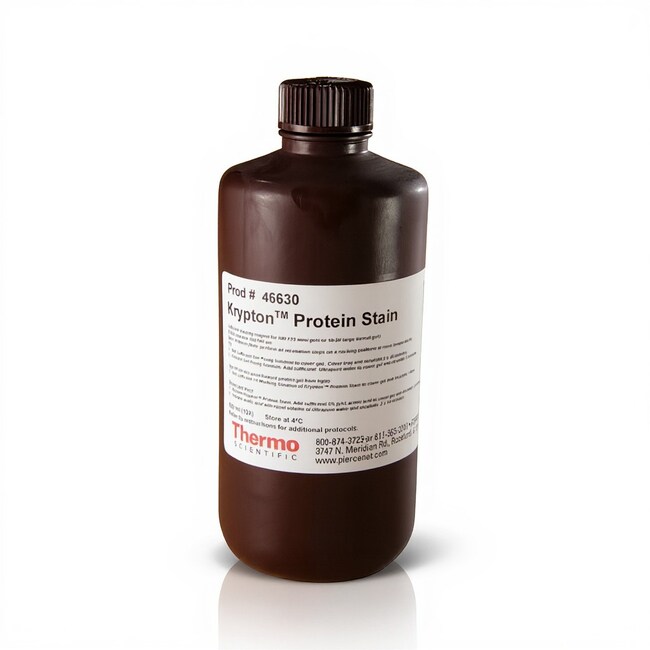
Krypton™ 荧光蛋白染色剂
Thermo Scientific Krypton Fluorescent Protein Stain enables sensitive visualization with fluorescence imagers (520nm excitation; 580nm emission) of proteins separated in了解更多信息
| 货号 | 数量 |
|---|---|
| 46630 | 500 mL |
货号 46630
价格(CNY)
12,021.00
Each
数量:
500 mL
价格(CNY)
12,021.00
Each
Thermo Scientific Krypton Fluorescent Protein Stain enables sensitive visualization with fluorescence imagers (520nm excitation; 580nm emission) of proteins separated in polyacrylamide gels or transferred to membranes.
Features of Krypton Fluorescent Protein Stain:
• Intense fluorescent stain—excitation and emission maxima of 520nm and 580nm, respectively (compatible with 532nm excitation light sources and 580 to 600nm emission filters)
• Instrument-compatible—effective with popular laser-based and filter-based fluorescence imagers
• Broad dynamic range—linear quantitative range spans three to four orders of magnitude Sensitive—detect as little as 0.25ng protein with the standard protocol (approx. 2.5 hours); at least as sensitive as fluorescent stains from other suppliers
• Fast—standard (2.5 hours) and rapid (30 minutes) protocols are significantly faster than procedures of other popular fluorescent stains
• Versatile—compatible with proteomics workflows involving downstream mass spectrometry
• Compact—supplied as a 10X solution to save storage space; just dilute with water before use
This fluorescent protein gel stain is for bright yellow-orange fluorescent detection of proteins separated by 1D or 2D polyacrylamide gel electrophoresis (SDS-PAGE). Krypton Stain uses a protein-binding dye with fluorescence properties (Ex/Em = 520/580nm) suitable for visualization with a variety of standard laser-based and filter-based fluorescence imagers and documentation systems. Proteins are detectable at concentrations greater than 0.25ng per band in a typical mini-gel lane (greater than 2ng for the rapid staining protocol). Krypton Stain provides high signal intensity, exhibits minimal protein-to-protein variation, has an excellent quantitative dynamic range and is compatible with subsequent destaining and analysis by mass spectrometry.
For best results, detect bands using visible laser-based imagers equipped with a 532nm laser light source. Although 580nm-filters are optimal for emission, 600nm-filters are also compatible. Stained gels can be imaged on any platform with the respective excitation and emission filters.
Features of Krypton Fluorescent Protein Stain:
• Intense fluorescent stain—excitation and emission maxima of 520nm and 580nm, respectively (compatible with 532nm excitation light sources and 580 to 600nm emission filters)
• Instrument-compatible—effective with popular laser-based and filter-based fluorescence imagers
• Broad dynamic range—linear quantitative range spans three to four orders of magnitude Sensitive—detect as little as 0.25ng protein with the standard protocol (approx. 2.5 hours); at least as sensitive as fluorescent stains from other suppliers
• Fast—standard (2.5 hours) and rapid (30 minutes) protocols are significantly faster than procedures of other popular fluorescent stains
• Versatile—compatible with proteomics workflows involving downstream mass spectrometry
• Compact—supplied as a 10X solution to save storage space; just dilute with water before use
This fluorescent protein gel stain is for bright yellow-orange fluorescent detection of proteins separated by 1D or 2D polyacrylamide gel electrophoresis (SDS-PAGE). Krypton Stain uses a protein-binding dye with fluorescence properties (Ex/Em = 520/580nm) suitable for visualization with a variety of standard laser-based and filter-based fluorescence imagers and documentation systems. Proteins are detectable at concentrations greater than 0.25ng per band in a typical mini-gel lane (greater than 2ng for the rapid staining protocol). Krypton Stain provides high signal intensity, exhibits minimal protein-to-protein variation, has an excellent quantitative dynamic range and is compatible with subsequent destaining and analysis by mass spectrometry.
For best results, detect bands using visible laser-based imagers equipped with a 532nm laser light source. Although 580nm-filters are optimal for emission, 600nm-filters are also compatible. Stained gels can be imaged on any platform with the respective excitation and emission filters.
仅供科研使用。不可用于诊断程序。
规格
检测定位凝胶内检测
检测方法荧光
数量500 mL
靶标分子蛋白质
标签或染料具有专利技术的预混液
产品线Krypton
产品类型蛋白染料
Unit SizeEach
内容与储存
收到产品后,在 4°C 下储存。