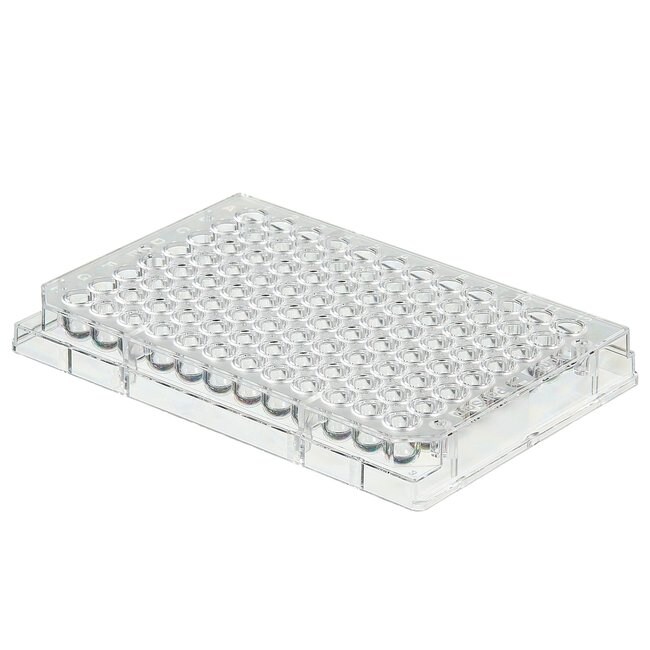
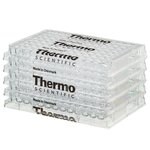
For Clear Flat-Bottom Immuno Nonsterile 96-Well Plates, is the surface treatment solely on the bottom of the well, or is it also applied to the sides?
For energy treated plates, the entire plate surface receives the energy treatment. The MaxiSorp, PolySorp, MediSorp and MultiSorp plates are energy treated plates. For traditionally treated plates, the well surface is treated up to the listed working volume.
Are your Thermo Scientific 8-Well Strip Caps for Immuno Standard Modules compatible with all Nunc MicroWell 96-Well Microplates and Nunc Immuno 96-Well Plates?
Our Thermo Scientific 8-Well Strip Caps for Immuno Standard Modules were designed to provide a positive seal for flat and round bottom wells of our Nunc MicroWell 96-Well Microplates and Nunc Immuno 96-Well Plates.
8-Well Strip Caps for Immuno Standard Modules are not compatible with C or V bottom wells of the Nunc Microwell 96-Well Microplates and Nunc Immuno 96-Well Plates.
For Nunc Immuno plates and modules, what are the advantages of one well geometry type over another? Which types should I use for various applications?
The following list describes the geometries of wells available for Nunc Immuno-plates and modules:
- Flat bottom (F): Allows maximum transmission of light. These plates can be read on a monochromatic reader.
- Round bottom (U): This geometry optimizes washing and coating. These plates can be read using a dual wavelength reader.
- "C" bottom (C): This design of the well is a combination of both flat and round bottoms. Basically, it is a flat bottomed well with curved edges at the bottom. These plates also can be read using a monochromatic reader combining optimal reading and washing.
- StarWell: These wells have a modified "C" shape geometry with eight fins strategically placed at the bottom. This feature increases surface area, allowing more molecules to become immobilized which reduces incubation times.
Which surfaces do you recommend for RIA (radioimmunoassay)?
The choice of plates or modules will depend on the type of RIA you are planning to perform and specific assay conditions. Nunc provides two different surfaces for immunoassays, PolySorp and MaxiSorp.
- MaxiSorp surface is highly charged and should be used if the assay requires quantitative measurement of proteins (antibodies) or molecules with polar groups.
- PolySorp surface should be used if the assay consists of less polar molecules with hydrophobic characteristics.
Which 96-well Immuno plates or modules do you recommend for various applications?
The following list offers a brief description of the features of Nunc products and their specific applications:
- Nunc-Immuno Plates, MaxiSorp surface - These plates are designed for solid phase immuno assays and have a polystyrene surface with high affinity for polar groups and hydrophilic molecules. These 96-well plates are available with flat (F), round (U), or (C) bottom-well designs.
- Nunc-Immuno Plates, PolySorp surface - These plates have a polystyrene surface which adsorps less polar molecules compared to the MaxiSorp surface and has a high affinity for hydrophobic groups. These 96-well plates are available with flat (F), round (U), or (C) bottom-well designs.
- Nunc-Immuno Modules - These modules are designed for solid-phase immuno assays. The modules are available in 8-, 12- or 16-well formats with (F), (U), and (C) bottom-well and 8-well BreakApart with (C) bottom-well designs. These different formats allow one to choose the style which is appropriate for their assay design.
BreakApart Modules and LockWell Modules can be used for radioimmunoassays.
- Nunc StarWell Immuno Breakable Modules - The 8-well modules feature eight fins on the inner wall of the (C) bottom wells. This design increases the surface area by 50%. The increase in surface area allows more molecules to be immobilized, increasing assay signal. The fin configuration provides shorter diffusion distance to the surface, reducing incubation times.
- LockWell Immuno Breakable Modules - Each plate consists of 1 x 8 breakable strips. These strips are assembled in a designed frame which locks each well into place by a spring lock. This spring lock design orientates each well at the same horizontal level allowing uniform washing and reading. The LockWell Modules are available with round (U), (C) or StarWell bottom-well designs.
- Plates and Modules with (CovaLink) Covalent Binding Surfaces: These plates can be used to bind proteins, peptides, DNA or carbohydrates. Covalent linkage occurs via secondary amine group. This allows a specific orientation and provides improved stability compared to passive adsorption due to chemical binding between molecules. Binding of molecules on PolySorp and MaxiSorp surfaces is obtained by passive adsorption. CovaLink is a surface grafted with secondary amino groups (<NH) which serves as a bridge for covalent coupling. The covalent binding can immobilize small molecules such as biotin or peptides which may otherwise bind weakly by physical adsorption and facilitate the recognition by detection molecule.
- Nunc FluoroNunc/LumiNunc 96-Well Plates: These plates are optimized for IFMA (Immunofluorometric Assays) or FIA (Fluorometric Immuno Assays). The transparent polystyrene plates give a low background fluorescence and are optimal where a read-through system is used. The white plates/modules provide maximum reflection of fluorescence signal while maintaining low background. The white plates/modules are often used for epifluorescence reading. Black modules reduce background fluorescence and minimize back-scatter light which is often encountered in epifluorescence.