Search


引用和文献 (10)
Thermo Scientific™
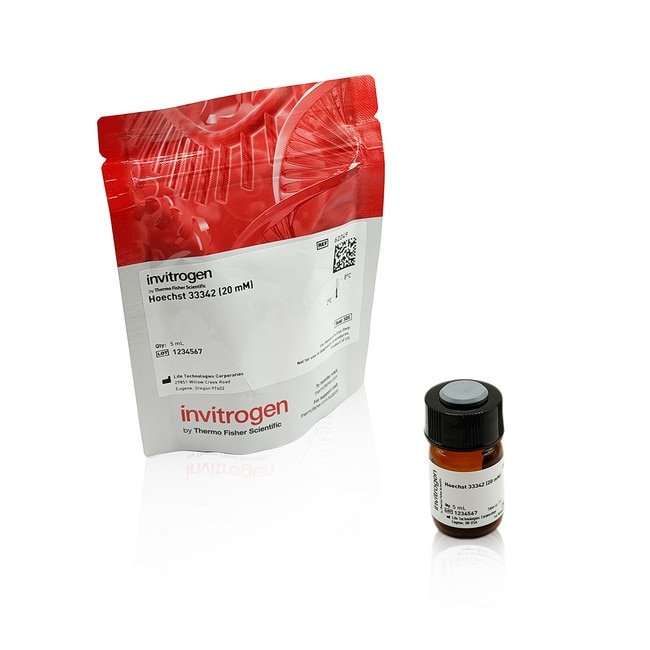
Hoechst 33342 溶液 (20 mM)
Thermo Scientific Pierce Hoechst 33342 荧光染料是一种高质量 Hoechst 染料溶液,可用于细胞成像技术中 DNA 和细胞核的固定细胞和活细胞荧光染色了解更多信息
| 货号 | 数量 |
|---|---|
| 62249 | 5 mL |
货号 62249
价格(CNY)
1,557.00
Online exclusive
Ends: 31-Dec-2026
2,162.00共减 605.00 (28%)
Each
数量:
5 mL
价格(CNY)
1,557.00
Online exclusive
Ends: 31-Dec-2026
2,162.00共减 605.00 (28%)
Each
Thermo Scientific Pierce Hoechst 33342 荧光染料是一种高质量 Hoechst 染料溶液,可用于细胞成像技术中 DNA 和细胞核的固定细胞和活细胞荧光染色。
Hoechst 33342 荧光染料的特点:
•Hoechst 染料—专用于 DNA(即真核细胞的核)的蓝色荧光染料
• 便利—以易于使用的 Hoechst 染料溶液 (20 mM) 形式提供
• 细胞成像—细胞渗透性染料可有效用于固定细胞和活细胞染色
• 复染剂—适用于与荧光显微镜检查或高内涵筛选 (HCS) 荧光抗体的特定靶标检测配合使用
Hoechst 33342(2'-[4-乙氧基苯基]-5-[4-甲基-1-哌嗪基]-2,5'-bi-1H-苯并咪唑三盐酸化物三水合物)是一种细胞渗透性 DNA 染色剂,可被紫外光激发并在 460 至 490 nm 处发射蓝色荧光。Hoechst 33342 优先与 DNA 的腺嘌呤-胸腺嘧啶 (A-T) 区域结合。该染料可与 DNA 的小沟结合,展现出依赖于染料:碱基对比值的不同荧光发射光谱。
Hoechst 荧光染料的特性
作为荧光成像方法的复染剂,Hoechst 染料可兼容荧光素和罗丹明染料标记的抗体及其他探针以及 Thermo Scientific DyLight Fluor。稳定的 20 mM 水性储备液基本可直接使用。
Hoechst33342 用于活细胞或固定细胞和组织的细胞核的特异性染色。该染色剂通常与 5-溴-2'-脱氧尿苷 (BrdU) 标记结合使用,以区分凋亡细胞核的紧凑染色质,从而确定复制细胞并根据细胞 DNA 含量对细胞进行分类。Hoechst 33342 和碘化丙啶通常一起用于对细胞凋亡和细胞周期分布各个阶段同时进行流式细胞和荧光成像分析。
Hoechst 33342 荧光染料的特点:
•Hoechst 染料—专用于 DNA(即真核细胞的核)的蓝色荧光染料
• 便利—以易于使用的 Hoechst 染料溶液 (20 mM) 形式提供
• 细胞成像—细胞渗透性染料可有效用于固定细胞和活细胞染色
• 复染剂—适用于与荧光显微镜检查或高内涵筛选 (HCS) 荧光抗体的特定靶标检测配合使用
Hoechst 33342(2'-[4-乙氧基苯基]-5-[4-甲基-1-哌嗪基]-2,5'-bi-1H-苯并咪唑三盐酸化物三水合物)是一种细胞渗透性 DNA 染色剂,可被紫外光激发并在 460 至 490 nm 处发射蓝色荧光。Hoechst 33342 优先与 DNA 的腺嘌呤-胸腺嘧啶 (A-T) 区域结合。该染料可与 DNA 的小沟结合,展现出依赖于染料:碱基对比值的不同荧光发射光谱。
Hoechst 荧光染料的特性
作为荧光成像方法的复染剂,Hoechst 染料可兼容荧光素和罗丹明染料标记的抗体及其他探针以及 Thermo Scientific DyLight Fluor。稳定的 20 mM 水性储备液基本可直接使用。
Hoechst33342 用于活细胞或固定细胞和组织的细胞核的特异性染色。该染色剂通常与 5-溴-2'-脱氧尿苷 (BrdU) 标记结合使用,以区分凋亡细胞核的紧凑染色质,从而确定复制细胞并根据细胞 DNA 含量对细胞进行分类。Hoechst 33342 和碘化丙啶通常一起用于对细胞凋亡和细胞周期分布各个阶段同时进行流式细胞和荧光成像分析。
仅供科研使用。不可用于诊断程序。
规格
颜色蓝色
最大浓度20 mM
检测方法荧光
染料类型细胞通透性
发射497 nm
激发波长范围361 nm
适用于(应用)荧光标记
适用于(设备)荧光显微镜、高内涵仪器
形式液体
产品线Pierce
数量5 mL
运输条件室温
标签类型Fluorescent Dye
产品类型核酸染色剂
亚细胞定位细胞核/核仁
Unit SizeEach
内容与储存
收货后,在 4°C 下避光储存。
常见问题解答 (FAQ)
我有一份活细菌和血小板细胞的混合液,需要将其中的细菌分离出来。你们有什么建议吗?
DAPI和Hoechst 染料非常相似,该如何选用?
Is DAPI a good live-cell nuclear label?
I want to label the nuclei of live cells and track them over time. Can I use DAPI for this?
I have a mix of live bacteria and platelet cells, and I need to be able to separate out the bacteria. Do you have a suggestion?
引用和文献 (10)
引用和文献
Abstract
Generation, transcriptome profiling, and functional validation of cone-rich human retinal organoids.
Journal:Proc Natl Acad Sci U S A
PubMed ID:31072937
'Rod and cone photoreceptors are light-sensing cells in the human retina. Rods are dominant in the peripheral retina, whereas cones are enriched in the macula, which is responsible for central vision and visual acuity. Macular degenerations affect vision the most and are currently incurable. Here we report the generation, transcriptome
Yin Yang 1 Orchestrates a Metabolic Program Required for Both Neural Crest Development and Melanoma Formation.
Journal:Cell Stem Cell
PubMed ID:30951662
'Increasing evidence suggests that cancer cells highjack developmental programs for disease initiation and progression. Melanoma arises from melanocytes that originate during development from neural crest stem cells (NCSCs). Here, we identified the transcription factor Yin Yang 1 (Yy1) as an NCSCs regulator. Conditional deletion of Yy1 in NCSCs resulted in
Semisynthetic biosensors for mapping cellular concentrations of nicotinamide adenine dinucleotides.
Journal:Elife
PubMed ID:29809136
We introduce a new class of semisynthetic fluorescent biosensors for the quantification of free nicotinamide adenine dinucleotide (NAD
Neuropsin (OPN5) Mediates Local Light-Dependent Induction of Circadian Clock Genes and Circadian Photoentrainment in Exposed Murine Skin.
Journal:Curr Biol
PubMed ID:31607531
Nearly all mammalian tissues have functional, autonomous circadian clocks, which free-run with non-24 h periods and must be synchronized (entrained) to the 24 h day. This entrainment mechanism is thought to be hierarchical, with photic input to the retina entraining the master circadian clock in the suprachiasmatic nuclei (SCN) and the SCN
Ca
Journal:Mol Cell
PubMed ID:31053472
Abnormal processing of stressed replication forks by nucleases can cause fork collapse, genomic instability, and cell death. Despite its importance, it is poorly understood how the cell properly controls nucleases to prevent detrimental fork processing. Here, we report a signaling pathway that controls the activity of exonuclease Exo1 to prevent