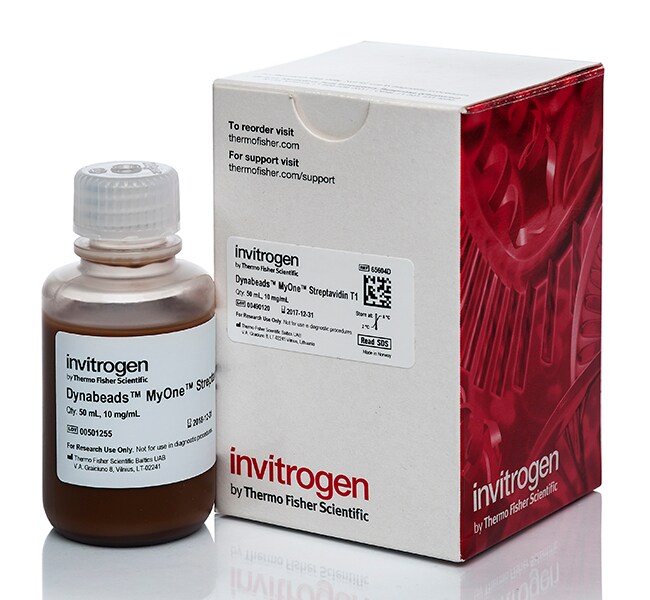
Dynabeads™ MyOne™ 链霉亲和素 T1
Invitrogen17万+抗体限时买二赠一,靶点广,灵活用!
Dynabeads™ MyOne™ 链霉亲和素 T1
Invitrogen™

Dynabeads™ MyOne™ 链霉亲和素 T1

Dynabeads MyOne 链霉素亲和素 T1 是分离和处理生物素化核酸、抗体或其他生物素化配体及靶标的黄金标准。链霉亲和素-生物素相互作用的极高结合亲和力(Kd=10-15)已在大量应用中使用。优点及特性:•可直接快速分离任意生物素化分子•了解更多信息
Have Questions?
更改视图buttonViewtableView
货号产品类型数量
65604DDynabeads™ MyOne™ Streptavidin T150 mL
65001Dynabeads™ MyOne™ Streptavidin C12 mL
65002Dynabeads™ MyOne™ Streptavidin C110 mL
65602Dynabeads™ MyOne™ Streptavidin T110 mL
65601Dynabeads™ MyOne™ Streptavidin T12 mL
65605DDynabeads™ Streptavidin for Target Enrichment2 mL
65606DDynabeads™ Streptavidin for Target Enrichment10 mL
65607DDynabeads™ Streptavidin for Target Enrichment50 mL
11205DDynabeads™ M-280 Streptavidin2 mL
11206DDynabeads™ M-280 Streptavidin10 mL
60210Dynabeads™ M-280 Streptavidin100 mL
65305Dynabeads™ M-270 Streptavidin2 mL
65306Dynabeads™ M-270 Streptavidin10 mL
60101Dynabeads™ kilobaseBINDER™ Kit200 Isolations
65801DDynabeads™ Streptavidin Trial Kit4 x 1 mL
货号 65604D
价格(CNY)
93,285.00
Each
添加至购物车
产品类型:
Dynabeads™ MyOne™ Streptavidin T1
数量:
50 mL
价格(CNY)
93,285.00
Each
添加至购物车

Dynabeads MyOne 链霉素亲和素 T1 是分离和处理生物素化核酸、抗体或其他生物素化配体及靶标的黄金标准。链霉亲和素-生物素相互作用的极高结合亲和力(Kd=10-15)已在大量应用中使用。优点及特性:

•可直接快速分离任意生物素化分子
• 灵活的实验方案,温和高效的液相反应动力学
• 低电荷和中性磁珠,适用于结合蛋白质、肽和抗体
• 小巧、均一的尺寸,确保每 mg 微珠均具有较大的表面积及对应靶分子的高容量
• 沉积速率低但含铁量高,可确保快速磁性分离
• 生物磁性实验方案,可针对自动化平台轻松灵活调整
• 高批次间重现性,可确保应用得到一致的结果

关于 Dynabeads MyOne 链霉素亲和素 T1
这些粒径均一的超顺磁性微珠直径为 1 µm,具有单层而非多层的重组链霉素亲和素,共价偶联至表面并进一步用 BSA 封闭。单层链霉亲和素留下了绝大多数生物素结合位点,不仅可用于结合游离的生物素,还可用于结合生物素化配体/靶标。该磁珠表现出了快速液相反应动力学。其特异性、确定的表面可实现高效捕获、分离与下游处理。单层链霉亲和素确保泄漏水平可忽略不计,同时又没有过量吸附的链霉亲和素,从而保证了结果的一致性和可重现性。1 µm Dynabeads MyOne 磁珠在培养时表面积大、容量高、磁吸效率高、沉积速率低。可针对亟需高通量的自动化方案量身定制。

应用
在过去15年中,链霉素亲和素偶联的 Dynabeads 已被大量应用使用和引用。其关键应用包括单链 DNA 模板制备、RNA 和 DNA 结合蛋白分离、大分子 DNA 片段固定、产物纯化测序,以及核酸特异性捕获。可针对自动化流程轻松灵活调整。Dynabeads 在全球超过25,000台常规 IVD 仪器上使用。

结合能力
分子大小和生物素化程序都会影响结合能力。结合能力还取决于可用的空间和微珠与分子之间及分子与分子之间的电荷相互作用。在结合之后,微珠表面的每个亲和素分子有两个或三个生物素结合位点。每 mg Dynabeads MyOne 链霉素亲和素 T1 通常可结合:

•950–1500 pmol 游离生物素
• ∼20 µg 生物素化 IgG
• ∼400 pmol 生物素化肽
• ∼20 µg ds-DNA
• ∼400 pmol ss-寡核苷酸

仅供科研使用。不可用于诊断程序。
规格
磁珠类型Magnetic polystyrene-based beads covalently coupled with recombinant Streptavidin
结合属性950-1500 pmoles free biotin/mg beads
认证/合规ISO9001 and ISO13485
最大浓度10 mg/mL
直径(公制)1 μm (CV < 5%)
适用于(应用)Immunoassays, IP, ChIP, RIP, cell isolations, or DNA isolation for downstream amplification reactions or NGS, requiring high sensitivity, rapid target capture with compatibility with subsequent enzymatic reactions
适用于(设备)KingFisher™ Sample Purification System, DynaMag™ magnets
高通量能力High-throughput Compatible
产品线Dynabeads
产品类型Dynabeads™ MyOne™ Streptavidin T1
数量50 mL
调控状态For Research Use Only
有效期48 months from date of manufacture
运输条件Ambient Temperature
表面功能基团Tosylactivated hydrophobic surface blocked with BSA
产品规格Beads in Suspension
分离技术Magnetic Bead
Unit SizeEach
内容与储存
Dynabeads MyOne Streptavidin T1 are supplied in PBS, pH 7.4, with 0.1% BSA and 0.02% NaN3 . Store at 2–8°C.

常见问题解答 (FAQ)

降低Dynabeads磁珠沉降速度的最佳pH是多少?

这取决于涂层或生物素化分子的特性。我们建议您通过测试来确定针对特定实验的最佳条件。

What is the optimal pH to reduce the settling rate for Dynabeads magnetic beads?

This is dependent on coating or the biotinylated molecule properties. Our recommendation is that this should be tested to find optimum conditions for the specific assay.

Find additional tips, troubleshooting help, and resources within our Dynabeads Nucleic Acid Purification Support Center.

What is the density of Dynabeads magnetic beads?

The density of Dynabeads magnetic beads is a challenging property to determine. The reason is that Dynabeads magnetic beads have a 17-37% magnetic iron oxide content in order to have a reasonable magnetic separation time, and the density of the iron oxide is about 4.9 g/cm3. Dynabeads magnetic beads are composite materials, being a mix of polymers and iron oxide, and there are very few polymers that have a density below 1.

The sedimentation rate depends on the bead diameter squared, so the sedimentation of a 1 µm bead is much slower than that of 2.8 µm. The effect of diameter on sedimentation rate is to some extent counteracted by the fact that smaller beads need to have a higher content of iron oxide for magnetic separation applications. Typically, our M-280 Dynabeads (diameter 2.8 µm) have a density of 1.4 g DS/cm3 (DS = dry substance), our M-270 Dynabeads (diameter 2.8 µm) and M-450 Dynabeads (diameter 4.5 µm) have a density of 1.6 g DS/cm3, and our MyOne Dynabeads (diameter 1 µm) have a density of 1.8 g DS/cm3.

Find additional tips, troubleshooting help, and resources within our Dynabeads Nucleic Acid Purification Support Center as well as our Dynabeads Cell Isolation and Expansion Support Center and Protein Immunoprecipitation (IP), Co-Immunoprecipitation (Co-IP), and Pulldown Support Center.

As a negative control, I mixed my uncoated Streptavidin-Coupled Dynabeads with my sample but got lots of non-specific binding to the beads. Why?

When exposed to a sample consisting of different types of molecules, any solid phase matrix can interact with these molecules due to hydrophobicity, charge or other types of interactions. It is not surprising that you get non-specific binding to the beads. This method is actually used for pre-clearing of sample and is not considered a good negative control. When pre-blocked and coated with a specific molecule, beads show a lot less non-specific binding than when they are not coated. As a negative control, you could try beads that are coated with an irrelevant molecule.

Find additional tips, troubleshooting help, and resources within ourProtein Immunoprecipitation (IP), Co-Immunoprecipitation (Co-IP), and Pulldown Support Center.

I have a dsDNA biotinylated on streptavidin Dynabeads. How can I dissociate the non-biotinylated DNA strand from the biotinylated one?

There are two methods to dissociate the non-biotinylated DNA from the biotinylated DNA strand. The following protocols are based on using 20 µL of Dynabeads Streptavidin, but are scalable. Both methods may release very small amounts of complementary biotinylated strand from streptavidin. If it is critical that no biotinylated strand is released, either adopt a different biotin modification using dual biotin (two biotin groups in sequence) or covalently bind DNA to e.g., Dynabeads M-270 Carboxylic Acid.

Using heat:

- Wash the DNA coated Dynabeads in 50 µL 1 x SSC.*
- Resuspend the beads in another 50 µL of 1 x SSC Incubate at 95 degrees C for 5 mins.
- Quickly put the tube in magnet stand for 1-2 mins and transfer the supernatant to a new tube.
- The supernatant contains your non-biotinylated DNA strand.

Using NaOH:

- Wash the DNA coated Dynabeads in 50 µL 1 x SSC.*
- Resuspend the beads in 20 µl of freshly prepared 0.15 M NaOH.
- Incubate at room temperature for 10 mins. Put the tube in magnet stand for 1-2 mins and transfer the supernatant to a new tube.
- The supernatant contains your non-biotinylated DNA strand. Neutralize the probe by adding 2.2 µL 10 x TE, pH 7.5 and 1.3 µL 1.25 M acetic acid.

Wash the Dynabeads coated with biotinylated strand once with 50 µL 0.1M NaOH, once with 50 µL of B&W buffer and once with 50 µL TE buffer.

*1 x SSC (0.15 M NaCl, 0.015 M sodium citrate. Dissolve the reagents in 800 mL water. Adjust pH to 7.0 with NaOH. Adjust the volume to 1 liter with water).

Find additional tips, troubleshooting help, and resources within our Dynabeads Nucleic Acid Purification Support Center.