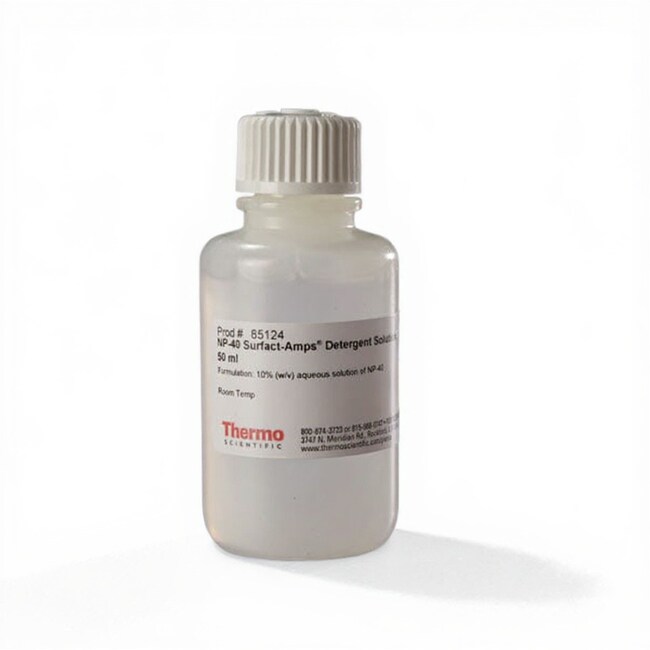
NP-40 Surfact-Amps™ 去污剂溶液
Invitrogen17万+抗体限时买二赠一,靶点广,灵活用!
NP-40 Surfact-Amps™ 去污剂溶液
Thermo Scientific™

NP-40 Surfact-Amps™ 去污剂溶液

Thermo Scientific Surfact-Amps NP-40 去污剂溶液是一种高纯度的 NP-40 去污剂,以 10% 溶液形式保持稳定,装于您选择的 10了解更多信息
Have Questions?
更改视图buttonViewtableView
货号数量
8512450 mL
283246 x 10 mL
85125500 mL
货号 85124
价格(CNY)
1,374.00
飞享价
Ends: 31-Dec-2025
1,787.00
共减 413.00 (23%)
Each
添加至购物车
数量:
50 mL
请求批量或定制报价
价格(CNY)
1,374.00
飞享价
Ends: 31-Dec-2025
1,787.00
共减 413.00 (23%)
Each
添加至购物车
Thermo Scientific Surfact-Amps NP-40 去污剂溶液是一种高纯度的 NP-40 去污剂,以 10% 溶液形式保持稳定,装于您选择的 10 mL 玻璃安瓿或两种尺寸的 HDPE 塑料瓶中。

Surfact-AMPS NP-40 去污剂溶液的特点:

NP-40—用于多种蛋白方法的非离子去污剂
准确—精确 10% 去污剂超纯水溶液
易于使用—溶液易于分配和稀释,以进行使用
极高纯度—过氧化物和羰基低于 1.0 µeq/mL
稳定—包装在 HDPE 瓶中的惰性氮气中

这是一种易于使用、经纯化的 NP-40 去污剂 10% (w/v) 溶液,可用于多种常规和高要求蛋白研究方法及分子生物学技术。NP-40 是一种非离子聚氧乙烯表面活性剂,经常作为细胞裂解缓冲液或其他溶液的成分用于提取并溶解各种蛋白。Surfact-Amps 去污剂溶液 (10% w/v) 提供卓越的纯度、质量和稳定性。与黏性很高的纯去污剂不同,Surfact-Amps 10% 溶液很容易进行移液及精确分配。在玻璃安瓿或非浸出 HDPE 瓶中于氮气下小心制备并包装表面活性剂溶液,以确保它们的稳定性并且过氧化物和降解产物不会积聚。

NP-40 去污剂的特性:
• 分子量:617 g
• 去污剂类别:非离子
•聚集数:149
•胶束分子量:90,000 g
• 临界胶束浓度 (CMC):0.29 mM (0.0179%, w/v)
• 浊点:80°C
• 透析:否

NP-40 Surfact-Amps 去污剂溶液的规格:
• 外观:透明、无色溶液,不含微粒物质。
• 浓度:10.0±1.0%
• 氧化剂:≤1.0µ eq/mL
• 羰基:≤1.0µ eq/mL
• 悬浮固体:残留物不能超过残留物参考值。

相关产品
Surfact-Amps™ 去污剂采样器
仅供科研使用。不可用于诊断程序。
规格
产品规格HDPE Bottle
数量50 mL
试剂类型去污剂溶液
形式液体
产品线Surfact-Amps™
产品类型去垢剂
Unit SizeEach

常见问题解答 (FAQ)

What are the main advantages of using Thermo Scientific Pierce Surfact-Amps detergents?

Thermo Scientific Pierce Surfact-Amps detergents are highly purified, precisely diluted (10%) formulations that are ideal for applications or assays that are sensitive to contaminants that are present in unpurified detergents. We test every batch to insure that our detergents contain less than 1.0 µeq/mL peroxides and carbonyls and package them under nitrogen, to prevent oxidization during storage.

Superior quality - lower measurable contaminant levels than other leading vendors
Accurate -precise 10% detergent solution in ultrapure water
Easy-to-use - solution is simple to dispense and dilute for use
Exceptionally pure - less than 1.0 µeq/mL peroxides and carbonyls

Find additional tips, troubleshooting help, and resources within our Protein Purification and Isolation Support Center.

Are detergents denaturing or non-denaturing with respect to protein structure?

Ionic detergents, or those that carry a charge, are the most likely to be denaturing to proteins. Denaturing detergents can be anionic such as sodium dodecyl sulfate (SDS) or cationic such as ethyl trimethyl ammonium bromide. These detergents totally disrupt membranes and denature proteins by breaking protein-protein interactions through changes in the three-dimensional structure of the proteins. Nondenaturing detergents can be divided into nonionic detergents (i.e., Triton X-100), bile salts (i.e., cholate), and zwitterionic detergents (i.e., CHAPS).


Find additional tips, troubleshooting help, and resources within our Protein Purification and Isolation Support Center.

What are detergents?

Detergents are amphipathic molecules containing both a nonpolar “tail” having aliphatic or aromatic character, and a polar “head”. The ionic character of the polar head group forms the basis for broad classification of detergents as ionic, nonionic, or zwitterionic.

Find additional tips, troubleshooting help, and resources within our Protein Purification and Isolation Support Center.

How does detergent-based cell lysis work?

Detergents are amphipathic molecules, meaning they contain both a nonpolar “tail” having aliphatic or aromatic character and a polar “head”. Like the components of biological membranes, detergents have hydrophobic-associating properties as a result of their nonpolar tail groups. Nevertheless, detergents are themselves water soluble.

Consequently, detergent molecules allow the dispersion (miscibility) of water-insoluble, hydrophobic compounds into aqueous media, including the extraction and solubilization of membrane proteins. Detergent monomers solubilize membrane proteins by partitioning into the membrane bilayer. With increasing amounts of detergents, membranes undergo various stages of solubilization.

Find additional tips, troubleshooting help, and resources within our Protein Purification and Isolation Support Center.

What types of detergents are available for cell lysis?

Detergents can be denaturing or non-denaturing with respect to protein structure. Denaturing detergents can be anionic such as sodium dodecyl sulfate (SDS) or cationic such as ethyl trimethyl ammonium bromide. These detergents totally disrupt membranes and denature proteins by breaking proteinprotein interaction. These detergents are considered harsh. Non-denaturing detergents can be divided into nonionic detergents (i.e., Triton X-100), bile salts (i.e., cholate), and zwitterionic detergents (i.e., CHAPS). These detergents do not denature proteins and do not break protein-protein interactions. These detergents are considered mild.

Find additional tips, troubleshooting help, and resources within our Protein Purification and Isolation Support Center.