Search


引用和文献 (10)
Invitrogen™
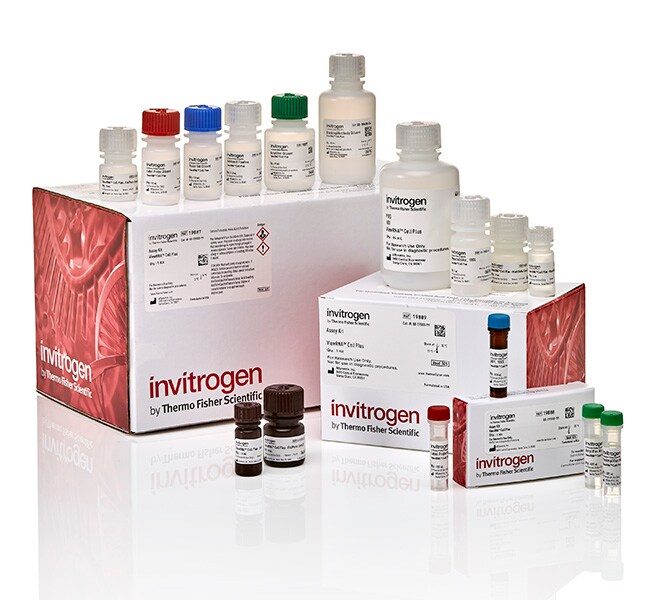
ViewRNA™ Cell Plus 检测试剂盒
ViewRNA Cell Plus 检测是一种结合了免疫细胞化学技术与 ViewRNA 技术(一种专有的荧光原位杂交和连续分支 DNA 扩增技术)的新型检测,可对单个细胞中的具有单分子灵敏度的了解更多信息
| 货号 | 数量 |
|---|---|
| 88-19000-99 | 1 kit |
货号 88-19000-99
价格(CNY)
25,983.00
Each
数量:
1 kit
价格(CNY)
25,983.00
Each
ViewRNA Cell Plus 检测是一种结合了免疫细胞化学技术与 ViewRNA 技术(一种专有的荧光原位杂交和连续分支 DNA 扩增技术)的新型检测,可对单个细胞中的具有单分子灵敏度的 RNA 和蛋白进行可视化。本检测方法支持使用间接和直接免疫细胞化学技术同时检测多达三种 RNA 靶标,从而实现对细胞表面或细胞内蛋白的免疫表型分析,适用于对特定细胞亚群进行详细表征。用于同时检测第四个 RNA 靶标,ViewRNA ISH 细胞 740 模块(货号 QVC0200)可与本试剂盒配合使用。可分析 740 通道 (AlexaFluor 750) 的额外靶标。
ViewRNA Cell Plus 检测试剂盒含有进行检测所需的所有试剂。目标基因及抗体的靶标探针组单独出售。
反应性/物种
探针可设计用于任何物种。这些是较常用/检测的物种:亚美尼亚仓鼠、狒狒、牛、犬、猫、鸡、黑猩猩、奶牛、食蟹猴、驴、山羊、金黄叙利亚仓鼠、豚鼠、仓鼠、马、人、猕猴、猴、小鼠、非人灵长类动物、橄榄狒狒、猪、豚尾猴、兔、大鼠、恒河猴、绵羊
已报告应用
显微镜检查、免疫细胞化学技术
ViewRNA Cell Plus 检测试剂盒含有进行检测所需的所有试剂。目标基因及抗体的靶标探针组单独出售。
反应性/物种
探针可设计用于任何物种。这些是较常用/检测的物种:亚美尼亚仓鼠、狒狒、牛、犬、猫、鸡、黑猩猩、奶牛、食蟹猴、驴、山羊、金黄叙利亚仓鼠、豚鼠、仓鼠、马、人、猕猴、猴、小鼠、非人灵长类动物、橄榄狒狒、猪、豚尾猴、兔、大鼠、恒河猴、绵羊
已报告应用
显微镜检查、免疫细胞化学技术
仅供科研使用。不可用于诊断程序。
规格
适用于(应用)显微镜检查、免疫细胞化学技术
产品类型RNA 原位杂交测定试剂盒
数量1 kit
检测方法引物-探针检测
产品规格试剂盒
Unit SizeEach
常见问题解答 (FAQ)
How do ViewRNA assays compare to RNAScope assays?
How is the signal amplified in ViewRNA assays?
Where can I find general information about ViewRNA ISH Assays?
For ViewRNA assays, can I use the same set of wash solutions for all samples, including the positive and negative controls?
To perform ViewRNA assays, which incubator oven should I use, Cat. No. QS0704 or QS0712?
引用和文献 (10)
引用和文献
Abstract
Single cell transcriptome profiling of retinal ganglion cells identifies cellular subtypes.
Journal:Nat Commun
PubMed ID:30018341
'Retinal ganglion cells (RGCs) convey the major output of information collected from the eye to the brain. Thirty subtypes of RGCs have been identified to date. Here, we analyze 6225 RGCs (average of 5000 genes per cell) from right and left eyes by single-cell RNA-seq and classify them into 40
miR-103 promotes endothelial maladaptation by targeting lncWDR59.
Journal:Nat Commun
PubMed ID:29980665
'Blood flow at arterial bifurcations and curvatures is naturally disturbed. Endothelial cells (ECs) fail to adapt to disturbed flow, which transcriptionally direct ECs toward a maladapted phenotype, characterized by chronic regeneration of injured ECs. MicroRNAs (miRNAs) can regulate EC maladaptation through targeting of protein-coding RNAs. However, long noncoding RNAs (lncRNAs),
Long non-coding RNAs influence the transcriptome in pulmonary arterial hypertension: the role of PAXIP1-AS1.
Journal:J Pathol
PubMed ID:30450722
'In idiopathic pulmonary arterial hypertension (IPAH), global transcriptional changes induce a smooth muscle cell phenotype characterised by excessive proliferation, migration, and apoptosis resistance. Long non-coding RNAs (lncRNAs) are key regulators of cellular function. Using a compartment-specific transcriptional profiling approach, we sought to investigate the link between transcriptional reprogramming by lncRNAs
KDM6A and KDM6B play contrasting roles in nuclear transfer embryos revealed by MERVL reporter system.
Journal:EMBO Rep
PubMed ID:30389724
Despite the success of animal cloning by somatic cell nuclear transfer (SCNT) in many species, the method is limited by its low efficiency. After zygotic genome activation (ZGA) during mouse development, a large number of endogenous retroviruses (ERVs) are expressed, including the murine endogenous retrovirus-L (MuERVL/MERVL). In this study, we
Detection and Differentiation of Multiple Viral RNAs Using Branched DNA FISH Coupled to Confocal Microscopy and Flow Cytometry.
Journal:Bio Protoc
PubMed ID:30505886
Due to the exceptionally high mutation rates of RNA-dependent RNA polymerases, infectious RNA viruses generate extensive sequence diversity, leading to some of the lowest barriers to the development of antiviral drug resistance in the microbial world. We have previously discovered that higher barriers to the development of drug resistance can