Search


引用和文献 (5)
Thermo Scientific™
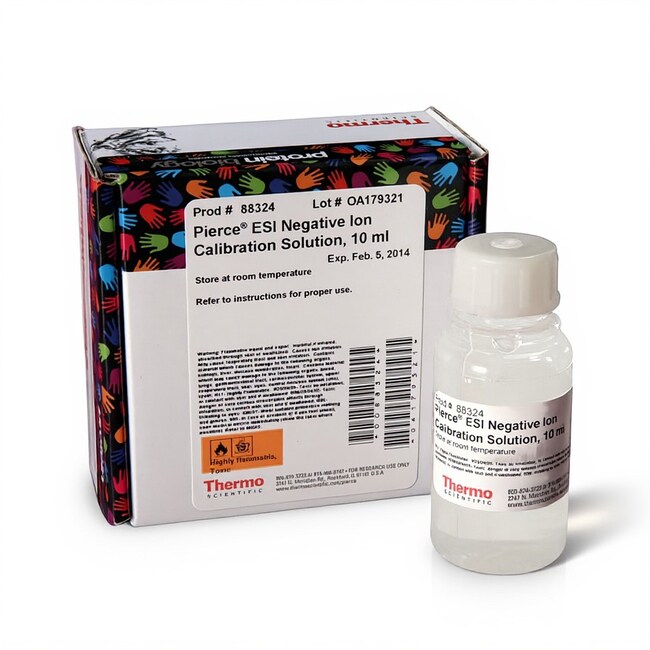
Pierce™ 阴离子校准液
Thermo Scientific Pierce ESI 阴离子校准液是高纯度可离子化分子混合物,设计用于 Thermo Scientific LTQ 系列质谱仪的阴离子模式校准。阴离子校准液的特点:•强峰—SDS了解更多信息
| 货号 | 数量 |
|---|---|
| 88324 | 10 mL |
货号 88324
价格(CNY)
2,206.00
Online exclusive
Ends: 31-Dec-2026
2,723.00共减 517.00 (19%)
Each
数量:
10 mL
价格(CNY)
2,206.00
Online exclusive
Ends: 31-Dec-2026
2,723.00共减 517.00 (19%)
Each
Thermo Scientific Pierce ESI 阴离子校准液是高纯度可离子化分子混合物,设计用于 Thermo Scientific LTQ 系列质谱仪的阴离子模式校准。
阴离子校准液的特点:
•强峰—SDS、牛磺胆酸钠和 Ultramark 1621 的混合物,溶于乙腈/甲醇/乙酸溶液中。
•即用型—将质量参比标准品上样至进样针并进样至仪器
• 高纯度—用不可浸出容器盛装的质谱级试剂
• 稳定—在室温下可储存一年以上(参见 CofA,以了解各批次的特定有效期)
Pierce ESI 阴离子校准液是一种即用型液体制剂,适用于快速进行维持 Thermo Scientific 质谱仪稳健性能所需的常规校准。ESI 阴离子校准液在 ISO 9001 工厂生产,每个批次均按照严格的质量标准进行质量控制。这种稳定溶液以防漏、高纯度 PTFE 瓶装形式提供。
ESI 阴离子校准液可用于校准 LTQ 系列、LTQ Velos 系列、LTQ Orbitrap 系列和 Exactive 质谱仪。
更多产品数据
• Thermo Scientific 质谱仪用校准液
阴离子校准液的特点:
•强峰—SDS、牛磺胆酸钠和 Ultramark 1621 的混合物,溶于乙腈/甲醇/乙酸溶液中。
•即用型—将质量参比标准品上样至进样针并进样至仪器
• 高纯度—用不可浸出容器盛装的质谱级试剂
• 稳定—在室温下可储存一年以上(参见 CofA,以了解各批次的特定有效期)
Pierce ESI 阴离子校准液是一种即用型液体制剂,适用于快速进行维持 Thermo Scientific 质谱仪稳健性能所需的常规校准。ESI 阴离子校准液在 ISO 9001 工厂生产,每个批次均按照严格的质量标准进行质量控制。这种稳定溶液以防漏、高纯度 PTFE 瓶装形式提供。
ESI 阴离子校准液可用于校准 LTQ 系列、LTQ Velos 系列、LTQ Orbitrap 系列和 Exactive 质谱仪。
更多产品数据
• Thermo Scientific 质谱仪用校准液
仅供科研使用。不可用于诊断程序。
规格
最终产品类型肽
适用于(设备)质谱仪
数量10 mL
工作流程步骤校准
检测方法质谱分析
形式液体
产品线Pierce
产品类型校准液
原始材料肽
Unit SizeEach
内容与储存
Store between 2°C and 8°C for one year (see CofA for specific expiration date of each lot).
引用和文献 (5)
引用和文献
Abstract
Untargeted metabolomics to understand the basis of phenotypic differences in amphotericin B-resistant Leishmania parasites.
Journal:Wellcome open research
PubMed ID:32133420
Background: Protozoan Leishmania parasites are responsible for a range of clinical infections that represent a substantial challenge for global health. Amphotericin B (AmB) is increasingly used to treat Leishmania infection, so understanding the potential for resistance to this drug is an important priority. Previously we described four independently-derived AmB-resistant L.
Identification of Phenolic Compounds from Hancornia speciosa (Apocynaceae) Leaves by UHPLC Orbitrap-HRMS.
Journal:Molecules (Basel, Switzerland)
PubMed ID:28098848
Apocynaceae is a botanical family distributed mainly in tropical and subtropical regions of the world. In Brazil, they comprise about 90 genera and 850 species, inhabiting various types of vegetation. Within this large botanical family, the genus Hancornia is considered monotypic, with its only species Hancornia speciosa Gomes. Antihypertensive, antidiabetic,
Protocol for identifying metabolite biomarkers in patient uterine fluid for early ovarian cancer detection.
Journal:STAR protocols
PubMed ID:38489270
High mortality of ovarian cancer (OC) is primarily attributed to the lack of effective early detection methods. Uterine fluid, pooling molecules from neighboring ovaries, presents an organ-specific advantage over conventional blood samples. Here, we present a protocol for identifying metabolite biomarkers in uterine fluid for early OC detection. We describe
Tulasporins A-D, 19-Residue Peptaibols from the Mycoparasitic Fungus Sepedonium tulasneanum
Journal:Nat Prod Commun
PubMed ID:30508342
Four new 19-residue peptaibols, named tulasporins A-D (1-4), were isolated from the semi-solid cultures of Sepedonium tulasneanum. Their structures were elucidated on the basis of extensive ESI-HRMS(n) fragmentation studies as well as (1)H NMR spectroscopic analyses. Interestingly, the structures of tulasporins A-D (1-4) resemble those of chrysospermins isolated earlier from
Mapping small metabolite changes after traumatic brain injury using AP-MALDI MSI.
Journal:Analytical and bioanalytical chemistry
PubMed ID:39090264
Traumatic brain injury (TBI) is an alteration of brain function caused by a sudden transmission of an external force to the head. The biomechanical impact induces acute and chronic metabolic changes that highly contribute to injury evolution and outcome. TBI heterogeneity calls for approaches allowing the mapping of regional molecular