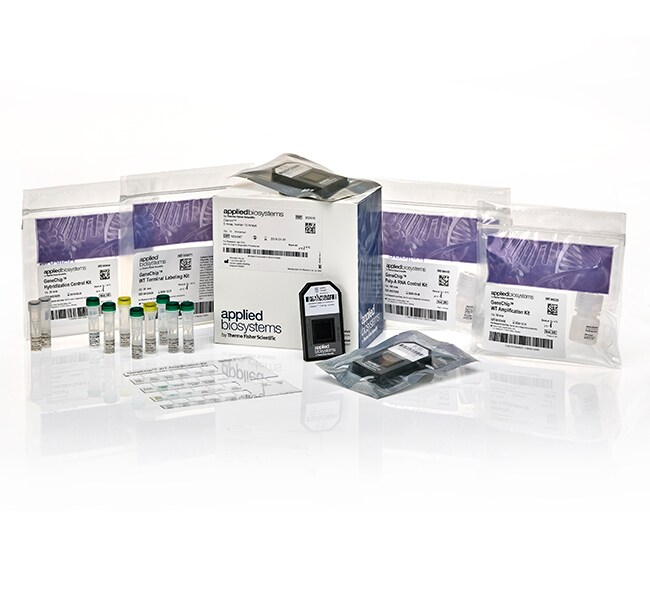
Clariom™ D Assay,人类
Clariom™ D Assay,人类
Applied Biosystems™

Clariom™ D Assay,人类

采用用于人类样品的 Clariom D Assay(新一代的转录组水平表达谱分析工具),可以更快速地从转录组深处发现生物标记物。Clariom D Assay 可详细显示转录组细节视图,采用更快的路径获取研究所需结果了解更多信息
Have Questions?
更改视图buttonViewtableView
货号阵列数量
90292330 阵列
90292210 阵列
货号 902923
价格(CNY)
-
阵列数量:
30 阵列
采用用于人类样品的 Clariom D Assay(新一代的转录组水平表达谱分析工具),可以更快速地从转录组深处发现生物标记物。Clariom D Assay 可详细显示转录组细节视图,采用更快的路径获取研究所需结果。Clariom D Assay 可让转录研究科学家快速简单地得到高保真度的生物标记物特征。这些检测的新设计基于行业领先的微阵列技术,提供了较为复杂的全转录组范围基因水平和外显子水平的表达谱,包括在为期三天的单一实验中,检测编码和长链非编码 (lnc)RNA 的选择性剪接事件的能力。

拓展发现新型、信息丰富生物标记物的潜力
近年来快速扩展的已知转录基因数量,为可操作性的生物标记物(例如转录变异和 lncRNA)提供了更多的来源,这可用于临床应用和促进对疾病机制的理解。这类生物标记物可能会被冗长、复杂且昂贵的测序和靶向表达方法所遗漏,从而导致特征难以重现,浪费时间和金钱。

Clariom D 测定试剂盒可全面覆盖转录基因组(包括所有已知编码和未编码的剪接变体),与临床样品类型兼容并提供灵活的数据分析软件,因此它是转译研究人员执行复杂表达生物标记物发现研究并希望以极快速度获得可靠、临床相关且可行结果的首选工具。

获取所有所需数据
• 在从样品量庞大的公共数据库中获得的 >540,000 个转录本中快速鉴别复杂的疾病特征,该数据库较全面地覆盖现有人转录组,从而确保不会遗漏生物标记物。
•可靠地检测产生编码 RNA 和 lncRNA 亚型的基因、外显子和其他选择性剪接事件。
•检测罕见的低表达转录本,而一般的测序方法检测不到这类转录本。
•使用直观、高度可视化的免费分析软件,在数分钟内可从数据获得深度结果。
当有珍贵样品时,一次获得正确结果。

• 从各种样品类型中提取 RNA,包括血液、细胞、新鲜/新鲜冷冻组织。
• 该检测可保持样品完整性并降低数据变异性,且无需球蛋白或 rRNA 去除步骤。

Clariom D 解决方案以单一样品(检测盒阵列)格式提供,可在 GeneChip ™ 3000 仪器系统上使用,包括试剂和快速简单的转录组分析控制台 (TAC) 软件,该软件可分析和显示基因、外显子、通路和选择性剪接事件。

获得所需要的覆盖范围、所需的可重现性以及有意在发现中发挥作用的结果。
仅供科研使用。不可用于诊断程序。
规格
产品线Applied Biosystems™
数量30 次反应
运输条件经批准可在室温下或者湿冰或干冰上运输
类型D 检测
数组转录组谱分析
产品规格阵列检测盒
阵列数量30 阵列
种属
Unit SizeEach

常见问题解答 (FAQ)

What reagent kit should I use with my array?

Please refer to the Microarray Reagent Guide for Arrays and Expression Kits to match the correct reagents your array.

Find additional tips, troubleshooting help, and resources within our Microarray Analysis Support Center.

Why is it important to use Tough-Spots® labels when using GeneChip cartridge arrays?

Tough-Spots® labels are small adhesive stickers used to temporarily seal the backs of cartridge arrays during the overnight hybridization step. They are required to prevent loss of volume due to evaporation through the septa. We recommend using Tough-Spots® labels on Rolls from USA Scientific (Item No. 9185-0000)

Find additional tips, troubleshooting help, and resources within our Microarray Analysis Support Center.

What are the respective hybridization volumes based on array format for Affymetrix gene expression arrays?

Proper hybridization volume is critical to obtaining an even signal across a given array. Too little volume can lead to black circles in the middle of the array. Too much volume can leak out of the back of the array. The correct hybridization volume leaves enough room for a small air bubble to circulate around the array surface during the overnight hybridization. Here are the recommended hybridization and fill volumes based on the array format:
Array Format; Hybridization Volume; Fill Volume
- 49 Format (Standard); 200 µL; 250 µL
- 64 Format; 200 µL; 250 µL
- 100 Format (Midi); 130 µL; 160 µL
- 169 Format (Mini); 80 µL; 100 µL
- 400 Format (Micro); 80 µL; 100µL

Find additional tips, troubleshooting help, and resources within our Microarray Analysis Support Center.

Why is strand-specificity important when performing Clariom D and Clariom S assays?

Clariom D arrays have probes that cover all known regions of transcription including probes in overlapping regions from both strands. To obtain strand-specific information from the Clariom D arrays, the WT Pico and WT Plus reagents (which are strand-specific) must be used. This is important because without strand-specific reagent, it would not be possible to decipher the source strand of DNA, which makes it challenging to untangle true gene- and exon- level expression and alternative splicing events.

Strand-specificity is significantly less important for customers interested in gene-level only information (i.e., those using Clariom S) as compared to customers who want to understand the complexities of the whole transcriptome including identifying antisense transcripts and ncRNA (i.e., those using Clariom D). While strand-specificity is less important for gene-level expression only, probes within regions of overlapping transcription from both strands are avoided in the Clariom S array design (unlike Clariom D). This is important because if Clariom S did not preserve strand-specificity, there could be an overestimation of gene-level expression causing false positive or negative results. With Clariom S having a "stranded" design, it does not necessarily need a strand-specific reagent kit.

Find additional tips, troubleshooting help, and resources within our Microarray Analysis Support Center.

What is an Event Score in TAC 4.0 Software?

TAC 4.0 includes two algorithms for identifying alternative splicing events: the TAC 2.0 algorithm and the new EventPointer. Algorithmic determination of alternate splicing remains a challenging problem. TAC 4.0 supports two different approaches that have different sets of strengths and weaknesses. After considerable testing, the new TAC 4.0 “'Event Score” leverages both previous TAC 2.0 event estimation score and Event Pointer p-value and sorts the most likely alternative splicing events to the top. Of course, the TAC 2.0 event score and EventPointer p-values remain individually available.

Find additional tips, troubleshooting help, and resources within our Microarray Analysis Support Center.