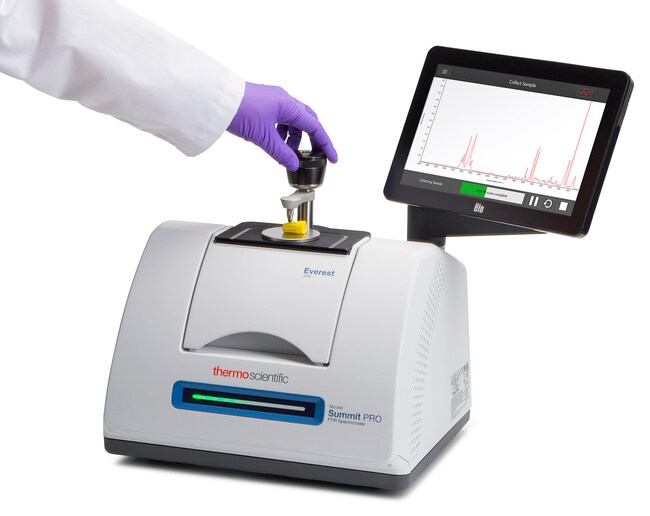
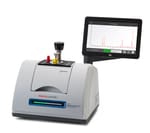
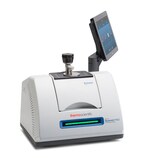
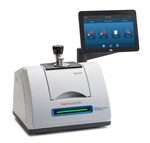
Nicolet™ Summit™ FTIR 光谱仪
Thermo Scientific™

Nicolet™ Summit™ FTIR 光谱仪

Thermo Scientific™ Nicolet™ Summit™ FTIR 光谱仪可助力您的生产率迈上新台阶,让您事半功倍。对单用户实验室和多用户实验室来说,Summit 光谱仪均是理想选择。简单却具有高功能性的软件使新老用户都能轻松使用仪器。
Have Questions?
更改视图buttonViewtableView
货号包括
912A0972Summit PRO FTIR Spectrometer
912A1139Summit X FTIR Spectrometer
912A1060Summit LITE FTIR Spectrometer
货号 912A0972
价格(CNY)
-
申请报价
包括:
Summit PRO FTIR Spectrometer

自信地鉴定样品组分,并轻松、快速地验证材料,让您可以快速作出重要决策。使用小巧的 Thermo Scientific™ Nicolet™ Summit™ FTIR 光谱仪,通过仪器正面的多色 LED 灯带快速查看合格/不合格 QC 结果。Thermo Scientific™ OMNIC™ Paradigm 软件在安装了 Windows™ 操作系统的计算机上运行,可减少进行测量、自动化工作流程和生成报告的步骤。通过 Wi-Fi 连接在云端发送和共享数据。这款光谱仪是繁忙的 QA/QC 实验室和教学实验室的理想选择。 

Nicolet Summit FTIR 光谱仪概述
Nicolet Summit FTIR 光谱仪具有三种不同的型号,可助力您的生产率迈上新台阶,让您事半功倍。

  • Thermo Scientific™ Nicolet™ Summit™ LITE 光谱仪
  • Thermo Scientific™ Nicolet™ Summit™ X 光谱仪
  • Thermo Scientific™ Nicolet™ Summit™ PRO 光谱仪

对单用户实验室和多用户实验室来说,这些产品均是理想选择。简单却具有高功能性的软件使新老用户都能轻松使用仪器。

Nicolet Summit FTIR 光谱仪光学器件
为了实现极佳的可靠性和准确性,Nicolet Summit FTIR 光谱仪采用我们独特的 LightDrive 光学引擎设计而成。

  • 数据重现性更高:先进的红外源消除了热点迁移,使光谱数据的一致性更高,尤其是通过衰减全反射 (ATR) 附件得到的数据。
  • 购置成本较低:我们为红外源、干涉仪和激光器提供10年质保(X 和 PRO 型号)和5年质保(LITE 型号),因此您的维护成本极低。此外,Unity™ Lab Services 或我们遍布全球的合格经销商还可提供服务支持合同和培训。
  • LITE、X 和 PRO 型号:具有多种经工厂验证的规格(不仅是典型可实现的结果),您可在预算内选择符合样品需求的性能。使用 PRO 型号可达到 0.45 cm-1 的光谱分辨率。使用 Summit X 和 LITE 型号可达到 0.6 cm-1 的光谱分辨率。

Nicolet Summit FTIR 光谱仪材料分析软件
OMNIC Paradigm 软件易于使用的界面可简化实验室操作,编程应用程序则可简化数据采集、处理和解读。

  • 缩短工作流程设置时间:直观、可视化工作流程创建器具有拖放功能,可引导您完成工作流程创建并简化日常流程。
  • 遵循 cGxP 合规审计:通过我们的数据库基础架构、数据安全软件和审计管理器应用程序获得高水平的数据完整性,帮助您符合欧洲药典 (Ph.Eur.)、美国药典 (USP)、日本药典 (JP) 和中国药典 (CP) 规定的仪器认证要求。符合 21 CFR 第11部分的要求并提供数据安全包。
  • 随时随地进行数据分析:Wi-Fi 全连接,您可以将数据发送到云端 Thermo Fisher Connect 帐户,并在远离实验室的地方分析数据。也可与世界各地的同事共享数据和协作,从而加快研究速度。让学生在教学实验室或宿舍就可以访问数据。
  • OMNIC Paradigm 桌面版软件:从仪表板屏幕快速查找所需内容、创建库或执行多组分搜索。
  • PRO 型号提供触摸屏或桌面选项:当您在节省空间的独立光谱仪上运行分析时,可以执行触摸屏工作流程。

Nicolet Summit FTIR 光谱仪用途
应用领域:QA/QC、法医刑侦、聚合物、制药、环境、学术/教学等。

样品类型:分析固体、液体和气体。

分析类型:化学鉴定、化学键变化、纯度、混合物分析、污染物分析、定量。

规格
射束分离器KBr/Ge 中红外区优化
组分数量LightDrive 光学引擎组件:光源、激光、干涉仪和检测器
检测器类型热电冷却(TEC)DTGS,用于实现极大检测器响应线性
尺寸(深 x 宽 x 高)光谱仪:32 x 34 x 24 cm(12.7 x 13.3 x 9.6 in.)
光谱仪(包括触摸屏):32 x 53 x 43 cm(12 x 20.8 x 17.0 in.)
电气要求100/240 V,47/63 Hz,110 W
适用于(应用)Polymers and Plastics; Quality Control QA/QC; Pharmaceuticals; Education; Forensics; Geology-Gemstone Analysis; Automotive, Environmental
适用于(设备)Everest 金刚石 ATR;iD 附件 (iD7 ATR),上百种标准市售附件
包括Summit PRO FTIR Spectrometer
源类型标准:具有非迁移热点的单点源,可实现卓越的数据重现性(10年质保)
光谱范围8000 至 350 cm-1 经优化的中红外 KBr 分束器
光谱分辨率优于 0.45 cm-1
重量(英制)光谱仪重量:24 lb
光谱仪重量(包括触摸屏):29 lb.
重量(公制)光谱仪重量:10.9 kg
光谱仪重量(包括触摸屏):12.6 kg
宽度(英制)光谱仪:13.3 in
光谱仪(包括触摸屏):20.8 in.
宽度(公制)光谱仪:34 cm
光谱仪(包括触摸屏):53 cm
电压100/240 V
Unit SizeEach

常见问题解答 (FAQ)

What is Raman spectroscopy?

In Raman spectroscopy, an unknown sample of material is illuminated with monochromatic (single wavelength or single frequency) laser light, which can be absorbed, transmitted, reflected, or scattered by the sample. Light scattered from the sample is due to either elastic collisions of the light with the sample's molecules (Rayleigh scatter) or inelastic collisions (Raman scatter). Whereas Rayleigh scattered light has the same frequency (wavelength) of the incident laser light, Raman scattered light returns from the sample at different frequencies corresponding to the vibrational frequencies of the bonds of the molecules in the sample.

If you wish to learn more about Raman spectroscopy, visit our online Raman Spectroscopy Academy (https://www.thermofisher.com/us/en/home/industrial/spectroscopy-elemental-isotope-analysis/spectroscopy-elemental-isotope-analysis-learning-center/molecular-spectroscopy-information/raman-technology.html), where you will find basic Raman tutorials, advanced Raman webinars on sample applications, and a helpful instrument guide.

Using the Beer-Lambert law in FTIR ATR for quantitative analysis of a time-sensitive, migrating substance (e.g., erucamide) in a polymer is difficult. How can this be overcome?

The Beer-Lambert law is based on stable samples and reproducible conditions. In ATR, you have two concerns. First, the sample must make contact with the crystal in a consistent manner. If the material is rough or crystalline, you must ensure reproducibility. Grinding the material to a fine powder may be necessary. Second, ATR is a surface technique, examining the sample to a depth of around 1-4 microns. If the additive or target molecule is migrating further away, you will lose the signal. In this case, transmission, which illuminates the entire sample and entire thickness, may be a viable option (depending upon thickness). In some cases, the application of pressure can change the signal due to changes in the crystallinity or orientation of polymer strands in the sample. Any deeper insights would require an understanding of the specific sample involved.

What types of sampling cells and detectors are used for protein analysis using Fourier Transform Infrared Spectroscopy (FTIR)?

One key experimental step in protein analysis is the removal of the water bands (most proteins are in buffers). This requires highly controlled path-length transmission cells or ATR. Most historical work was done in 6-10 micron path length transmission cells using BaF2 or similar windows. The analytical region is roughly between 1400 and 1750cm-1 where these windows are transmissive. Recently, ATR devices using silicon, germanium, or diamond windows have become more prevalent. Reactions or binding of proteins to the crystal can occur with ZnSe devices (due to surface charges); sometimes this is desired but often it is not. Most of the literature is based on transmission cells. Protein analysis requires skill and consistency, so training is essential for most laboratories.

What is the advantage of DRIFTS compared to ATR technique in Fourier Transform Infrared Spectroscopy (FTIR)? What is the difference?

DRIFTS is used in both mid-IR and near-IR. In the mid-IR, DRIFTS requires the sample be blended with diluents like KBr, with 3-10% sample. This is typically undesirable as the sample is now mixed. However, DRIFTS is heavily used in catalysis research where powdered material is exposed to high temperature, elevated pressures, and mixtures of reactant gases. Several accessory suppliers make devices specific for this. In the near-IR, DRIFTS is used without dilution through direct measurement - many hand-held probes exist allowing analysis through a container wall (like plastic bags) meaning the sample can be analyzed without touching or contaminating it.

ATR involves making contact with the sample by forcing it into contact with a crystal. ATR generally does not require dilution and works well with solids like credit cards or car bumpers which would be tough in DRIFTS. ATR has, for the most part, displaced DRIFTS in the mid-IR except in special cases, while DRIFTS remains a method of choice in the near-IR world.

What are some subtleties and scenarios in inorganic applications for Fourier Transform Infrared Spectroscopy (FTIR)?

Fourier Transform Infrared Spectroscopy (FTIR) responds to a change in dipole moment, regardless of whether it is organic or inorganic. Metal oxides, carbonates, and carbonyls are good examples. The basic equation states that the wavenumber is proportional to the square root of the spring constant (bond strength) and one over the square root of the reduced mass. Simply put, as mass of the atoms involved in the bond goes up, the wavenumber goes down. Many inorganics have peaks below 400cm-1, such as ferrocene, acetylferrocene and cadmium oxide. This necessitates the use of “far-IR” optics. Many forensics users have found far-IR useful in identifying paint chips, due to their inorganic content. There are several ATR accessories that now permit far-IR ATR (mostly monolithic diamond devices). The Thermo Scientific Nicolet iS50 FTIR Spectrometer was designed to make far-IR performance trivial with a built-in ATR as well. Ultimately, if you have further interest in this area, you need to speak with an FTIR sales person to understand the capabilities and limitations.