Search
 元素搜索
元素搜索 结构搜索
结构搜索

Thermo Scientific Chemicals
无水氧化钌(IV), 99.9% (metals basis)
CAS: 12036-10-1 | O2Ru | 133.07 g/mol
| 货号 | 数量 |
|---|---|
| A10816.03 又称 A10816-03 | 1 g |

化学标识符
CAS12036-10-1
IUPAC Namedioxoruthenium
Molecular FormulaO2Ru
InChI KeyWOCIAKWEIIZHES-UHFFFAOYSA-N
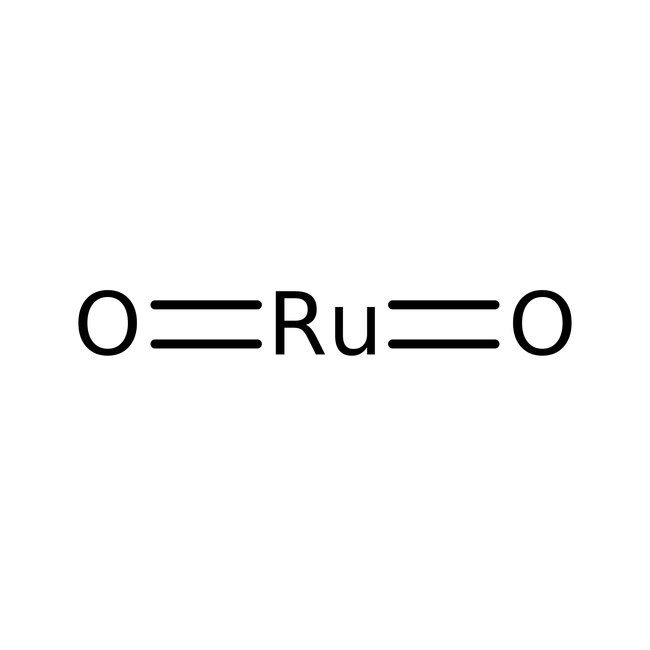
SMILESO=[Ru]=O
查看更多内容
规格 规格表
规格表
规格表FormPowder
Appearance (Color)Black
Assay from Supplier's CofA≥99.9% RuO₂
Elemental Analysis(Ruthenium, Ru) : 73.0-76.5%
The most often used oxygen catalyst is ruthenium(IV) oxide. It is applied as an electrochemical super capacitor material, and it has high capacity to store charge. RuO2 is used as catalyst in the Deacon process which produces chlorine through the oxidation of hydrogen chloride. Owing to the high charge transfer capability, it is used as active material in super capacitors. The dispersion property of RuO2 is used to increase the capacitance of nanocomposite electrode materials for supercapacitors. RuO2 is extensively used for the coating of titanium anodes, and as a catalyst and doping agent, for use in the removal of hydrogen sulfide from oil refineries.
This Thermo Scientific Chemicals brand product was originally part of the Alfa Aesar product portfolio. Some documentation and label information may refer to the legacy brand. The original Alfa Aesar product / item code or SKU reference has not changed as a part of the brand transition to Thermo Scientific Chemicals.
Applications
The most often used oxygen catalyst is ruthenium(IV) oxide. It is applied as an electrochemical super capacitor material, and it has high capacity to store charge. RuO2 is used as catalyst in the Deacon process which produces chlorine through the oxidation of hydrogen chloride. Owing to the high charge transfer capability, it is used as active material in super capacitors. The dispersion property of RuO2 is used to increase the capacitance of nanocomposite electrode materials for supercapacitors. RuO2 is extensively used for the coating of titanium anodes, and as a catalyst and doping agent, for use in the removal of hydrogen sulfide from oil refineries.
Solubility
Insoluble in water, and acids. Soluble in fused alkali.
Notes
Incompatible with oxidizers, acids, aqua regia, organic solvents.
The most often used oxygen catalyst is ruthenium(IV) oxide. It is applied as an electrochemical super capacitor material, and it has high capacity to store charge. RuO2 is used as catalyst in the Deacon process which produces chlorine through the oxidation of hydrogen chloride. Owing to the high charge transfer capability, it is used as active material in super capacitors. The dispersion property of RuO2 is used to increase the capacitance of nanocomposite electrode materials for supercapacitors. RuO2 is extensively used for the coating of titanium anodes, and as a catalyst and doping agent, for use in the removal of hydrogen sulfide from oil refineries.
Solubility
Insoluble in water, and acids. Soluble in fused alkali.
Notes
Incompatible with oxidizers, acids, aqua regia, organic solvents.
RUO – Research Use Only
General References:
- Hu, M. L.; Safarifard. V.; Morsali, A.; Shao, T. L.; Li, X. Facile fabrication of ruthenium(IV) oxide nanostructures by thermal decomposition of two new organoruthenium(II) complexes. Inorg. Chem. Commun. 2013, 37, 189-192.
- Mani, R.; Fischer, M.; Joy, E.; Gopalakrishnan, J.; Jansen, M. Ruthenium(IV) pyrochlore oxides: Realization of novel electronic properties through substitution at A- and B-sites. Solid State Sci. 2009, 11 (1), 189-194.