Search

Gibco™
Bac-to-Bac™ C-His TOPO™ 表达系统
Bac-to-Bac baculovirus expression is an efficient method for producing baculovirus for high-level protein expression in insect cells. It relies on了解更多信息
| 货号 | 数量 |
|---|---|
| A11100 | 20 次反应 |
货号 A11100
价格(CNY)
64,506.00
Each
数量:
20 次反应
价格(CNY)
64,506.00
Each
Bac-to-Bac baculovirus expression is an efficient method for producing baculovirus for high-level protein expression in insect cells. It relies on generation of recombinant virus by site-specific transposition in E. coli rather than homologous recombination in insect cells. The pFastBac C-His TOPO expression system features:
• Flexibility—The Bac-to-Bac C-His TOPO vector contains a C-terminal His-tag with a TEV cleavage site for easy purification of His- tagged proteins with nickel-chelating resins (such as the Invitrogen ProBond Purification System) and generation of native proteins with the aid of the Invitrogen AcTEV Protease.
• Fast cloning, easy screening—Blunt TOPO cloning technology enables cloning of blunt-end PCR products into the pFastBac TOPO vector in five minutes. In addition, the pFastBac TOPO expression kit is supplied with Mach1-T1R E. coli that enable the visualization of colonies eight hours after plating on ampicillin-selective plates due to their faster doubling time compared to other standard cloning strains. Find out more about the advantages of TOPO cloning ›
• High transfection efficiency with ExpiFectamine Sf Transfection Reagent—The Bac-to-Bac TOPO expression kits now come with the next-generation ExpiFectamine Sf Transfection Reagent for efficient DNA transfection in insect cells using fast, flexible protocols. Find out more about this reagent ›
• Time-saving expression bacmid—With the Bac-to-Bac system, the expression cassette of the pFastBac vector recombines with the parent bacmid in DH10Bac E. coli Competent Cells to form an expression bacmid. The bacmid is then transfected into insect cells for production of recombinant baculovirus particles.
• Easy colony screening—The parent bacmid in DH10Bac E. coli contains a segment of the lacZa gene. The lacZa gene is disrupted upon transposition of the expression cassette into the bacmid, allowing for blue/white selection of recombinants for easier identification of recombinant colonies.
• High protein expression—The pFastBac vector uses the strong polyhedrin promoter to generate high levels of expression in a variety of insect cell line such as Sf9, Sf21, and High Five cells.
• Flexibility—The Bac-to-Bac C-His TOPO vector contains a C-terminal His-tag with a TEV cleavage site for easy purification of His- tagged proteins with nickel-chelating resins (such as the Invitrogen ProBond Purification System) and generation of native proteins with the aid of the Invitrogen AcTEV Protease.
• Fast cloning, easy screening—Blunt TOPO cloning technology enables cloning of blunt-end PCR products into the pFastBac TOPO vector in five minutes. In addition, the pFastBac TOPO expression kit is supplied with Mach1-T1R E. coli that enable the visualization of colonies eight hours after plating on ampicillin-selective plates due to their faster doubling time compared to other standard cloning strains. Find out more about the advantages of TOPO cloning ›
• High transfection efficiency with ExpiFectamine Sf Transfection Reagent—The Bac-to-Bac TOPO expression kits now come with the next-generation ExpiFectamine Sf Transfection Reagent for efficient DNA transfection in insect cells using fast, flexible protocols. Find out more about this reagent ›
• Time-saving expression bacmid—With the Bac-to-Bac system, the expression cassette of the pFastBac vector recombines with the parent bacmid in DH10Bac E. coli Competent Cells to form an expression bacmid. The bacmid is then transfected into insect cells for production of recombinant baculovirus particles.
• Easy colony screening—The parent bacmid in DH10Bac E. coli contains a segment of the lacZa gene. The lacZa gene is disrupted upon transposition of the expression cassette into the bacmid, allowing for blue/white selection of recombinants for easier identification of recombinant colonies.
• High protein expression—The pFastBac vector uses the strong polyhedrin promoter to generate high levels of expression in a variety of insect cell line such as Sf9, Sf21, and High Five cells.
仅供科研使用。不可用于诊断程序。
规格
耐抗生素细菌氨苄青霉素 (AmpR)、庆大霉素 (GmR)
克隆方法Blunt TOPO™
表达机制基于细胞的表达
产品规格液体
产品线Bac-to-Bac、TOPO
蛋白标记His 标签 (6x)
数量20 次反应
表达系统杆状病毒
促进剂多角体蛋白
类型表达系统
Unit SizeEach
内容与储存
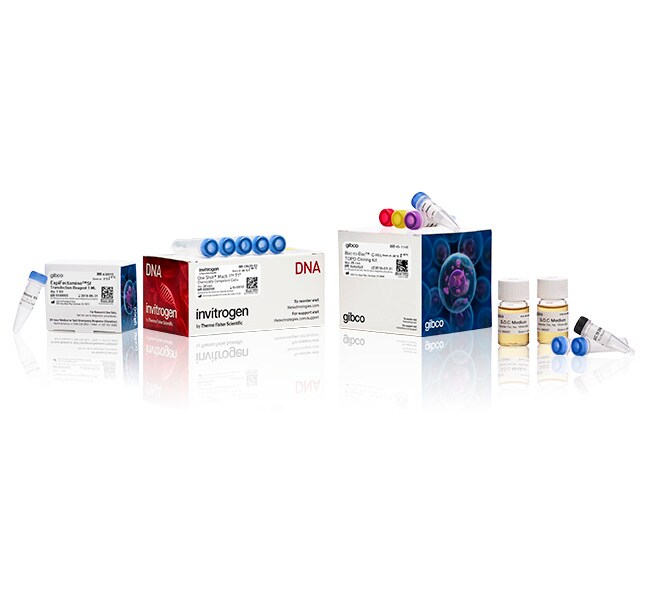
Bac-to-Bac C-His TOPO 表达试剂盒:
• 用于 20 次 TOPO 克隆反应的载体试剂盒,在 -20°C 下储存
– pFastBac/CT-TOPO 载体含有 C 端 TEV 切割位点和 His 标签
–pFastBac 1-Gus 对照质粒(对照表达载体)
– 其他试剂盒试剂:10X PCR、dNTP 混合物、盐溶液、无菌水、对照 PCR 模板、多角体蛋白正向引物、SV40 pA 反向引物
•用于 20 次反应的 One Shot Mach1-T1R 化学感受态大肠杆菌 (20 x 50 µL),在 -80°C 下储存
•用于 20 次反应的 MAX Efficiency DH10Bac 感受态大肠杆菌(4 个试剂盒,每个试剂盒 5 x 0.1 mL),在 -80°C 下储存
•ExpiFectamine Sf 转染试剂 (1 mL),在 4°C 下储存,切勿冷冻
• 用于 20 次 TOPO 克隆反应的载体试剂盒,在 -20°C 下储存
– pFastBac/CT-TOPO 载体含有 C 端 TEV 切割位点和 His 标签
–pFastBac 1-Gus 对照质粒(对照表达载体)
– 其他试剂盒试剂:10X PCR、dNTP 混合物、盐溶液、无菌水、对照 PCR 模板、多角体蛋白正向引物、SV40 pA 反向引物
•用于 20 次反应的 One Shot Mach1-T1R 化学感受态大肠杆菌 (20 x 50 µL),在 -80°C 下储存
•用于 20 次反应的 MAX Efficiency DH10Bac 感受态大肠杆菌(4 个试剂盒,每个试剂盒 5 x 0.1 mL),在 -80°C 下储存
•ExpiFectamine Sf 转染试剂 (1 mL),在 4°C 下储存,切勿冷冻