Search


引用和文献 (5)
Gibco™
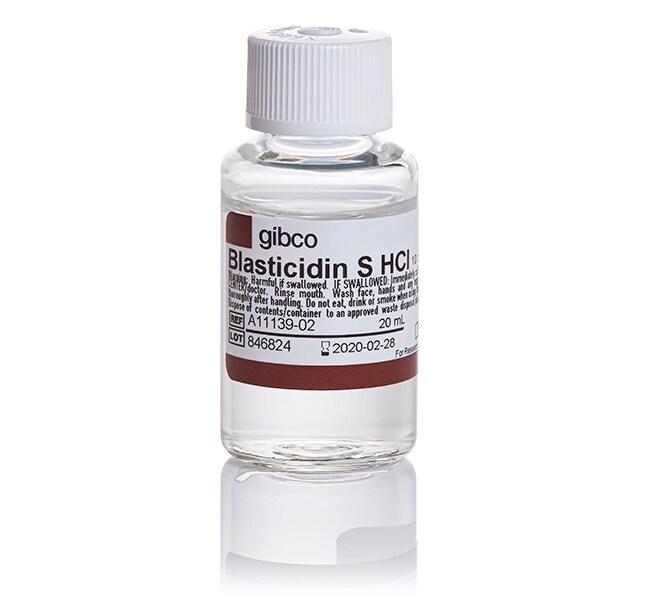
杀稻瘟菌素 S HCl (10 mg/mL)
杀稻瘟菌素 S 是从灰色链霉菌中分离出的一种肽基核苷类抗生素。它是细菌和真核细胞中蛋白合成的强效抑制剂,同时对真菌、线虫和肿瘤细胞也具有活性。杀稻瘟菌素 S 通过阻断释放因子诱导的肽基-tRNA 水解而起作用,并抑制肽键形成。可用作哺乳动物细胞和细菌细胞的选择剂了解更多信息
Have Questions?
更改视图

| 货号 | 数量 |
|---|---|
| A1113902 | 1 瓶 |
| A1113903 | 10 小瓶 |
货号 A1113902
价格(CNY)
14,410.00
Each
数量:
1 瓶
价格(CNY)
14,410.00
Each
杀稻瘟菌素 S 是从灰色链霉菌中分离出的一种肽基核苷类抗生素。它是细菌和真核细胞中蛋白合成的强效抑制剂,同时对真菌、线虫和肿瘤细胞也具有活性。杀稻瘟菌素 S 通过阻断释放因子诱导的肽基-tRNA 水解而起作用,并抑制肽键形成。可用作哺乳动物细胞和细菌细胞的选择剂。建议的工作浓度介于 1 至 30 µg/mL 之间,具体取决于细胞系,用于细菌选择的浓度为 25–100 µg/mL。迅速发生细胞死亡,可在不到一周内生成对杀稻瘟菌素稳定耐药的哺乳动物细胞系。
携带 BSR 和 BSD(分别从蜡样芽孢杆菌 K55-S 和土曲霉中分离出)可获得杀稻瘟菌素 S 抗性。BSR 抗性基因编码杀稻瘟菌素 S 脱氨酶,该酶催化杀稻瘟菌素 S 转化为脱氨基羟基杀稻瘟菌素 S。脱氨基羟基稻瘟菌素 S 是杀稻瘟菌素 S 的非生物活性衍生物,不与原核或真核核糖体相互作用,也不抑制原核或真核核糖体。BSD 抗性基因也编码杀稻瘟菌素 S 脱氨酶,该酶催化与 BSR 脱氨酶类似的反应。为了进行细菌选择,LB 培养基的盐含量必须保持低水平(低于 90 mM),pH 值不应超过7.0,以维持杀稻瘟菌素 S 的活性。建议使用杀菌曲线,以确定杀灭非耐药性细胞的杀稻瘟菌素 S 有效浓度下限。
应用
查看哺乳动物细胞、大肠杆菌和酵母菌中杀稻瘟菌素选择的详细方案。
携带 BSR 和 BSD(分别从蜡样芽孢杆菌 K55-S 和土曲霉中分离出)可获得杀稻瘟菌素 S 抗性。BSR 抗性基因编码杀稻瘟菌素 S 脱氨酶,该酶催化杀稻瘟菌素 S 转化为脱氨基羟基杀稻瘟菌素 S。脱氨基羟基稻瘟菌素 S 是杀稻瘟菌素 S 的非生物活性衍生物,不与原核或真核核糖体相互作用,也不抑制原核或真核核糖体。BSD 抗性基因也编码杀稻瘟菌素 S 脱氨酶,该酶催化与 BSR 脱氨酶类似的反应。为了进行细菌选择,LB 培养基的盐含量必须保持低水平(低于 90 mM),pH 值不应超过7.0,以维持杀稻瘟菌素 S 的活性。建议使用杀菌曲线,以确定杀灭非耐药性细胞的杀稻瘟菌素 S 有效浓度下限。
应用
查看哺乳动物细胞、大肠杆菌和酵母菌中杀稻瘟菌素选择的详细方案。
仅供科研使用。不可用于诊断程序。
规格
细胞类型真核细胞、原核细胞
最大浓度10 mg/mL
培养类型哺乳动物细胞培养,昆虫细胞培养
产品线Gibco
数量1 瓶
有效期9 个月
形式液体
产品类型Geneticin
无菌无菌过滤
加有添加剂HEPES:
Unit SizeEach
内容与储存
储存条件:-5°C 至 -20°C(避光储存)
运输条件:干冰
有效期:自生产之日起 9 个月
运输条件:干冰
有效期:自生产之日起 9 个月
常见问题解答 (FAQ)
哺乳动物细胞的稳转筛选过程中可一起使用哪些种类的抗生素(Geneticin,Zeocin,潮霉素B,杀稻瘟素和嘌呤霉素)?
我该如何对我的培养物去污染?
你们提供哪些抗生素来帮助用户控制或减少细胞培养中的污染情况?
Which of your antibiotics (Geneticin, Zeocin, Hygromycin B, Blasticidin, and Puromycin) can be used together for stable selection in mammalian cells?
What are the recommended concentrations of antibiotics to use for selection in prokaryotes and eukaryotes?
引用和文献 (5)
引用和文献
Abstract
A Scalable, Multiplexed Assay for Decoding GPCR-Ligand Interactions with RNA Sequencing.
Journal:Cell Syst
PubMed ID:30904378
'G protein-coupled receptors (GPCRs) are central to how mammalian cells sense and respond to chemicals. Mammalian olfactory receptors (ORs), the largest family of GPCRs, mediate the sense of smell through activation by small molecules, though for most bonafide ligands, they have not been identified. Here, we introduce a platform to
A Brain Penetrant Mutant IDH1 Inhibitor Provides In Vivo Survival Benefit.
Journal:Sci Rep
PubMed ID:29062039
'Mutations in IDH1 are highly prevalent in human glioma. First line treatment is radiotherapy, which many patients often forego to avoid treatment-associated morbidities. The high prevalence of IDH1 mutations in glioma highlights the need for brain-penetrant IDH1 mutant-selective inhibitors as an alternative therapeutic option. Here, we have explored the utility
Biological Characterization of a Stable Effector Functionless (SEFL) Monoclonal Antibody Scaffold in Vitro.
Journal:J Biol Chem
PubMed ID:27994063
The stable effector functionLess (SEFL) antibody was designed as an IgG1 antibody with a constant region that lacks the ability to interact with Fc? receptors. The engineering and stability and pharmacokinetic assessments of the SEFL scaffold is described in the accompanying article (Jacobsen, F. W., Stevenson, R., Li, C., Salimi-Moosavi,
Proteomics reveals Rictor as a noncanonical TGF-ß signaling target during aneurysm progression in Marfan mice.
Journal:Am J Physiol Heart Circ Physiol
PubMed ID:30004239
The objective of the present study was to 1) analyze the ascending aortic proteome within a mouse model of Marfan syndrome (MFS; Fbn1
Ubiquitination of DNA Damage-Stalled RNAPII Promotes Transcription-Coupled Repair.
Journal:Cell
PubMed ID:32142649
Transcription-coupled nucleotide excision repair (TC-NER) is initiated by the stalling of elongating RNA polymerase II (RNAPIIo) at DNA lesions. The ubiquitination of RNAPIIo in response to DNA damage is an evolutionarily conserved event, but its function in mammals is unknown. Here, we identified a single DNA damage-induced ubiquitination site in